
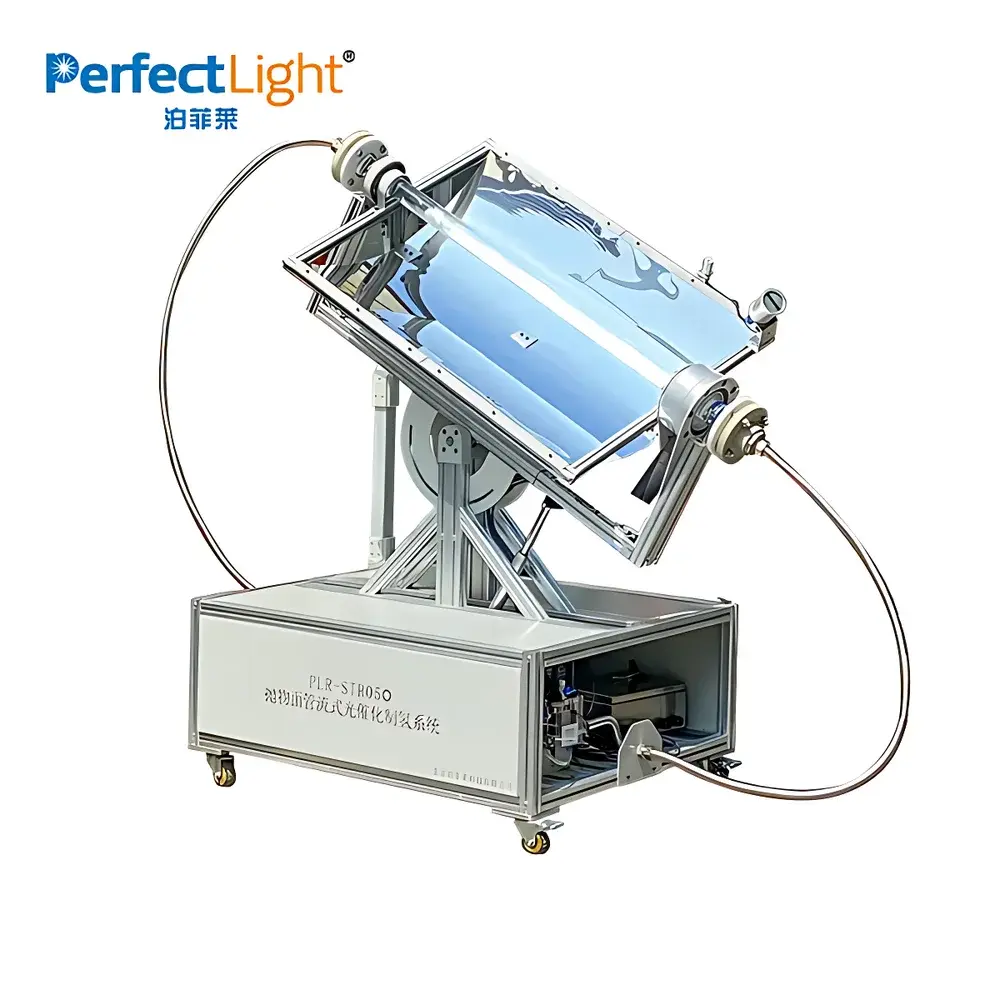
PLR-STR05O Parabolic Trough Solar Photocatalytic Hydrogen Production System
| Brand | PerfectLight (PoFeiLai) |
|---|---|
| Origin | Beijing, China |
| Model | PLR-STR05O |
| Reactor Effective Illuminated Area | >0.5 m² |
| Concentration Ratio | ≤5 |
| Reactor Specification | DN50 borosilicate glass tube, length >1000 mm |
| Operating Pressure | Ambient with micro-positive pressure (5–10 kPa) |
| Gas–Liquid Separation | Integrated |
| Storage Tank Volume | 10 L |
| Irradiance Monitoring | 0–1200 W/m² (at reactor plane) |
| pH Range | 1–14, accuracy ±0.02 |
| ORP Range | −2000 to +2000 mV, accuracy ±15 mV |
| Flow Rate Monitoring | 3–60 L/min, accuracy ±3 L/min |
| Temperature Monitoring | 0–80 °C, accuracy ±1 °C |
| Environmental Sensors | Wind speed, ambient temperature/humidity/pressure |
| Flow Control | Variable-frequency pump (0–60 L/min, head >10 m) |
| Azimuth Tracking Range | ±70° |
| Elevation Adjustment Range | 0–50° (manual) |
| Safety Alarms | Wind speed, temperature, and angle limits |
| Data Logging | Real-time acquisition with automated report generation |
| Structural Wind Resistance | Grade 6 (IEC 61400-1 compliant) |
| Enclosure Rating | IP65 |
| Mobility | Modular, ground-mountable or mobile base compatible |
| Human–Machine Interface | 7-inch PLC touchscreen + PC-based control software |
Overview
The PLR-STR05O Parabolic Trough Solar Photocatalytic Hydrogen Production System is an engineered outdoor photoreactor platform designed for scalable solar-driven hydrogen generation via heterogeneous photocatalysis. It employs a fixed-focus parabolic trough geometry—fabricated from precision-rolled aluminum alloy reflectors—to concentrate incident broadband solar irradiance onto a linear DN50 borosilicate glass reaction tube. This optical configuration achieves a concentration ratio of up to 5×, significantly increasing photon flux density on the catalyst-coated inner surface without thermal runaway risk, enabling efficient utilization of both direct and diffuse sunlight under real-world atmospheric conditions. The system operates at ambient pressure with controlled micro-positive backpressure (5–10 kPa), facilitating stable gas–liquid phase separation and continuous H₂ collection while minimizing catalyst leaching or bubble-induced flow disruption. Its architecture integrates fundamental principles of non-imaging optics, fluid dynamics, and electrochemical monitoring to support quantitative research in solar fuel synthesis, particularly for TiO₂-, g-C₃N₄-, or metal–organic framework (MOF)-based photocatalysts.
Key Features
- Parabolic trough concentrator with ≥0.5 m² effective illuminated area, optimized for spectral transmission across 280–2500 nm
- Motorized azimuthal sun-tracking mechanism (±70° range) synchronized with real-time irradiance input, ensuring maximum optical coupling throughout diurnal cycles
- Manually adjustable elevation angle (0–50°) for seasonal declination compensation and latitude-specific alignment
- IP65-rated 7-inch industrial PLC touchscreen interface with embedded logic for local operation, alarm logging, and parameter override
- PC-compatible control software supporting SCADA-style visualization, time-stamped data export (CSV/Excel), and configurable alarm thresholds
- Borosilicate glass reactor tube (DN50, L >1000 mm) with high UV transparency and thermal shock resistance (ΔT >120 °C)
- Integrated environmental sensing suite: pyranometer-calibrated irradiance sensor, Pt100 temperature probe, capacitive humidity sensor, piezoresistive barometer, and cup-anemometer wind speed monitor
- Variable-frequency circulation pump (0–60 L/min, head >10 m) enabling precise Reynolds number control for laminar-to-turbulent transition studies
- Modular aluminum extrusion frame rated to IEC 61400-1 Level 6 wind loading (≤13.8 m/s sustained), corrosion-resistant anodized finish
Sample Compatibility & Compliance
The PLR-STR05O accommodates aqueous-phase photocatalytic suspensions, immobilized catalyst coatings on inner tube walls, and transparent electrolyte solutions containing sacrificial reagents (e.g., methanol, triethanolamine). Its open-loop recirculation design supports continuous-flow and batch-recirculation modes. All wetted components comply with ISO 8502-3 for surface cleanliness prior to catalyst deposition. The system meets GLP-aligned documentation requirements for experimental traceability: all sensor calibrations are NIST-traceable (irradiance, pH, ORP, flow), and data timestamps adhere to ISO/IEC 17025:2017 Annex A.4 for measurement uncertainty reporting. Electrical safety conforms to IEC 61000-6-2 (immunity) and IEC 61000-6-4 (emissions); mechanical stability satisfies EN 13849-1 PL e functional safety for tracking actuation.
Software & Data Management
Control and acquisition are managed through a dual-layer architecture: a deterministic real-time PLC kernel handles low-level I/O (PID-regulated pump speed, azimuth motor position feedback, alarm interlocks), while a Windows-based supervisory application provides GUI-driven experiment sequencing, multi-parameter trend analysis, and automated compliance reporting. Data streams—including irradiance, pH, ORP, flow rate, temperature, and wind metrics—are logged at user-defined intervals (1 s to 5 min) with SHA-256 hash integrity verification. Exported datasets include metadata headers compliant with ISA-88 Part 1 section 5.5 for batch record reconstruction. Audit trails record all operator actions, parameter changes, and system events per FDA 21 CFR Part 11 requirements, including electronic signatures for protocol approval and report finalization.
Applications
- Quantitative evaluation of photocatalyst quantum yield under natural sunlight vs. simulated AM1.5G illumination
- Long-term stability testing (>1000 h) of co-catalyst-modified semiconductors under outdoor thermal cycling and UV exposure
- Hydrodynamic optimization of annular flow regimes to enhance mass transfer of photogenerated carriers to liquid–solid interfaces
- Correlative analysis of H₂ evolution rate versus real-time ORP/pH shifts during sacrificial agent consumption
- Field validation of reactor scaling laws for distributed solar hydrogen farms (per ASTM E2940-22 Section 6.2)
- Integration with downstream PEM electrolyzer feedstock conditioning units for hybrid solar–electrochemical systems
FAQ
What standards govern the calibration of integrated sensors?
All primary sensors are factory-calibrated against NIST-traceable references: irradiance (ISO 9060:2018 Class C pyranometer), pH/ORP (DIN 19263), flow (ISO 5167-1), and temperature (IEC 60751 Pt100 Class A). Calibration certificates are provided with each unit.
Can the system operate autonomously during extended unattended periods?
Yes—the PLC firmware includes fail-safe logic that initiates emergency shutdown (pump stop, tracker stow) if wind speed exceeds 13.8 m/s, reactor temperature exceeds 75 °C, or azimuth error persists beyond ±5° for >60 s. Logged data persist in non-volatile memory.
Is catalyst coating of the reactor tube supported by the system design?
The DN50 glass tube features standardized flanged end caps and internal access ports, enabling spin-coating, dip-coating, or spray pyrolysis under inert atmosphere prior to installation. Tube replacement requires no recalibration of optical alignment.
How is gas purity verified during H₂ collection?
The integrated gas–liquid separator includes a calibrated sampling port upstream of the collection manifold. Users may connect portable GC-TCD or electrochemical H₂ analyzers (e.g., ASTM D1946-compliant) for real-time purity assessment.
Does the system support integration with laboratory information management systems (LIMS)?
Yes—via OPC UA server implementation (IEC 62541), enabling bidirectional data exchange with commercial LIMS platforms for sample ID mapping, SOP execution logging, and regulatory submission packaging.
Related Products



