
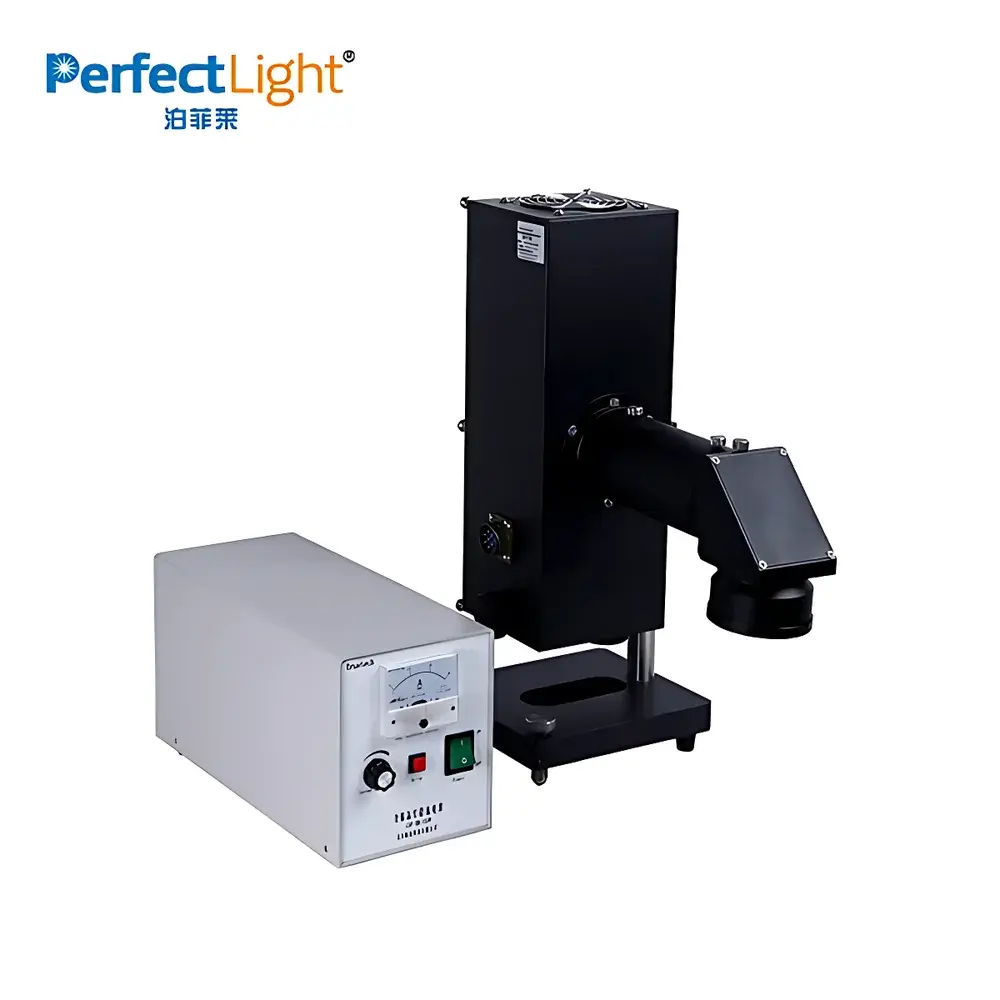
CHF-XM2 Mercury Arc Lamp Light Source by PerfectLight
| Brand | PerfectLight |
|---|---|
| Origin | Beijing, China |
| Manufacturer Type | Authorized Distributor |
| Product Category | Domestic |
| Model | CHF-XM2 |
| Light Source Type | Medium-Pressure Mercury Arc Lamp |
| Illumination Mode | External (Top/ Side Illumination) |
| Output Modes | Point Source, Collimated Beam, Fiber-Coupled Output |
| Point Source Diameter | 4–6 mm |
| Collimated Beam Diameter | 50 mm |
| Beam Divergence | ≤0.85° (at working distance < 250 mm) |
| Spectral Range | 300–1100 nm |
| Beam Uniformity (Φ60 mm) | ≤ ±11% |
| Local Uniformity (2 cm × 2 cm area) | ≤ ±5% |
| Focus Adjustment | Continuous zoom from point source to Φ60 mm collimated spot |
Overview
The CHF-XM2 Mercury Arc Lamp Light Source, engineered by PerfectLight, is a high-stability, medium-pressure mercury discharge lamp system designed for precision optical excitation in photochemical and photophysical research laboratories. Operating on the principle of gas-discharge luminescence, the CHF-XM2 emits intense line spectra superimposed on a broad continuum—dominant peaks at 365 nm (i-line), 405 nm (h-line), 436 nm (g-line), 546 nm, and 579 nm—enabling selective excitation across UV–VIS–NIR (300–1100 nm). Its external illumination architecture supports top- or side-illumination configurations, making it compatible with custom optical benches, electrochemical cells, gas-phase reactors, and liquid-phase cuvettes. Since its commercial introduction in 2002, the CHF-XM series has been deployed in over 1,000 academic and industrial laboratories globally, particularly in solar energy conversion, photocatalysis, and optoelectronic device characterization.
Key Features
- Modular optical design enables rapid reconfiguration between point-source, collimated-beam, and fiber-coupled output modes without realignment.
- Collimated output delivers a 50 mm diameter beam with divergence ≤0.85° at distances under 250 mm, optimized for uniform irradiation of standard test samples (e.g., 2 cm × 2 cm solar cells).
- Beam uniformity meets ISO 9050 and IEC 60904-9 Class B requirements: ≤ ±11% spatial non-uniformity across Φ60 mm aperture; ≤ ±5% local variation within 2 cm × 2 cm active area.
- Integrated continuous zoom mechanism allows seamless transition from sub-6 mm point source to Φ60 mm homogenized field—critical for coupling with monochromators, integrating spheres, or confocal setups.
- Thermally stabilized lamp housing and forced-air cooling ensure stable arc positioning and spectral reproducibility over extended operation (>500 h lamp life under rated conditions).
- EMI-shielded power supply with soft-start ignition and arc current regulation minimizes intensity drift (<1.5% RMS over 1 h) and suppresses electrical noise in sensitive detection systems.
Sample Compatibility & Compliance
The CHF-XM2 is routinely integrated with surface photovoltage spectroscopy (SPS), incident photon-to-current efficiency (IPCE) systems, potentiostat-controlled photoelectrochemical (PEC) cells, and gas-phase photocatalytic reactors. Its spectral output aligns with ASTM E2577 (Standard Practice for Photocatalytic Activity Testing) and ISO 22197-1 (Air purification performance of photocatalytic materials). When paired with calibrated reference detectors and NIST-traceable filters, the system supports quantitative quantum yield determination per ISO 10678 and IUPAC recommendations. The external illumination geometry avoids thermal loading on temperature-sensitive samples and permits simultaneous in situ monitoring via Raman, FTIR, or mass spectrometry.
Software & Data Management
While the CHF-XM2 operates as a standalone analog light source, it features TTL-compatible trigger input and analog 0–5 V intensity modulation interface for synchronization with data acquisition systems (e.g., LabVIEW, MATLAB, or Python-based DAQ platforms). Optional digital control modules support RS-232/USB communication for remote lamp ignition, current ramping, and runtime logging—facilitating GLP-compliant experiment tracking and audit-ready records. All firmware adheres to IEC 61508 functional safety principles for laboratory equipment, and intensity calibration reports are provided with NIST-traceable spectral irradiance data (W·m⁻²·nm⁻¹) at key wavelengths.
Applications
- Quantitative action spectrum measurement in heterogeneous photocatalysis (e.g., TiO₂, g-C₃N₄, MOFs)
- Photoelectrochemical water splitting (H₂/O₂ evolution) and CO₂ reduction studies under simulated solar illumination
- Steady-state and time-resolved surface photovoltage (SPV) and charge extraction analysis
- VOC abatement kinetics (formaldehyde, NOₓ, SOₓ) in flow-through reactor configurations
- Aqueous-phase degradation of organic dyes (methylene blue, rhodamine B) and aromatic pollutants (benzene, toluene)
- Photoinduced isomerization and coloration kinetics in spiropyran- and azobenzene-based systems
- Optical pumping of upconversion nanoparticles and sensitized luminescence assays
FAQ
Is the CHF-XM2 compatible with monochromators?
Yes—the point-source and collimated outputs are optimized for efficient coupling into 1/4 m and 1/2 m monochromators, with minimal vignetting and high throughput across 300–1100 nm.
What safety certifications does the system meet?
The CHF-XM2 complies with IEC 61010-1 (Safety Requirements for Electrical Equipment for Measurement, Control, and Laboratory Use) and includes interlocked lamp housing, UV-blocking viewport, and thermal cut-off protection.
Can output intensity be modulated during operation?
Yes—via 0–5 V analog input (±0.5% linearity) or TTL-triggered pulse mode (1 Hz–1 kHz, duty cycle adjustable), enabling transient photocurrent or PL lifetime experiments.
Does PerfectLight provide spectral irradiance calibration data?
Each unit ships with a factory-measured spectral irradiance certificate (traceable to NIST SRM 2065), covering 300–1100 nm at 100 mm working distance under collimated mode.
What maintenance is required for long-term stability?
Lamp replacement every 500–800 h (depending on operating current), annual recalibration of collimation alignment, and quarterly cleaning of quartz exit windows with spectroscopic-grade methanol.





