
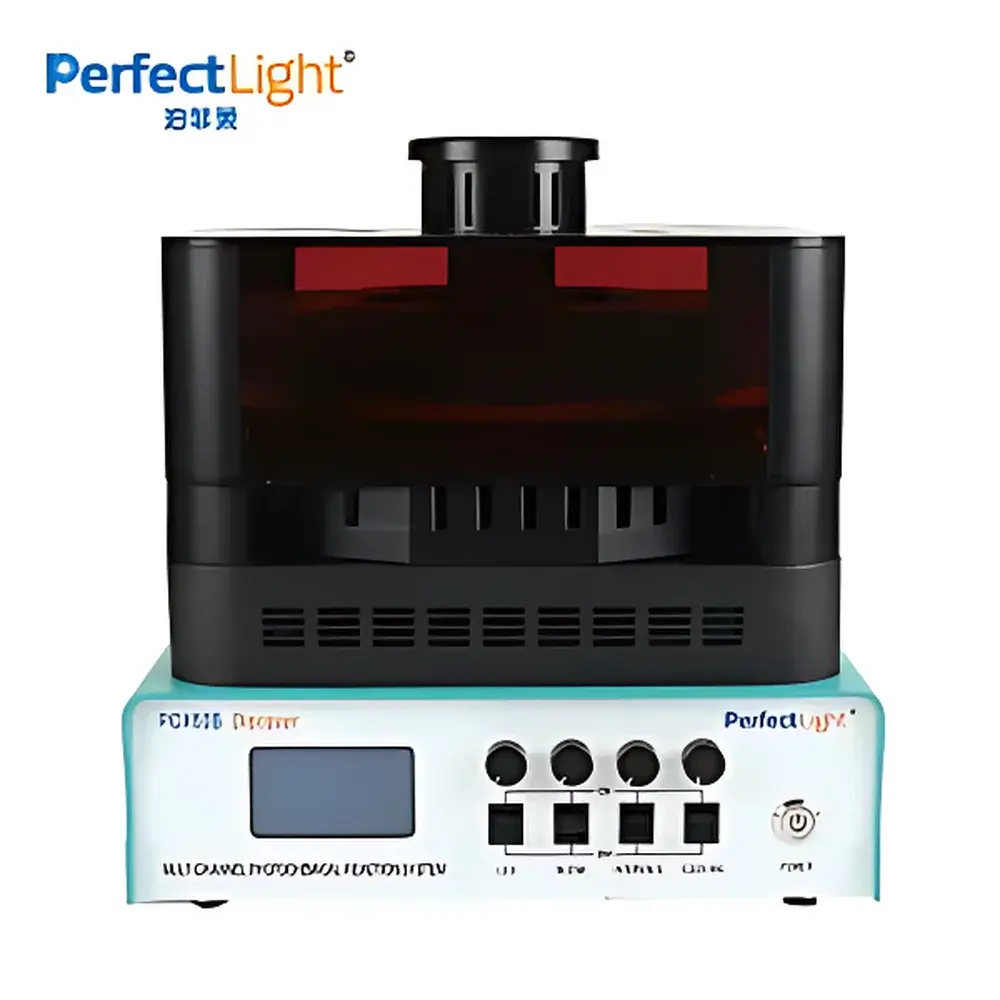
Photocatalytic High-Throughput Parallel Reaction System PCX-50B Discover by PerfectLight
| Brand | PerfectLight |
|---|---|
| Origin | Beijing, China |
| Model | PCX-50B Discover |
| Temperature Control Range | ≤ Ambient + 5 °C |
| Reaction Positions | 9 |
| Light Source Power | 5 W × 9 |
| Wavelength Options | 365, 385, 420, 450, 485, 520, 535, 595, 620, 630, 760, 880, 940 nm (customizable combinations) |
| Stirring Speed | 0–500 rpm |
| Reaction Vessel Capacity | Standard 50 mL × 9 (optional: 1.5, 5, 10 mL) |
| Max Pressure Rating | 0.05 MPa |
| Cooling Method | Integrated High-Speed Turbo-Air Cooling |
| Voltage | 220 VAC / 50 Hz |
| Current | 1 A |
Overview
The PCX-50B Discover is a purpose-engineered high-throughput photocatalytic parallel reaction system designed for quantitative, reproducible evaluation of light-driven chemical transformations under controlled irradiation and thermal conditions. Operating on the principle of bottom-illuminated, uniform-intensity photoexcitation, it employs nine independently addressable reaction positions arranged in a circular configuration, each receiving vertically incident light through optical-grade fused quartz vessel bottoms. This geometry ensures consistent photon flux delivery across all samples—critical for comparative quantum yield determination, catalyst screening, and kinetic profiling. Unlike conventional top- or side-illuminated reactors, the PCX-50B’s axial illumination path eliminates angular dispersion and refractive losses associated with curved vessel walls, thereby improving photon utilization efficiency and minimizing inter-position irradiance variance. Its integrated air-cooling architecture maintains thermal stability within ±0.5 °C of ambient temperature—essential for isolating photonic effects from thermally induced side reactions in mechanistic studies.
Key Features
- 9-position parallel reaction platform with fixed, ergonomically accessible vessel mounts for rapid sampling of both gaseous and liquid phases;
- Optical-grade quartz-bottomed reaction vessels (standard 50 mL; optional 1.5–10 mL formats) featuring integrated reflective cups to maximize effective photon capture;
- Modular LED irradiation module with individually collimated emitters—each fitted with precision-aligned optical lenses and calibrated focal planes—to ensure spatial and spectral uniformity across all channels;
- Customizable multi-wavelength configurations: users may select single or composite spectra from a library of 14 discrete peak wavelengths (365–940 nm), enabling targeted excitation of photocatalysts with defined bandgaps;
- Synchronized magnetic stirring driven by microcontroller-mechanical coupling, delivering identical rotational speeds (0–500 rpm, adjustable per experiment) across all positions to eliminate hydrodynamic variability;
- Integrated high-speed turbo-air cooling system maintaining temperature deviation ≤ +5 °C above ambient—no external chiller required;
- Pressure-rated vessel design (0.05 MPa max) compatible with vacuum, inert gas purging, and continuous-flow atmospheric control via optional B2/B3 cap configurations.
Sample Compatibility & Compliance
The PCX-50B Discover supports heterogeneous and homogeneous photocatalytic systems in both aqueous and organic media. Its modular cap system—including B1 (open degradation), B2 (single-port gas-tight sampling), B3 (dual-port with external atmosphere controller integration), and B4 (15 mL format)—enables compliance with ASTM E2500-13 (verification of laboratory equipment), ISO/IEC 17025:2017 (competence of testing laboratories), and GLP-relevant operational traceability. When paired with the AC1000 or PLA-MAC1005 multi-gas controllers, it meets requirements for controlled-atmosphere experimentation outlined in USP Analytical Instrument Qualification. All electronic subsystems conform to IEC 61010-1 safety standards for laboratory electrical equipment.
Software & Data Management
While the base PCX-50B Discover operates via front-panel digital interface with real-time display of setpoints and status indicators, it is fully compatible with optional data logging modules supporting timestamped irradiance monitoring, temperature tracking, and stir speed verification. When integrated with third-party LabVIEW or Python-based acquisition platforms, the system enables automated experiment sequencing, metadata tagging (e.g., wavelength, intensity, vessel ID), and export to CSV or HDF5 formats—facilitating alignment with FDA 21 CFR Part 11-compliant audit trails when deployed in regulated R&D environments.
Applications
- Quantitative photocatalytic water splitting (H₂/O₂ evolution) and overall water decomposition kinetics;
- CO₂ photoreduction to CH₄, CO, or C₂+ products under tunable visible/NIR excitation;
- Photodegradation kinetics of aqueous pollutants (azo dyes, phenols, pharmaceuticals) and gaseous VOCs (formaldehyde, toluene) under standardized irradiance;
- Action spectrum analysis and apparent quantum yield (AQY) measurement per ISO 25922:2015;
- High-throughput screening of metal–organic frameworks (MOFs), covalent organic frameworks (COFs), and doped semiconductor photocatalysts;
- Photoinduced electron transfer studies in supramolecular assemblies and hybrid perovskite systems.
FAQ
What is the maximum allowable pressure inside the reaction vessels?
Each quartz-bottomed vessel is rated for continuous operation up to 0.05 MPa (50 kPa gauge), suitable for moderate-pressure inert gas purging or sealed photolysis experiments.
Can the system accommodate non-standard reaction volumes?
Yes—besides the standard 50 mL vessels, optional 1.5 mL, 5 mL, and 10 mL formats are available with matching caps (B4 for 15 mL), enabling microscale screening and precious-sample conservation.
How is irradiance uniformity validated across the 9 positions?
Uniformity is ensured via three engineered mechanisms: (1) circular orbital motion of the irradiation array, (2) mechanical synchronization of LED focal planes using lens calibration jigs, and (3) flat quartz-bottom geometry eliminating path-length variation—collectively achieving ≤±3% irradiance deviation (measured at 365 nm, 100 mW/cm²).



