
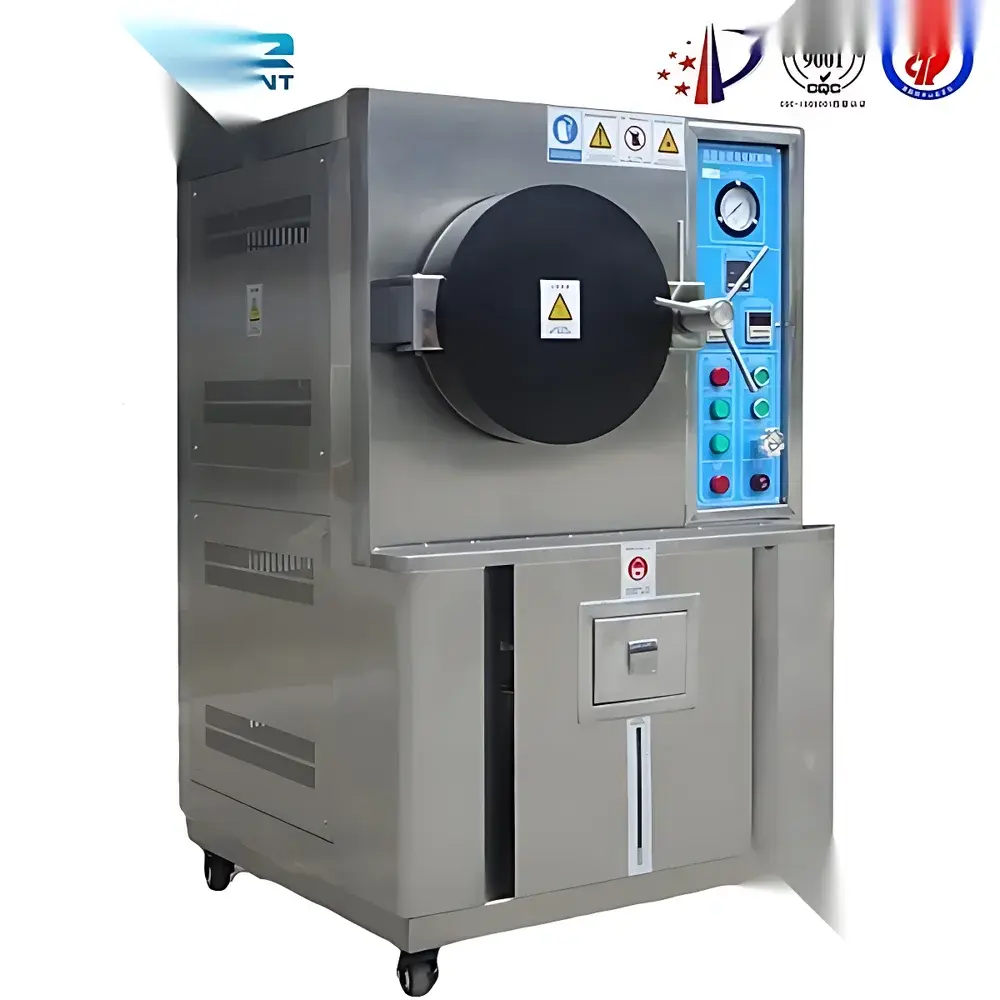
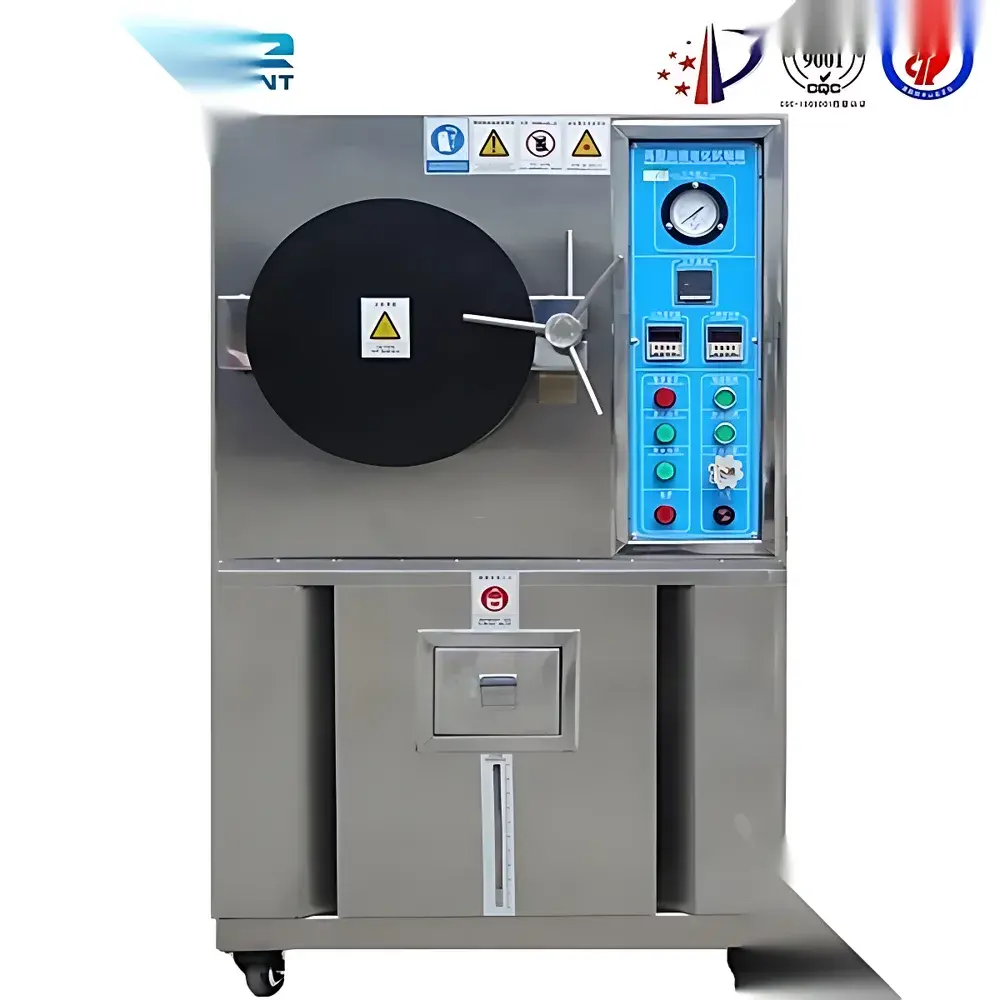
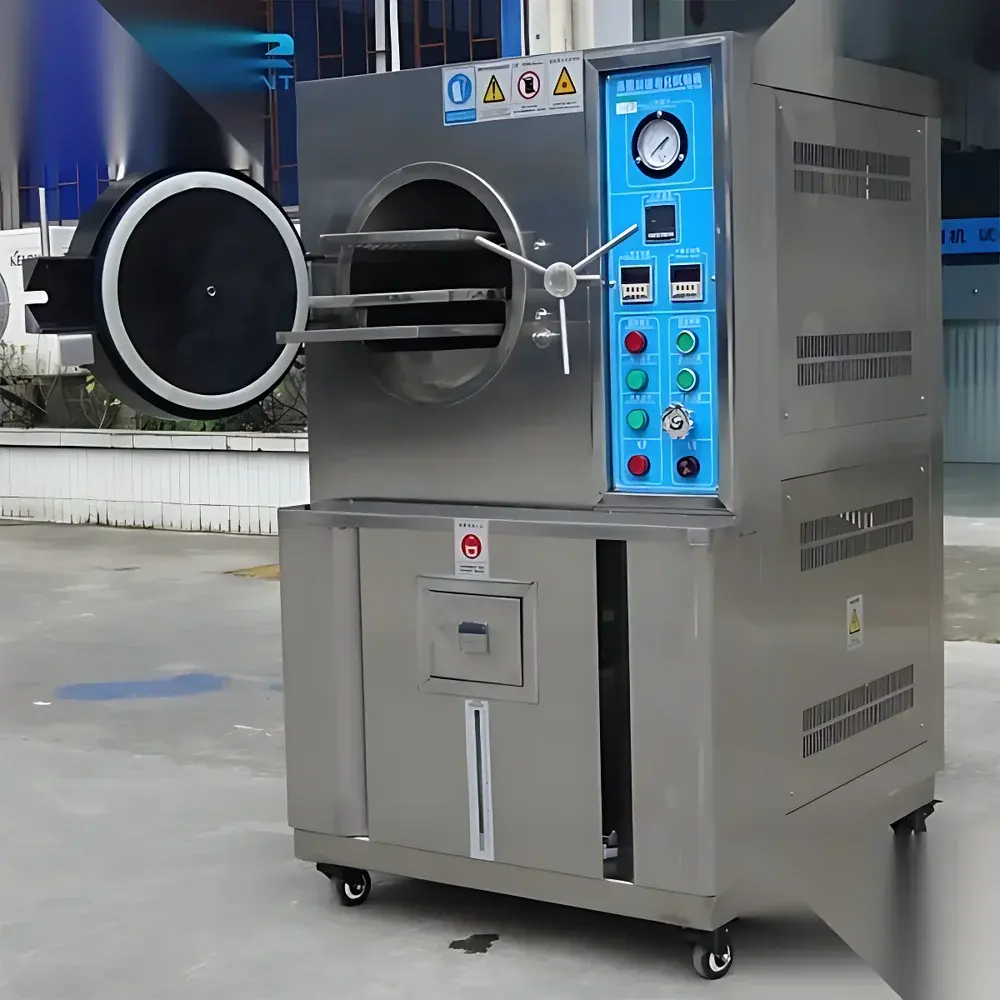
HAST Accelerated Life Test Chamber
| [Brand | Other Brands |
|---|---|
| Origin | Imported |
| Manufacturer Type | Authorized Distributor |
| Price | USD 14,500 (approx.) |
| Internal Chamber | Ø300 × 450 mm (cylindrical) |
| External Dimensions | 660 × 950 × 600 mm (W×H×D) |
| Interior Material | SUS304 Stainless Steel |
| Exterior Finish | Powder-Coated Steel |
| Temperature Range | 100–132°C |
| Humidity | 100% RH (saturated steam) |
| Pressure Range | 0.0–3.0 kg/cm² absolute (max. safety rating: 3.0 kg/cm² gauge = 1 atm + 2.0 kg/cm²) |
| Time Range | 0–1000 h |
| Temp. Uniformity | ±2.0°C at 100°C |
| Temp. Accuracy | ±0.5°C |
| Temp. Resolution | 0.1°C |
| Pressure Accuracy | ±0.15 kg/cm² |
| Heating Rate | RT to 121°C in ≤35 min |
| Pressurization Rate | 0.0 to 1.0 kg/cm² in ≤35 min |
| Control System | Microprocessor-based PID + SSR with LED display for temperature/time |
| Sensor | PT-100 RTD (Class A) |
| Heating Element | Insulated high-voltage resistant sheathed heater |
| Air Circulation | Natural convection of saturated steam] |
Overview
The HAST Accelerated Life Test Chamber is an engineered environmental stress screening system designed for highly accelerated reliability validation of electronic components, semiconductor packages, PCB assemblies, and hermetic or near-hermetic encapsulated devices. Operating on the principle of saturated or near-saturated high-pressure steam exposure, it subjects test specimens to elevated temperature, absolute pressure, and 100% relative humidity—conditions that dramatically accelerate moisture diffusion and hydrolytic degradation mechanisms without requiring prolonged conventional 85°C/85%RH testing. Unlike standard THB (Temperature-Humidity-Bias) chambers, this chamber complies with the thermodynamic constraints defined in JEDEC JESD22-A102B, ASTM F1876, and IEC 60068-2-66, enabling controlled execution of both saturated (SAT-HAST) and unsaturated (UHAST) test profiles. Its cylindrical stainless-steel pressure vessel architecture ensures structural integrity under sustained operating pressures up to 3.0 kg/cm² absolute, while maintaining strict thermal and pressure stability required for repeatable qualification-grade data.
Key Features
- Robust cylindrical inner chamber fabricated from electropolished SUS304 stainless steel—resistant to corrosion, steam erosion, and long-term condensate exposure.
- Microprocessor-based PID temperature controller with SSR output and real-time LED display for setpoint, actual temperature, and elapsed time; integrated analog pressure gauge for independent mechanical verification.
- Precision temperature control with ±0.5°C accuracy and 0.1°C resolution, validated across the full operational range (100–132°C).
- Pressure regulation stability of ±0.15 kg/cm² absolute, supporting reproducible stress application critical for failure mode correlation.
- Natural convection steam circulation—eliminates forced-air turbulence that may disturb delicate samples or induce non-uniform condensation patterns.
- PT-100 Class A RTD sensors mounted at multiple strategic locations for continuous uniformity monitoring per IEC 60068-3-5.
- Insulated, high-dielectric-strength heating elements rated for continuous operation under pressurized saturated conditions.
- Compliance-ready design meeting mechanical and procedural requirements of MIL-STD-810D Method 502.2, GJB 150.9, GB/T 2423.40, and JESD22-A102B.
Sample Compatibility & Compliance
This chamber accommodates a broad range of sample configurations—including bare dies, molded IC packages (QFP, BGA, CSP), multilayer ceramic capacitors, MEMS sensors, and hybrid modules—provided they are rated for internal vapor pressure exposure and do not outgas volatile organic compounds (VOCs) under test conditions. All test protocols must adhere to device-specific qualification limits defined in JEDEC standards and manufacturer datasheets. The system supports full traceability documentation aligned with GLP and GMP environments: calibration records for RTD sensors and pressure transducers are maintained per ISO/IEC 17025, and operational logs include timestamped temperature/pressure profiles exportable in CSV format. It satisfies regulatory expectations for reliability testing under FDA 21 CFR Part 11 when paired with validated software audit trails (see Software & Data Management section).
Software & Data Management
While the base configuration employs embedded microcontroller logic for autonomous test execution, optional PC-based supervisory software (sold separately) provides extended functionality: remote parameter configuration, real-time graphing of temperature/pressure/time trajectories, automated report generation (PDF/Excel), and secure user-access tiers (operator, engineer, administrator). All digital records include electronic signatures, immutable timestamps, and change history—enabling compliance with 21 CFR Part 11 Annex 11 and ISO 13485 clause 7.5.10. Data export conforms to ASTM E2500-18 for analytical traceability. Calibration certificates for primary sensors are NIST-traceable and include uncertainty budgets per ISO/IEC 17025.
Applications
- Qualification of plastic-encapsulated microcircuits (PEMs) per MIL-PRF-19500 and AEC-Q200.
- Failure analysis root cause identification for moisture-induced popcorning, wire bond lift-off, and mold compound delamination.
- Process validation of conformal coating integrity and underfill cure performance.
- Reliability screening of automotive electronics subjected to under-hood thermal-hygric cycling.
- Accelerated lifetime modeling for consumer IoT sensors exposed to tropical climatic conditions.
- Supporting HALT/HASS development by establishing upper stress boundaries prior to vibration or thermal shock integration.
FAQ
Is this chamber certified for use as a pressure vessel under PED or ASME BPVC Section VIII?
No—this unit is supplied as a test apparatus intended for laboratory use only. End users are responsible for local regulatory registration, periodic inspection, and safety valve certification per national pressure equipment directives.
Can unsaturated HAST (UHAST) profiles be executed?
Yes—by precise modulation of steam injection and chamber venting, the controller enables stable operation below saturation conditions, supporting JESD22-A110B and A118A test methods.
What maintenance intervals are recommended for long-term reliability?
RTD calibration every 6 months; pressure relief valve functional test before each qualification run; stainless-steel chamber passivation annually; gasket replacement after 500 cumulative pressurized hours.
Does the system support external data acquisition via Modbus or Ethernet/IP?
Optional communication modules (RS-485/Modbus RTU or Ethernet TCP/IP) are available for integration into centralized MES or SCADA platforms.



