
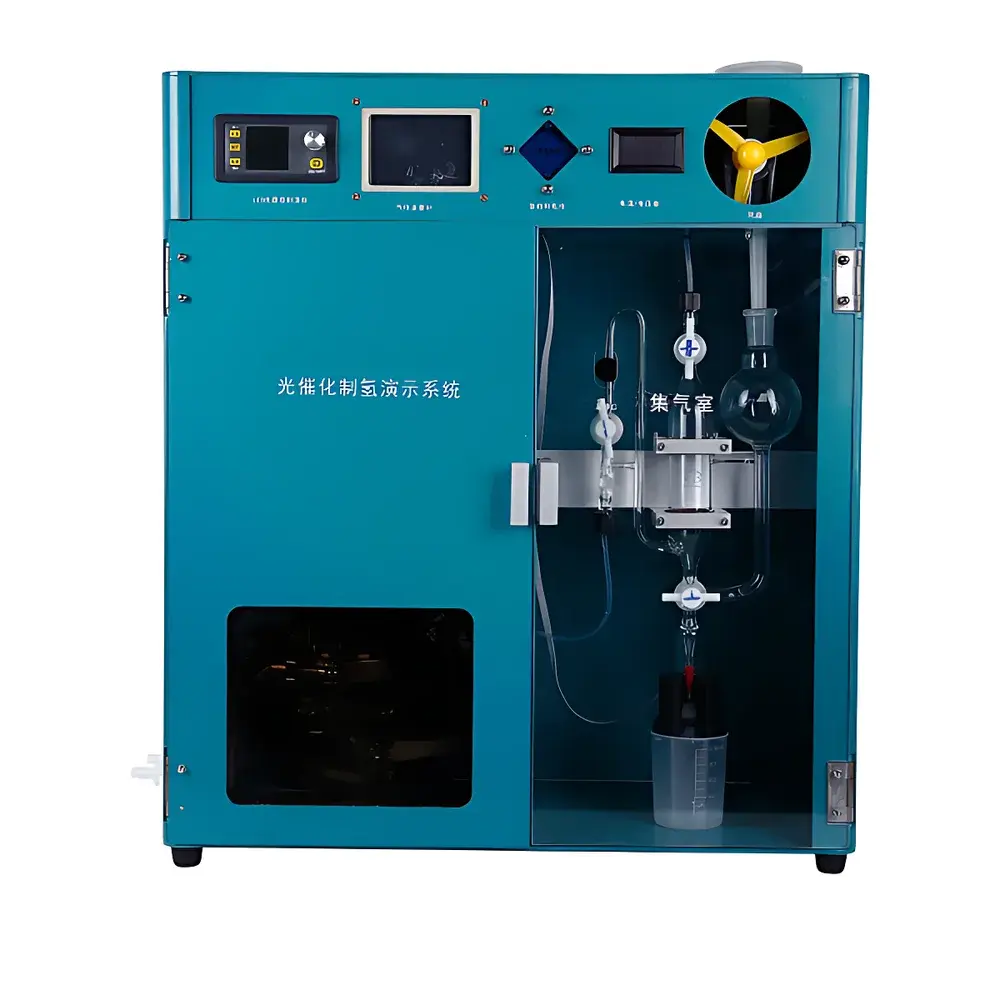
PLR DHEU-I Hydrogen Energy Utilization Demonstration System
| Brand | PerfectLight |
|---|---|
| Origin | Beijing, China |
| Manufacturer Type | Authorized Distributor |
| Country of Origin | China |
| Model | PLR DHEU-I |
| Power Supply | 220 VAC/50 Hz, 1 A (wide-range input: 110–260 VAC) |
| Light Source | 100 W high-power LED (standard 365 nm UV |
| Gas Collection | water-displacement and water-seal gas collection modes |
| Reactor | jacketed cylindrical reactor with U-shaped quartz window, flanged connection, ~160 mL nominal volume |
| Fuel Cell Output | 0.5–0.7 V, 15–20 mA under typical operating conditions |
| Volume Measurement | integrated sensor module for real-time digital display of gas volume (mL), droplet count, flow rate, and runtime |
| Dimensions | 500 × 454 × 215 mm (L×W×H) |
Overview
The PLR DHEU-I Hydrogen Energy Utilization Demonstration System is an integrated, benchtop-scale educational platform engineered to visualize and quantify multi-step energy conversion pathways—specifically, the photonic excitation of photocatalytic hydrogen evolution, followed by storage, purification, and electrochemical recombination in a proton exchange membrane (PEM) fuel cell. Unlike conventional chemical synthesizers or reaction stations, the DHEU-I is not designed for synthetic throughput or process optimization; rather, it implements fundamental physical principles—including photoelectrochemistry, Faraday’s laws of electrolysis, and galvanic cell thermodynamics—to deliver pedagogically rigorous, real-time demonstrations of renewable energy transduction. Its architecture centers on a sealed, temperature-stabilized photoreactor coupled to a calibrated gas-handling train and a functional PEM fuel cell stack, enabling quantitative correlation between photon flux (measured via LED drive parameters), evolved H₂ volume (via precision liquid-displacement sensing), and electrical output (V/I curves). This system conforms to standard undergraduate and graduate-level laboratory curricula aligned with ISO/IEC 17025-accredited teaching practices and supports foundational instruction in sustainable energy science.
Key Features
- Modular photoreactor with double-jacketed borosilicate glass body and U-shaped fused quartz optical window—designed for uniform irradiation and thermal stability during extended operation.
- Programmable 100 W LED light source with selectable emission bands (365 nm UV standard; optional 450–650 nm white spectrum), digitally controllable via embedded firmware for intensity, duty cycle, and spectral profile emulation.
- Real-time volumetric gas quantification using capacitive liquid-level sensing and calibrated droplet counting—supports traceable volume measurement (±0.1 mL resolution) with user-adjustable scaling factors for syringe needle inner diameter and local water density.
- Dual-mode gas collection: water-displacement for stoichiometric H₂ yield determination and water-seal back-pressure regulation for safe fuel cell feed control.
- Integrated PEM fuel cell module with platinum-catalyzed electrodes, delivering stable open-circuit voltage (0.5–0.7 V) and load-dependent current (15–20 mA at matched impedance), fully compatible with standard data acquisition interfaces (USB/RS-232).
- Compact footprint (500 × 454 × 215 mm) and CE-compliant power architecture (110–260 VAC, 50/60 Hz) ensure deployment flexibility across teaching labs, outreach exhibitions, and accreditation-ready instructional spaces.
Sample Compatibility & Compliance
The PLR DHEU-I is intended for use with aqueous photocatalytic suspensions (e.g., TiO₂, g-C₃N₄, or Pt-loaded CdS colloids) and standardized electrolyte solutions (e.g., 0.1 M Na₂SO₄ or methanol/water mixtures). It does not support organic solvents, corrosive halides, or pressurized gas handling beyond ambient atmospheric equilibrium. All wetted components comply with ISO 8502-3 for surface cleanliness and ASTM D1193 Type IV water compatibility. The system meets IEC 61000-6-3 (EMC emission) and IEC 61000-6-2 (immunity) standards. While not certified for industrial process validation, its measurement traceability aligns with GLP documentation requirements for academic and vocational training environments.
Software & Data Management
The system includes standalone Windows-compatible configuration software for LED parameter scheduling (intensity ramping, pulse-width modulation), real-time plotting of gas volume vs. time, and synchronized logging of fuel cell voltage/current waveforms. Export formats include CSV and MATLAB .mat files. Audit trails record operator ID, timestamp, session duration, and calibration coefficient modifications—supporting compliance with institutional GLP policies and internal assessment protocols. No cloud connectivity or remote access is implemented; all data reside locally to preserve integrity and simplify IT governance.
Applications
- Undergraduate laboratory modules on photoelectrochemical water splitting and fuel cell thermodynamics (ASTM E2575, ISO 17225-2).
- STEM outreach demonstrations illustrating the solar-to-hydrogen-to-electricity chain with quantitative metrics.
- Teacher training workshops focused on inquiry-based energy curriculum development.
- Capstone design projects evaluating catalyst performance metrics (e.g., turnover frequency, quantum yield estimation).
- Introductory courses in electrochemistry, physical chemistry, and sustainable engineering.
FAQ
Is the PLR DHEU-I suitable for quantitative research-grade hydrogen evolution measurements?
No—it is optimized for pedagogical reproducibility and conceptual clarity, not for high-precision catalytic activity benchmarking. For research applications requiring ±0.5% volumetric accuracy or <1 ppm O₂ contamination control, dedicated analytical gas chromatography or mass spectrometry-coupled photoreactors are recommended.
Can the reactor temperature be actively controlled?
The system includes a passive water-jacket interface but lacks an integrated chiller or heater; external recirculating baths may be connected via standard 6 mm quick-fit ports to maintain isothermal conditions within ±2 °C.
What safety certifications does the unit carry?
It bears CE marking per Directive 2014/35/EU (Low Voltage Directive) and 2014/30/EU (EMC Directive); no UL or CSA listing is provided.
Is custom wavelength LED integration supported?
Yes—third-party LED modules (with compatible 24 V DC input and TTL trigger interface) can be installed in place of the standard 365 nm unit, subject to optical alignment verification and firmware reconfiguration.
Does the system support automated long-term unattended operation?
It supports scheduled LED activation and continuous data logging up to 72 hours; however, manual intervention is required for gas collection vessel refilling, electrode cleaning, and electrolyte replenishment.



