
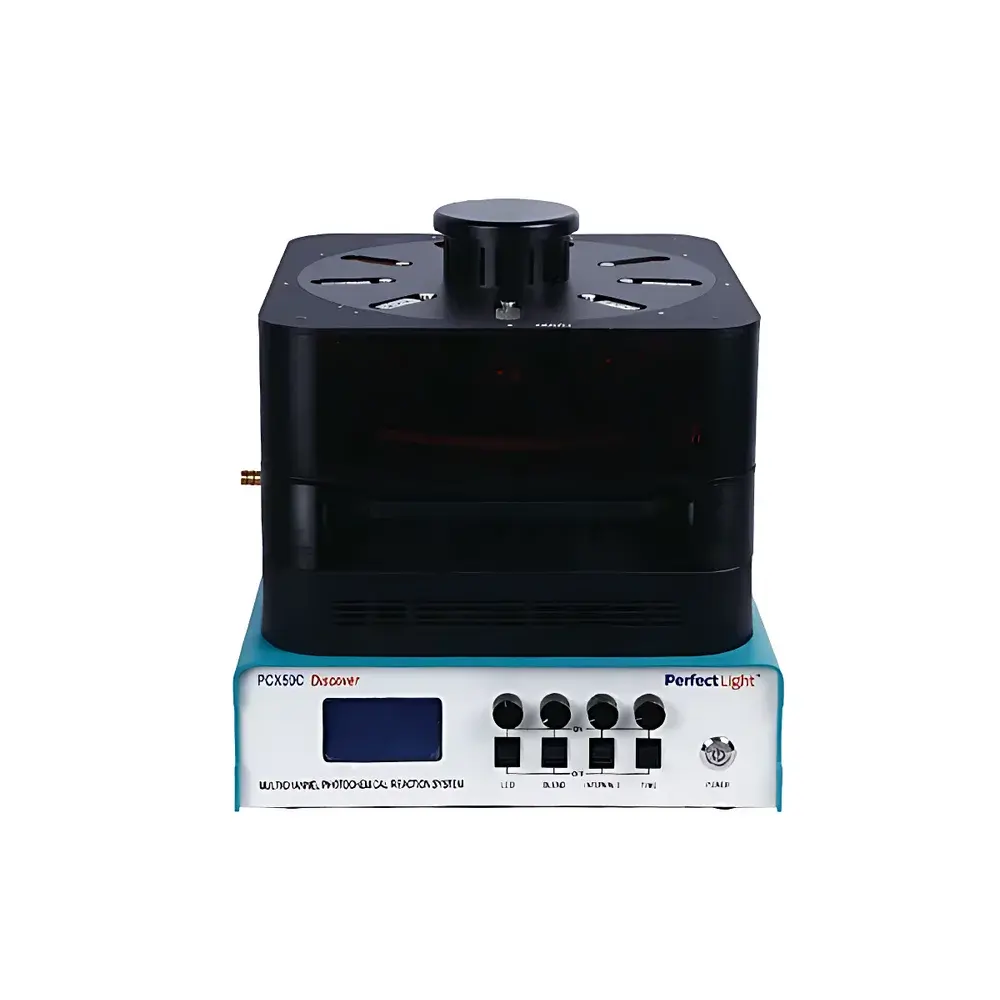
PerfectLight PCX-50C Discover Multi-Channel Photochemical Reaction System
| Brand | PerfectLight |
|---|---|
| Origin | Beijing, China |
| Model | PCX-50C Discover |
| Temperature Range | 10 °C to 80 °C |
| Temperature Control Accuracy | ±0.1 °C |
| Reaction Positions | 9 |
| Vessel Capacities | 1.5 mL, 5 mL, 15 mL, 50 mL |
| LED Irradiance Range | 100–450 mW/cm² |
| Customizable Wavelengths | 255–770 nm (UV–Vis–NIR), including solar-spectrum Vlight mode (380–780 nm) |
| Cooling Interface | Quick-connect water-cooling port compatible with external chiller units |
| Optical Configuration | Bottom-illumination with focused collimated optics per channel |
| Optional Accessories | PLS-MAC1005 Multi-Gas Controller, GPA1000 Automated Sampler, reflective-coated reaction vials |
Overview
The PerfectLight PCX-50C Discover is an engineered multi-channel photochemical reaction system designed for high-throughput, parallel photoreaction screening under rigorously controlled irradiation and thermal conditions. It operates on the principle of spatially resolved, wavelength-selective photon delivery to discrete reaction vessels—enabling systematic investigation of photocatalytic mechanisms, quantum yield dependencies, and kinetic profiles across diverse light-driven transformations. Unlike conventional batch reactors, the PCX-50C Discover implements a bottom-illuminated optical architecture with individually collimated LED emitters, minimizing scattering losses and ensuring uniform photon flux distribution across each reaction volume. Its integration-ready design supports GLP-compliant workflows in academic, pharmaceutical, and industrial R&D laboratories engaged in visible-light-mediated C–C bond formation, asymmetric photocatalysis, CO₂ reduction, and organic semiconductor synthesis.
Key Features
- 9-channel independent LED illumination: Each position features a thermally stabilized, wavelength-specific LED source with selectable emission from 255 nm (UVC) to 770 nm (NIR); includes dedicated Vlight mode (380–780 nm) for solar-simulated irradiation.
- Precise irradiance control: Adjustable output intensity (100–450 mW/cm²) enables quantitative modulation of photon flux—critical for distinguishing between primary photochemical events and secondary thermal contributions.
- High-fidelity thermal management: Integrated quick-connect water-cooling interface allows seamless coupling with external chillers or heating circulators; achieves stable setpoint control from 10 °C to 80 °C with ±0.1 °C accuracy—supporting both cryogenic selectivity enhancement and accelerated kinetics.
- Modular vessel compatibility: Supports standardized borosilicate glass vials (1.5, 5, 15, and 50 mL) with optional reflective interior coatings to increase effective photon absorption by up to 35% compared to standard configurations.
- Bottom-illumination geometry: Eliminates path-length variability and angular dependence inherent in side-irradiated systems—ensuring reproducible photon penetration depth and consistent actinic dose delivery.
- Parallel parameter synchronization: Microprocessor-controlled coordination of irradiance, temperature, and magnetic stirring speed across all nine channels ensures inter-reaction comparability required for statistically robust DoE (Design of Experiments) studies.
Sample Compatibility & Compliance
The PCX-50C Discover accommodates heterogeneous suspensions (e.g., TiO₂, g-C₃N₄), homogeneous molecular catalysts (e.g., Ir(ppy)₃, Ru(bpy)₃²⁺), and gas–liquid–solid triphasic systems when interfaced with the PLS-MAC1005 multi-gas controller. Reaction vessels maintain integrity under static pressures ranging from –0.1 MPa (vacuum) to +0.3 MPa (positive pressure), permitting safe operation with O₂, Cl₂, CO₂, and H₂—subject to appropriate safety protocols. The system conforms to IEC 61000-6-3 (EMC emissions) and IEC 61010-1 (electrical safety for laboratory equipment). While not certified for ISO/IEC 17025 accreditation out-of-the-box, its digital logging capabilities—including timestamped irradiance, temperature, and stir rate—support audit-ready data capture aligned with FDA 21 CFR Part 11 requirements when deployed with validated software environments.
Software & Data Management
The PCX-50C Discover operates via a dedicated embedded controller with intuitive touchscreen interface and RS-485/USB connectivity. All operational parameters—including real-time irradiance calibration logs, thermal ramp profiles, and error codes—are stored locally with UTC timestamps and exportable as CSV files. When integrated into the MCP-WS1000 Photochemical Workstation (with GPA1000 autosampler and GC/HPLC interfaces), it supports automated time-series sampling at user-defined intervals, enabling construction of concentration–time curves without manual intervention. Data synchronization follows ASTM E2500-22 guidelines for analytical instrument qualification, facilitating traceable method validation in regulated environments.
Applications
- High-throughput screening of photocatalysts for asymmetric α-alkylation, decarboxylative couplings, and metallaphotoredox reactions.
- Systematic evaluation of wavelength-dependent quantum efficiencies across metal-free organic dyes and transition-metal complexes.
- Kinetic modeling of photoredox-initiated radical chain processes under controlled photon flux and temperature gradients.
- Development of solar-fuel generation protocols—including photocatalytic water splitting and CO₂-to-methanol conversion—under simulated AM1.5G irradiance.
- Structure–activity relationship (SAR) studies linking catalyst absorption maxima (e.g., 450–550 nm for Ir-based systems) to redox potential windows and product selectivity.
- Accelerated stability testing of photoredox-active materials under prolonged irradiation and thermal stress.
FAQ
Does the PCX-50C Discover support simultaneous irradiation at multiple wavelengths across different channels?
Yes—each of the nine LED modules is independently addressable, allowing distinct wavelengths and intensities to be assigned per position.
Can the system be used for oxygen-sensitive reactions?
Yes—when paired with the PLS-MAC1005 multi-gas controller and vacuum-rated vials, it enables strict inert-atmosphere operation with continuous N₂/Ar purging or programmable gas partial pressure control.
Is calibration documentation provided for irradiance and temperature sensors?
Factory calibration certificates are supplied for both irradiance (NIST-traceable spectroradiometer) and Pt100 temperature sensors; users may perform field recalibration using external reference standards.
What is the maximum allowable working pressure inside reaction vials?
Standard vials are rated for continuous operation up to 0.3 MPa gauge pressure; custom high-pressure variants (up to 1.0 MPa) are available upon request.
How is optical alignment maintained across repeated experimental runs?
Each LED module incorporates a fixed-focus collimating lens assembly; mechanical alignment is verified during factory commissioning and does not require user adjustment during normal operation.



