
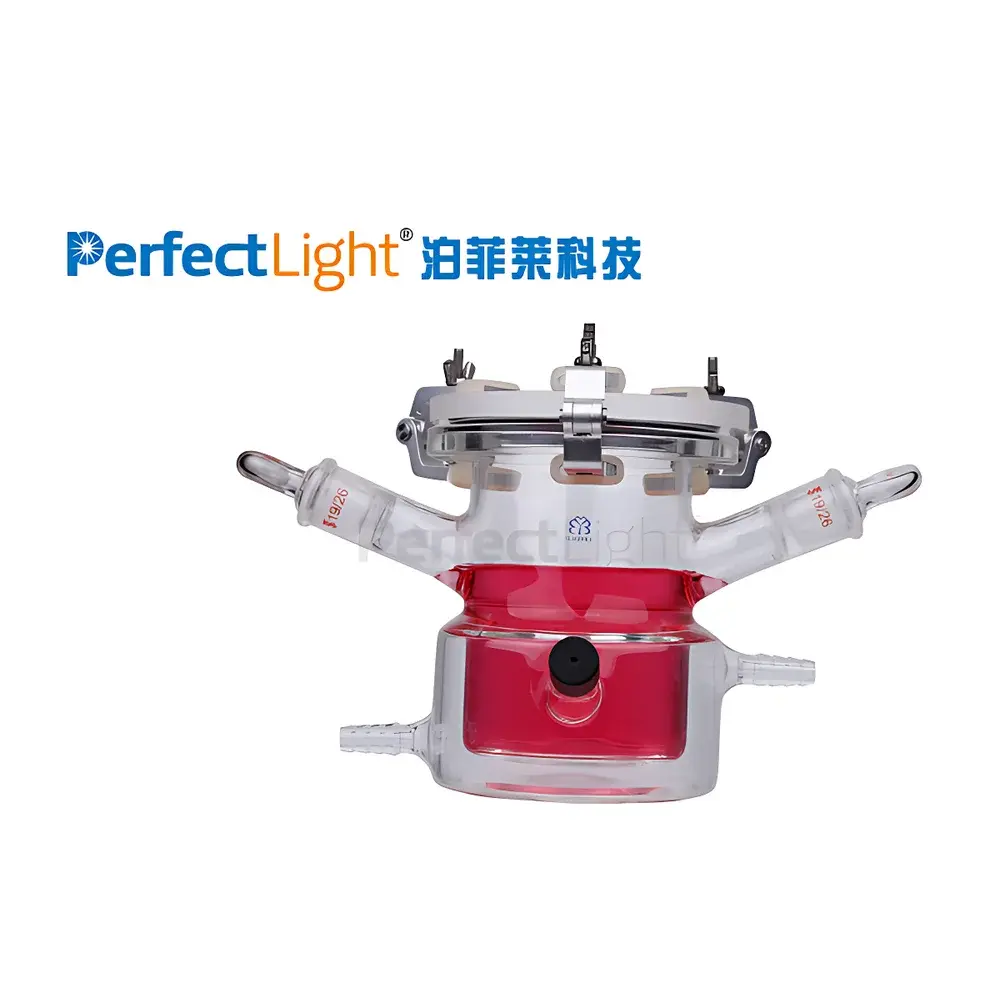
PofeiLai PQ Series Top-Illumination Quartz Photoreactor
| Brand | PofeiLai (PerfectLight) |
|---|---|
| Origin | Beijing, China |
| Model | PQ Series Laboratory-Scale Photoreactor |
| Construction Material | JGS-2 Fused Quartz |
| Optical Window Options | Quartz Flat Plate (Φ110 × 8 mm) or Quartz Jacketed Window |
| Total Volume | ~350 mL |
| Effective Reaction Volume | ~150 mL |
| Sealing Method | Flanged Connection with Viton/FFKM O-Ring Seal |
| Standard Ground Joints | Two 19/26 taper joints |
| Integrated Features | Gas Inlet/Outlet Ports for Atmosphere Control, Manual Sampling Port with Septum Penetration, Optional Vacuum/Reagent Addition Port, Optional Thermostatic Water Jacket |
| Compliance | Designed for ISO/IEC 17025-aligned laboratory use |
Overview
The PofeiLai PQ Series Top-Illumination Quartz Photoreactor is a precision-engineered laboratory-scale reaction system designed specifically for controlled heterogeneous and homogeneous photocatalytic processes under defined irradiation, temperature, and atmospheric conditions. Based on the Couette-type optical geometry principle—where incident photons pass perpendicularly through a high-transmittance JGS-2 fused quartz window—the reactor enables uniform photon flux delivery to the catalyst–substrate interface. Its top-illumination architecture eliminates shadowing effects common in side-irradiated vessels and ensures reproducible light path length across the reaction volume. The reactor operates as a sealed, pressure-rated (up to 0.3 MPa gauge), gas-tight vessel suitable for reactions involving reactive gases (e.g., O₂, H₂, CO, NOₓ) or inert atmospheres (N₂, Ar). It is routinely deployed in academic and industrial R&D for photocatalytic water splitting, organic pollutant degradation, CO₂ reduction, and photo-assisted synthesis where quantifiable photon dose, stoichiometric gas consumption, and non-invasive sampling are critical experimental requirements.
Key Features
- JGS-2 fused quartz construction (UV-VIS transmission >90% from 190–2500 nm) ensures minimal photon attenuation and thermal stability up to 300 °C.
- Interchangeable optical configurations: removable flat quartz plate (Φ110 × 8 mm) or coaxial quartz water-jacketed window for simultaneous illumination and active temperature regulation.
- Dual 19/26 standard taper ground joints enable modular integration with condensers, gas scrubbers, syringe pumps, or online GC/MS transfer lines.
- Integrated septum-piercing sampling port with borosilicate glass external thread allows quantitative liquid-phase withdrawal without system depressurization or headspace disturbance.
- Dedicated gas inlet/outlet ports support programmable gas purging sequences (e.g., three-cycle N₂ flush prior to O₂ introduction), enabling precise control over dissolved oxygen content and headspace composition.
- Optional thermostatic water jacket connects directly to external circulators (±0.1 °C stability) for isothermal kinetic studies between 5–80 °C.
Sample Compatibility & Compliance
The PQ photoreactor accommodates slurries (TiO₂, g-C₃N₄, MOFs), transparent solutions, and viscous media up to 500 mPa·s. Its chemically inert quartz body resists corrosion from strong acids (e.g., HNO₃, H₂SO₄), alkalis (NaOH ≤2 mol/L), and oxidants (H₂O₂, persulfates). All elastomeric seals meet USP Class VI and FDA 21 CFR 177.2600 specifications. The design supports ASTM E2535-22 (Standard Practice for Photocatalytic Activity Measurement) and ISO 22197-1:2021 (Photocatalytic Air Purification Performance Testing). Traceable calibration of light intensity (via NIST-traceable UV-A radiometer) and gas flow (mass flow controller certified to ISO 6104) is achievable using optional accessories. Full audit trail capability—including timestamped gas valve actuation logs and manual sampling event entries—is supported when integrated with validated LIMS or ELN platforms.
Software & Data Management
While the base PQ reactor operates manually, it is fully compatible with third-party automation systems via standardized 0–10 V analog I/O and RS485 Modbus RTU interfaces. Integration with LabVIEW™ or Python-based control suites enables synchronized logging of irradiance (W/m²), jacket temperature (°C), internal pressure (kPa), and gas flow rate (sccm). All sampling events, purge cycles, and parameter adjustments can be annotated and exported in CSV or XML format for regulatory submission. When deployed in GMP environments, the system meets ALCOA+ data integrity criteria when paired with 21 CFR Part 11–compliant electronic signatures and role-based access controls.
Applications
- Kinetic modeling of semiconductor photocatalysis (e.g., bandgap-dependent quantum yield determination per ISO 22197-2).
- Screening of photocatalyst stability under repeated illumination cycles with in situ pH/conductivity monitoring.
- Gas-phase photooxidation studies requiring real-time O₂ consumption tracking via paramagnetic O₂ sensor coupling.
- Photoelectrochemical precursor synthesis under argon glovebox-integrated operation.
- Validation of solar simulator spectral match (AM 1.5G) using calibrated reference cells mounted at the quartz window plane.
FAQ
What is the maximum operating temperature and pressure rating of the PQ reactor?
The JGS-2 quartz body supports continuous operation up to 300 °C; pressure rating is 0.3 MPa (gauge) when equipped with FFKM sealing components.
Can the reactor be used for in situ spectroscopic monitoring?
Yes—optional fiber-optic probe ports (QF-1/4″ NPT) can be installed adjacent to the quartz window for real-time UV-Vis absorption or fluorescence measurement.
Is vacuum compatibility verified?
All PQ units undergo helium leak testing to ≤1 × 10⁻⁹ mbar·L/s prior to shipment, confirming suitability for high-vacuum pretreatment (≤10⁻³ mbar) before gas dosing.
How is light intensity calibrated during experiments?
Users mount a NIST-traceable broadband UV-A radiometer (e.g., International Light ILT1700) directly against the quartz window surface; irradiance values are recorded pre- and post-run to correct for lamp drift.
Are custom geometries or additional ports available?
PofeiLai’s in-house reactor engineering team offers OEM design services—including bespoke volume scaling (50–1000 mL), alternative window materials (CaF₂ for VUV), and integration-ready flange patterns (CF, KF, or ANSI B16.5).



