
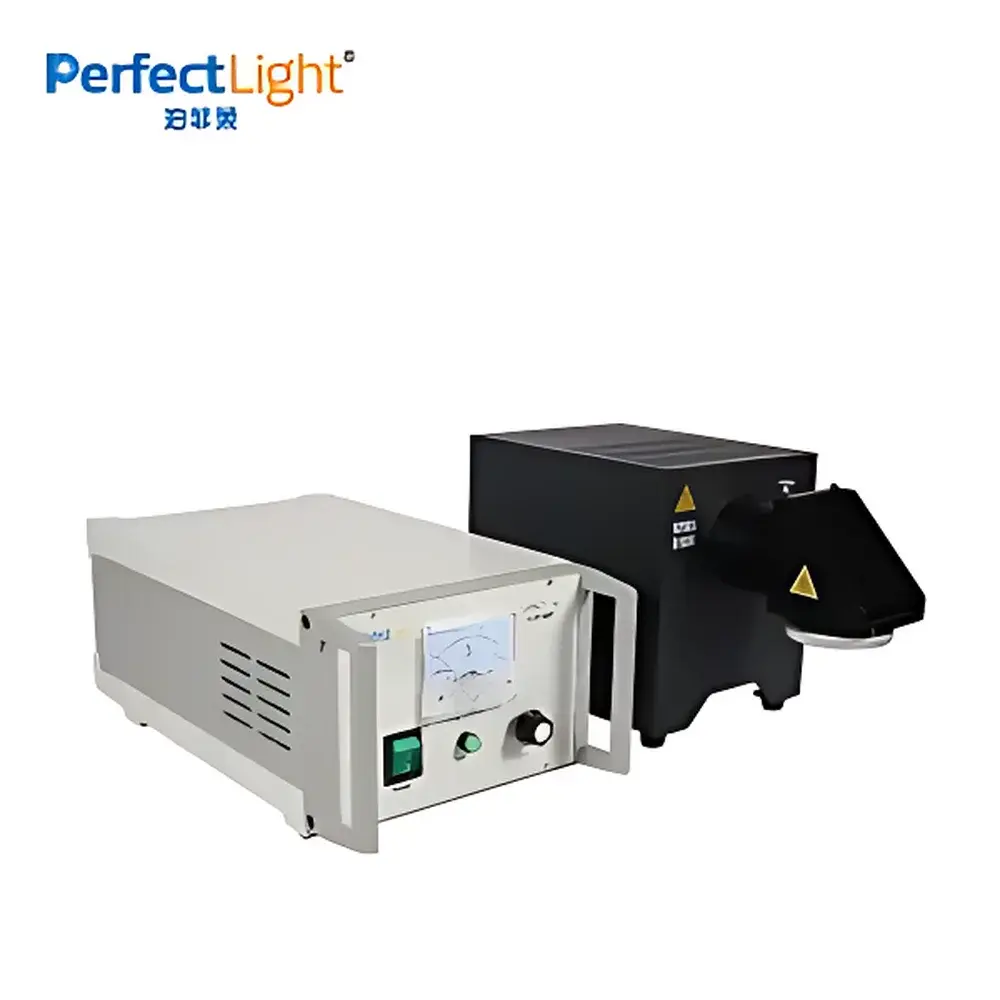
PLS-SXE300+300UV Xenon Light Source System
| Brand | PerfectLight (Perfetlight) |
|---|---|
| Origin | Beijing, China |
| Model | PLS-SXE300+300UV |
| Light Source Type | Xenon Arc Lamp |
| Illumination Mode | External Irradiation |
| Total Optical Power | 50 W |
| Spectral Range | 320–780 nm (extendable to 2500 nm) |
| Beam Divergence | ~6° (average) |
| Spot Diameter | 30–60 mm (distance-dependent) |
| Long-Term Irradiance Stability | ≤ ±3% |
| Lamp Power | 300 W |
| Power Adjustment Range | 150–300 W |
| Lamp Lifetime | >1000 h (under standard photocatalytic operating conditions) |
| Max Current Limit | 21 A |
| Triggering Method | Integrated High-Voltage Ignition (dual-stage, no high-voltage cabling) |
| Lamp Housing | Shielded Metal Enclosure |
| Power Management | Microcontroller-Based Digital Control |
| Safety | Low-Voltage Interconnect Between Lamp Housing and Power Supply |
Overview
The PLS-SXE300+300UV is a digitally controlled, air-cooled xenon arc light source system engineered for reproducible, stable broadband irradiation in laboratory-scale photochemical and photocatalytic research. It operates on the principle of DC-powered short-arc xenon discharge, generating continuum radiation from the deep ultraviolet (UV) through the visible and into the near-infrared (NIR) spectral region. Its 300 W rated lamp delivers 50 W of usable optical power within the 320–780 nm range—closely approximating solar spectral irradiance (AM 1.5G) without requiring complex optics or secondary collimation. The system’s external irradiation configuration enables flexible integration with custom reactors, electrochemical cells, gas-phase flow chambers, and liquid-phase immersion setups. Designed for continuous-duty operation, it features an optimized aluminum heat sink architecture that maintains thermal equilibrium during extended irradiation cycles (>8 h), ensuring minimal spectral drift and intensity fluctuation.
Key Features
- Stable broadband output with ≤ ±3% long-term irradiance variation over multi-hour operation—validated under constant-current driving conditions.
- Digitally regulated DC power supply with microcontroller-based feedback loop for precise lamp current control (150–300 W adjustable) and real-time thermal monitoring.
- Integrated dual-stage ignition circuit eliminates high-voltage transmission along interconnect cables—enhancing operator safety and electromagnetic compatibility (EMC).
- Robust all-metal lamp housing provides full EMI/RFI shielding and mechanical durability in shared lab environments.
- Optical output configured for external illumination with a nominal beam divergence of ~6°, enabling efficient coupling to fiber-optic bundles, monochromators, or direct reactor irradiation.
- Modular filter compatibility: supports standardized UV-cut (e.g., λ < 400 nm), visible-pass (400–700 nm), NIR-transmitting, and narrowband interference filters for wavelength-selective experiments.
Sample Compatibility & Compliance
The PLS-SXE300+300UV is compatible with heterogeneous photocatalysts (e.g., TiO₂, g-C₃N₄, perovskites), suspended nanoparticle dispersions, thin-film electrodes, gas-phase catalytic beds, and sealed quartz photoreactors. Its spectral output meets common requirements for ISO 10678:2010 (photocatalytic activity assessment), ASTM E2738 (standard practice for UV-Vis-NIR irradiance measurement), and JIS R 1703 (evaluation of photocatalytic air purification performance). While not certified for GMP or GLP environments out-of-the-box, its digital logging capability and stable output support audit-ready experimental documentation when paired with calibrated reference detectors (e.g., NIST-traceable photodiodes).
Software & Data Management
The system operates in standalone mode via front-panel controls but supports optional RS-232 or USB-to-serial interface for remote command execution (e.g., ON/OFF, power ramping, fault status polling). No proprietary GUI is bundled; however, third-party LabVIEW, Python (PySerial), or MATLAB scripts can log operational parameters—including setpoint current, elapsed runtime, and overtemperature alerts—for traceable experiment replication. All firmware events are timestamped and stored in non-volatile memory, supporting post-hoc correlation between irradiation history and analytical outcomes (e.g., GC-MS quantification, IPCE calculation, or quantum yield derivation).
Applications
- Photocatalytic water splitting (H₂/O₂ evolution) and overall water decomposition under simulated solar irradiation.
- CO₂ photoreduction to CH₄, CO, or C₂H₄ using plasmonic or molecular catalysts.
- Gas-phase degradation of VOCs (formaldehyde, toluene, NOₓ, SO₂) in dynamic flow reactors.
- Aqueous-phase pollutant abatement (methylene blue, rhodamine B, phenol) under controlled photon flux.
- Photoelectrochemical (PEC) characterization of semiconductor photoanodes/cathodes in three-electrode configurations.
- Wavelength-resolved action spectrum determination when used with motorized filter wheels or monochromator coupling.
FAQ
What is the recommended operating distance between the lamp output and sample surface?
For optimal uniformity and intensity control, maintain a working distance of 100–200 mm; spot diameter expands from ~30 mm at 100 mm to ~60 mm at 200 mm, per inverse-square approximation.
Can this system be used for UV-C (<280 nm) experiments?
No—the fused silica output window and internal optics transmit down to ~320 nm only; for sub-300 nm work, a dedicated deuterium or excimer source is required.
Is lamp alignment or collimation adjustment possible by the user?
The lamp position is factory-aligned and fixed; no user-serviceable optical adjustments are provided to preserve beam geometry and thermal safety margins.
How is lamp lifetime defined and validated?
Lifetime >1000 h refers to operational duration until luminous flux drops below 80% of initial value under 300 W constant-current drive at 25°C ambient, per IEC 62471 photobiological safety testing protocols.
Does the system comply with CE or UL safety standards?
It conforms to IEC 61000-6-3 (EMC emission limits) and IEC 61000-6-2 (immunity), but carries no CE/UL mark; end users must verify local regulatory acceptance prior to installation.





