
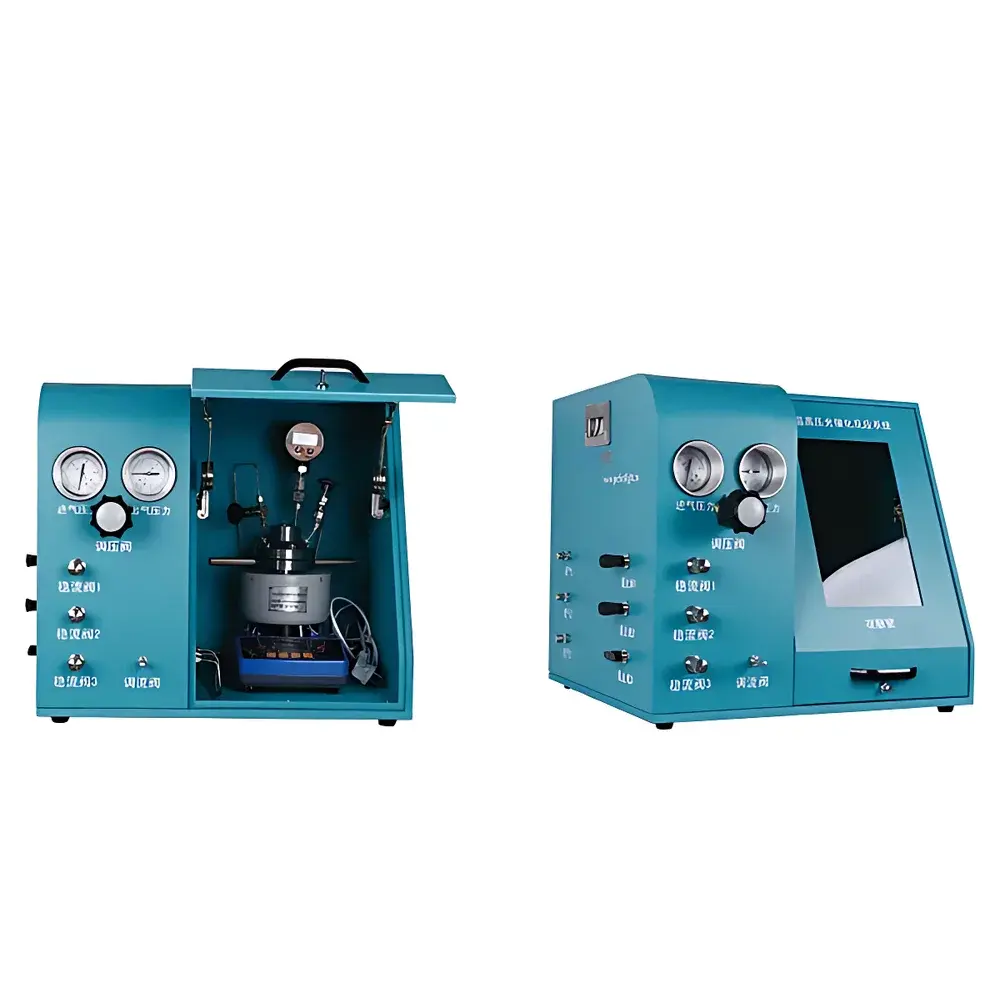
PLR-HGPR High-Temperature and High-Pressure Photocatalytic Reaction System
| Brand | PerfectLight (PofeiLai) |
|---|---|
| Origin | Beijing, China |
| Model | PLR-HGPR |
| Temperature Range | Ambient +10 °C to 300 °C (up to 380 °C) |
| Operating Pressure | 1–10 MPa |
| Reactor Volume | 50 mL (customizable: 25 mL or 100 mL) |
| Gas Inlets | 3 independent channels |
| Total Gas Flow Rate | 1–60 mL/min |
| Safety Relief Valve Setpoint | Adjustable up to 7 MPa |
| Gas Mixing Chamber Volume | 1 L |
| Flow Monitoring | Electronic soap-film flowmeter (10–60 mL/min range) |
| Optical Window | Thick fused-silica quartz, broadband transmission (190–2500 nm) |
Overview
The PLR-HGPR High-Temperature and High-Pressure Photocatalytic Reaction System is an engineered platform for conducting controlled, quantitative photocatalytic studies under thermodynamically demanding conditions. Designed around a differential-flow reactor architecture, it enables precise kinetic investigation of heterogeneous photocatalytic processes—both gas–solid and liquid–solid—under elevated temperature (up to 380 °C) and pressure (up to 10 MPa). Its core operational principle integrates photonic excitation (via broadband quartz-transmissible irradiation) with tightly regulated mass transport and thermal management. Unlike batch or semi-batch systems, the PLR-HGPR maintains steady-state concentration gradients across the catalyst bed, facilitating first-principles kinetic modeling in accordance with Langmuir–Hinshelwood or Eley–Rideal mechanisms. The system’s modular construction supports reproducible catalyst evaluation under industrially relevant process windows—critical for bridging lab-scale discovery to pilot-scale process development.
Key Features
- Differential-flow reactor design optimized for intrinsic kinetic analysis under non-equilibrium conditions
- Triple independent gas inlet channels, each equipped with dual-stage precision regulators (mass flow + pressure stabilization) for stoichiometric control and cross-contamination mitigation
- Broadband optical access via thick-walled fused-silica quartz window (190–2500 nm), compatible with UV-C, visible, and NIR light sources including Xe lamps, LED arrays, and laser diodes
- Integrated 1 L high-pressure gas mixing chamber enabling stable, long-duration operation (>48 h) without flow interruption or composition drift
- Real-time monitoring of reactor temperature (±0.5 °C accuracy) and pressure (±0.02 MPa resolution) via calibrated digital transducers with local display and analog output
- Electronic soap-film flowmeter (10–60 mL/min range) at exhaust for traceable, low-flow gas quantification—essential for low-conversion quantum yield studies
- Interlocked safety enclosure rated for Class I, Division 2 hazardous area compliance; includes pressure-activated emergency venting, visual/audible alarms, and mechanical cut-off valves
Sample Compatibility & Compliance
The PLR-HGPR accommodates powder, pelletized, monolithic, and coated-substrate catalysts—including TiO2, g-C3N4, MOFs, perovskites, and plasmonic nanostructures—within its removable 50 mL stainless-steel reactor body (316L grade, electropolished interior). Liquid-phase reactions support aqueous and organic solvents (e.g., methanol/water mixtures, acetonitrile) under pressurized inert or reactive atmospheres. All wetted components comply with ASTM A269 and ASME B31.3 standards. The system meets ISO 13849-1 (Category 3, PL e) for functional safety and supports GLP-compliant documentation through optional audit-trail-enabled data logging. Pressure vessel certification follows GB/T 150.1–2011 (equivalent to EN 13445), with third-party hydrostatic test validation available upon request.
Software & Data Management
While hardware-controlled operation is fully functional via front-panel interface, optional PC-based acquisition software provides synchronized timestamped logging of temperature, pressure, flow rates, and external sensor inputs (e.g., GC/FID, MS, or online FTIR signals). Data export adheres to ASTM E2500-17 format for raw signal integrity and metadata tagging (operator ID, experiment ID, calibration timestamps). Audit trail functionality satisfies FDA 21 CFR Part 11 requirements when paired with user authentication and electronic signature modules. All firmware updates are digitally signed and version-locked to ensure traceability across instrument lifecycles.
Applications
- Quantitative CO2 photoreduction to CH4, CO, or C2H4 under simulated syngas-relevant pressures (2–5 MPa)
- Thermally coupled photocatalytic oxidation of VOCs (formaldehyde, toluene, NOx) in humid air streams at >200 °C
- Kinetic isotope effect (KIE) studies in H2O/D2O-mediated photocatalytic water splitting
- Stability assessment of photoanodes under PEC-operating conditions (bias + illumination + 80 °C, 2 MPa O2)
- Photoinduced C–N coupling under NH3/CH4 co-feed at 300 °C and 4 MPa
- Time-resolved product evolution profiling using coupled online GC–TCD/FID or quadrupole MS
FAQ
Can the PLR-HGPR be used for liquid-phase photocatalysis under supercritical conditions?
Yes—the reactor is rated for 10 MPa and 380 °C, enabling studies in subcritical and near-supercritical water (SCW) or CO2, provided solvent compatibility and quartz window thermal limits are observed.
Is the quartz window replaceable in situ without breaking vacuum or pressure?
No—quartz window replacement requires full depressurization and disassembly; however, the thick-wall design (≥12 mm) ensures >5,000 h service life under continuous UV irradiation and thermal cycling.
Does the system support automated sequential gas switching during a single experiment?
Not natively—but programmable external solenoid manifolds (e.g., VICI Valco) can be integrated via TTL/RS-485 triggers for multi-step gas dosing protocols.
What calibration certificates are supplied with delivery?
NIST-traceable calibration reports for temperature sensors (ITS-90), pressure transducers (EN 837-1), and flowmeter (ISO 6789) are included; additional metrology documentation available upon order specification.
Is remote monitoring supported over Ethernet or Wi-Fi?
Standard configuration includes RS-485 Modbus RTU; optional Ethernet-to-Modbus gateways enable integration into LabVIEW, Python (pymodbus), or SCADA environments.



