
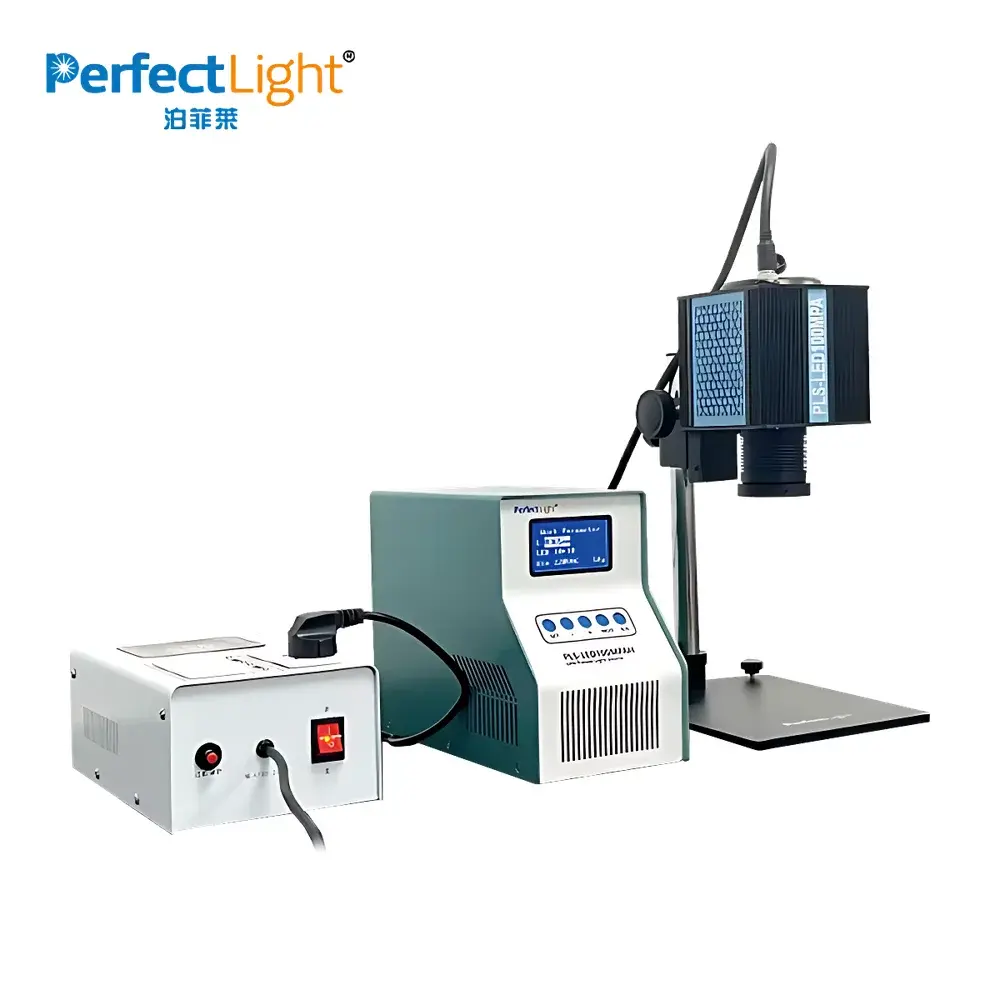
μLED Pulsed Light Source Series by PerfectLight
| Brand | PerfectLight |
|---|---|
| Origin | Beijing, China |
| Model | μLED |
| Light Source Type | High-Power Pulsed LED |
| Illumination Mode | External Irradiation |
| Pulse Frequency Range | 1 Hz – 100 kHz |
| Wavelength Compatibility | Version A: 365–590 nm |
| Version B | 630–1040 nm |
| LED Drive Current | 0.05–3.5 A (Constant Current Mode), 0.3–3.5 A (Pulse Mode) |
| LED Voltage Range | 10–40 V DC |
| Max Power Output | ≤100 W |
| Beam Diameter | Ø50 mm (adjustable via working distance) |
| Optimal Working Distance | 50 mm |
| Operating Ambient Temperature | −5 to 40 °C (short-term), Humidity: 0–85 % RH (non-condensing) |
| Input Voltage | Version A: AC 100–270 V / 50 Hz (via built-in stabilizer) |
| Version B | AC 220 V / 50 Hz (direct mains) |
| Protection Features | Overvoltage, Overcurrent, Overtemperature, Stall Detection & Self-Diagnostic Function |
| Power Stability | ≤0.5 W (electrical), ≤15 mW (optical) |
| Current Regulation Step | 1 mA |
| Current Stability | ±2 mA (0.05–0.3 A), ±15 mA (0.3–1.0 A), ±20 mA (1.0–3.5 A) |
Overview
The μLED Pulsed Light Source Series by PerfectLight is an engineered optical excitation platform designed for precision-controlled, time-resolved illumination in advanced photochemical and photobiological research. Based on high-efficiency, narrow-band LED technology, the system delivers stable, tunable pulsed light output across two broad spectral ranges—UV–visible (365–590 nm) and visible–NIR (630–1040 nm)—enabling rigorous experimental control over photon flux, duty cycle, and temporal profile. Unlike continuous-wave (CW) or arc-lamp-based sources, the μLED series leverages solid-state pulse modulation with closed-loop current regulation, ensuring reproducible irradiance delivery critical for kinetic studies in photocatalysis, photoelectrocatalysis, photodynamic therapy (PDT) research, and optogenetics. Its modular architecture supports interchangeable LED lamp housings, while integrated thermal management and real-time fault diagnostics guarantee operational robustness under extended duty cycles.
Key Features
- Precise pulse control: Adjustable frequency range from 1 Hz to 100 kHz with user-defined duty cycle and waveform timing;
- High-stability constant-current drive: Closed-loop regulation with ≤±20 mA current fluctuation across full 0.3–3.5 A operating range;
- Multi-parameter programmability: Independent adjustment of peak current, pulse width, repetition rate, and inter-pulse delay;
- Auto-adaptive power interface: Seamless compatibility with diverse LED lamp modules—no manual recalibration required when switching between spectral versions;
- Integrated safety architecture: Real-time monitoring of voltage, current, temperature, and thermal load; automatic shutdown and error logging upon overvoltage, overcurrent, or overtemperature events;
- Optimized optical delivery: Collimated Ø50 mm beam at 50 mm working distance; uniform irradiance profile suitable for reactor-scale illumination and microplate-based assays;
- Low electrical and optical power drift: ≤0.5 W electrical output fluctuation and ≤15 mW optical output variation across full wavelength and power range.
Sample Compatibility & Compliance
The μLED system is compatible with standard quartz and borosilicate reaction vessels, cuvettes (10 mm path length), and custom-built photoreactors. Its external irradiation configuration ensures non-invasive, top-down illumination without thermal coupling or electromagnetic interference—ideal for temperature-sensitive biological samples or electrochemical cells requiring electrode access. The device meets IEC 61000-6-3 (EMC Emission) and IEC 61000-6-2 (Immunity) standards. While not certified for clinical use, its design adheres to GLP-aligned engineering practices—including traceable calibration logs, deterministic pulse timing, and deterministic current setpoints—supporting audit-ready documentation for academic, industrial R&D, and regulatory preclinical studies (e.g., ISO 10993-12, ASTM E2937-14).
Software & Data Management
Control is implemented via USB-connected host software (Windows/Linux compatible) offering GUI- and script-based operation. All pulse parameters—including current amplitude, frequency, duty cycle, and burst sequences—are stored in timestamped, human-readable JSON configuration files. Software enforces parameter validation (e.g., preventing out-of-range combinations that could damage LEDs), logs real-time sensor data (current, voltage, heatsink temperature), and exports CSV-formatted irradiance profiles synchronized to external triggers (TTL input/output). Audit trails include operator ID, session start/end timestamps, and firmware version—supporting compliance with 21 CFR Part 11 requirements when deployed with validated electronic signatures and role-based access controls.
Applications
- Photocatalysis: Time-resolved investigation of charge carrier dynamics in TiO₂, g-C₃N₄, and MOF-based systems using sub-millisecond pulse trains;
- Photoelectrocatalysis: Synchronized illumination and potentiostat triggering for transient photocurrent analysis (TPA) and incident photon-to-current efficiency (IPCE) mapping;
- Photobiology: Dose-controlled activation of photosensitizers (e.g., porphyrins, phthalocyanines) in 2D/3D cell cultures and bacterial biofilms;
- Optogenetics screening: Reproducible blue/yellow/red-light pulses for channelrhodopsin/ChRmine/ReaChR activation in primary neuronal preparations;
- Material photostability testing: Accelerated aging protocols with controlled UV–VIS exposure cycles compliant with ISO 4892-3 and ASTM G154.
FAQ
What spectral ranges are supported, and can custom wavelengths be integrated?
The system supports two standardized configurations: Version A (365–590 nm) and Version B (630–1040 nm). Wavelengths between 590–630 nm are available as custom-engineered lamp modules upon request, subject to minimum order quantity and lead time confirmation.
Is the system compatible with third-party LED lamp housings?
Only PerfectLight-certified lamp modules are guaranteed for safe and stable operation. Interfacing non-OEM lamps may compromise current regulation accuracy, thermal safety margins, and warranty coverage.
How is pulse timing accuracy verified?
Each unit undergoes factory calibration using a calibrated photodiode and 1 GHz oscilloscope. Pulse edge jitter is ≤±5 ns (RMS) at 10 kHz, and frequency accuracy is maintained within ±0.01% across the full 1 Hz–100 kHz range.
Can the μLED operate in continuous-wave (CW) mode?
No. The system is optimized exclusively for pulsed operation. Constant-current mode provides steady-state DC-like output only during single-pulse-on states—not true CW illumination. For sustained irradiation, users must configure high-duty-cycle pulses (e.g., 99% at 1 kHz).
What environmental conditions are required for long-term reliability?
Ambient temperature must remain between 15–30 °C during continuous operation. Relative humidity should not exceed 70 % RH to prevent condensation on internal optics and PCBs. Forced-air cooling is recommended for >8-hour daily usage at >75 W output.






