
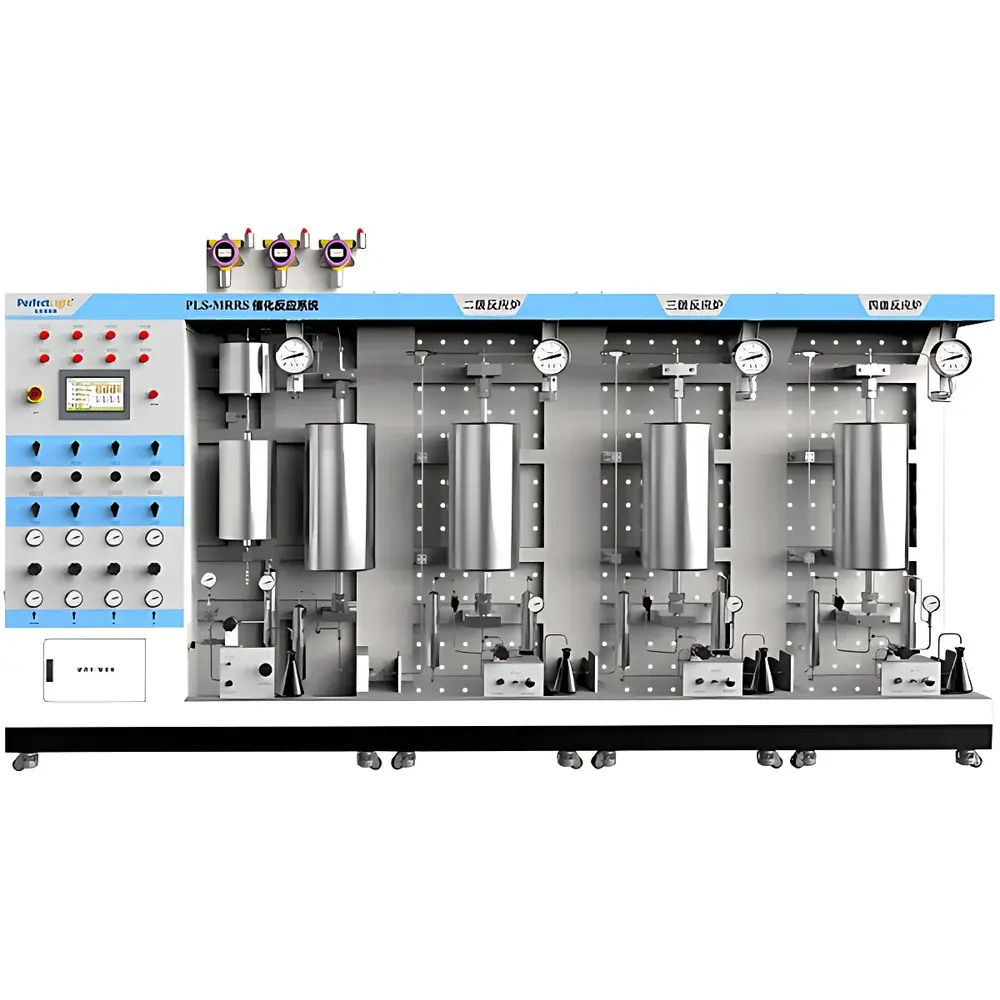
PerkinElmer PLS-MRRS Multi-Stage Fixed-Bed Catalytic Reaction System
| Brand | PerkinElmer (licensed from PerfectLight) |
|---|---|
| Model | PLS-MRRS |
| Temperature Range | Up to 800 °C |
| Pressure Range | Up to 3.0 MPa |
| Reactor Stages | Up to 4 cascaded units |
| Gas Inlets | 4 independent channels |
| Liquid Inlet | 1 precision syringe pump path |
| Preheating Temp | Up to 600 °C |
| Tubing Trace Heating | Up to 250 °C |
| Control Interface | 10.2″ touchscreen with embedded SCADA software |
| Safety Compliance | Dual hardware/software interlock, flame arrestors, leak detection, over-temp/over-pressure shutdown |
Overview
The PerkinElmer PLS-MRRS Multi-Stage Fixed-Bed Catalytic Reaction System is an engineered platform for rigorous thermal catalysis research under controlled gas–liquid co-feed conditions. Designed around the principles of continuous-flow fixed-bed reactor kinetics, it enables precise evaluation of catalyst activity, selectivity, and stability across industrially relevant temperature (up to 800 °C) and pressure (up to 3.0 MPa) regimes. Unlike single-stage reactors, the PLS-MRRS implements a modular cascade architecture—four independently programmable reaction zones arranged in series—allowing sequential reaction steps such as primary reforming followed by secondary water-gas shift or selective hydrogenation. Each stage integrates dedicated thermal control, real-time effluent sampling ports, and post-reactor phase separation, supporting mechanistic studies of multi-step heterogeneous catalytic pathways including methane steam reforming, CO₂ hydrogenation, Fischer–Tropsch synthesis, and VOC abatement.
Key Features
- Four-stage cascaded fixed-bed reactor configuration with individual temperature, pressure, and flow control per stage
- Integrated dual-phase feed system: four mass-flow-controlled gas channels + one high-precision liquid syringe pump (capable of both ambient-pressure and high-pressure liquid delivery)
- Full-path trace heating: preheater zone (≤600 °C), reactor tubing (≤250 °C), and condenser lines to prevent condensation, adsorption, or phase separation prior to analysis
- Programmable 16-segment thermal profiles per reactor zone, enabling complex ramp-hold-cool sequences compliant with ASTM D7213 and ISO 11348 protocols
- Dual-redundant safety architecture: hardware-based thermal fuses and pressure relief valves complement software-driven interlocks, including automatic shutdown upon detected gas leakage, over-temperature excursion (>±5 °C deviation), or pressure anomaly
- 10.2-inch industrial-grade touchscreen HMI running embedded Linux-based SCADA software with local data logging (CSV/SQLite), remote Ethernet access, and RS-485/Modbus TCP support for integration into centralized lab automation systems
Sample Compatibility & Compliance
The PLS-MRRS accommodates a broad range of solid catalyst forms—including pellets, extrudates, monoliths, and coated foams—across reactor volumes from 0.5 mL to 20 mL per stage. Its modular design supports interchangeable reactor cartridges compatible with standard Swagelok® and VCR® fittings, facilitating rapid catalyst screening without system revalidation. All wetted surfaces are constructed from 316L stainless steel or high-purity quartz, ensuring chemical inertness during exposure to H₂, CO, CH₄, H₂O vapor, NH₃, and corrosive intermediates (e.g., HCl, SO₂). The system meets mechanical integrity requirements per ASME B31.3 Process Piping Code and incorporates flame arrestors certified to EN ISO 16852 for flammable gas handling. It supports GLP-compliant operation through audit-trail-enabled software logging, user-access controls, and electronic signature capability aligned with FDA 21 CFR Part 11 Annex 11 expectations.
Software & Data Management
The embedded control software provides synchronized acquisition of ≥12 real-time process variables—including reactor inlet/outlet temperatures, bed thermocouple gradients, mass flow rates (gas and liquid), system pressure, and condensate collection weight—sampled at 1 Hz resolution. Data export supports time-stamped CSV, MATLAB .mat, and HDF5 formats. Optional OPC UA server integration enables seamless connectivity with LIMS (e.g., LabVantage, Thermo Fisher SampleManager) and MES platforms. All configuration changes, alarm events, and manual overrides are recorded with timestamp, operator ID, and IP address for full traceability. Firmware updates are delivered via secure HTTPS with SHA-256 signature verification.
Applications
- Steam/dry reforming of light hydrocarbons (CH₄, C₂H₆) and oxygenated feeds (CH₃OH, C₂H₅OH)
- CO₂ hydrogenation to CO (reverse water-gas shift), CH₃OH, or higher hydrocarbons
- Catalytic cracking and hydrotreating of bio-oils and pyrolysis vapors
- Low-temperature CO oxidation and NOₓ reduction over supported Pt/Pd/Rh formulations
- Multi-step deoxygenation/hydrogenation of lignin-derived phenolics
- Accelerated catalyst deactivation studies under cyclic thermal–chemical stress
FAQ
Can the PLS-MRRS operate under true differential reactor conditions?
Yes—the system allows precise control of residence time (via adjustable flow rates and fixed catalyst mass) and low conversion (<5%) operation through dilution gas blending and calibrated catalyst loading, enabling kinetic parameter extraction per IUPAC recommendations.
Is third-party analytical integration supported?
All effluent sampling ports comply with ASTM D1945 and ISO 6142 standards for GC/FID/TCD interfacing; optional heated transfer lines (up to 200 °C) and pressure-regulated split valves are available for direct coupling to online MS or FTIR systems.
How is calibration traceability maintained?
Each gas mass flow controller is factory-calibrated against NIST-traceable standards; liquid pump accuracy is verified using gravimetric methods per ISO 4185, with calibration certificates provided with shipment.
What maintenance intervals are recommended?
Preventive maintenance includes quarterly inspection of O-rings and valve seats, biannual thermocouple validation, and annual full-system leak testing per ISO 15848-2 Class A requirements.
Does the system support automated long-duration unattended runs?
Yes—scheduled shutdown, emergency cooldown sequences, and email/SMS alerting (via optional GSM module) enable 168-hour continuous operation with <0.5% parameter drift, validated per ISO/IEC 17025 clause 7.8.2.




