
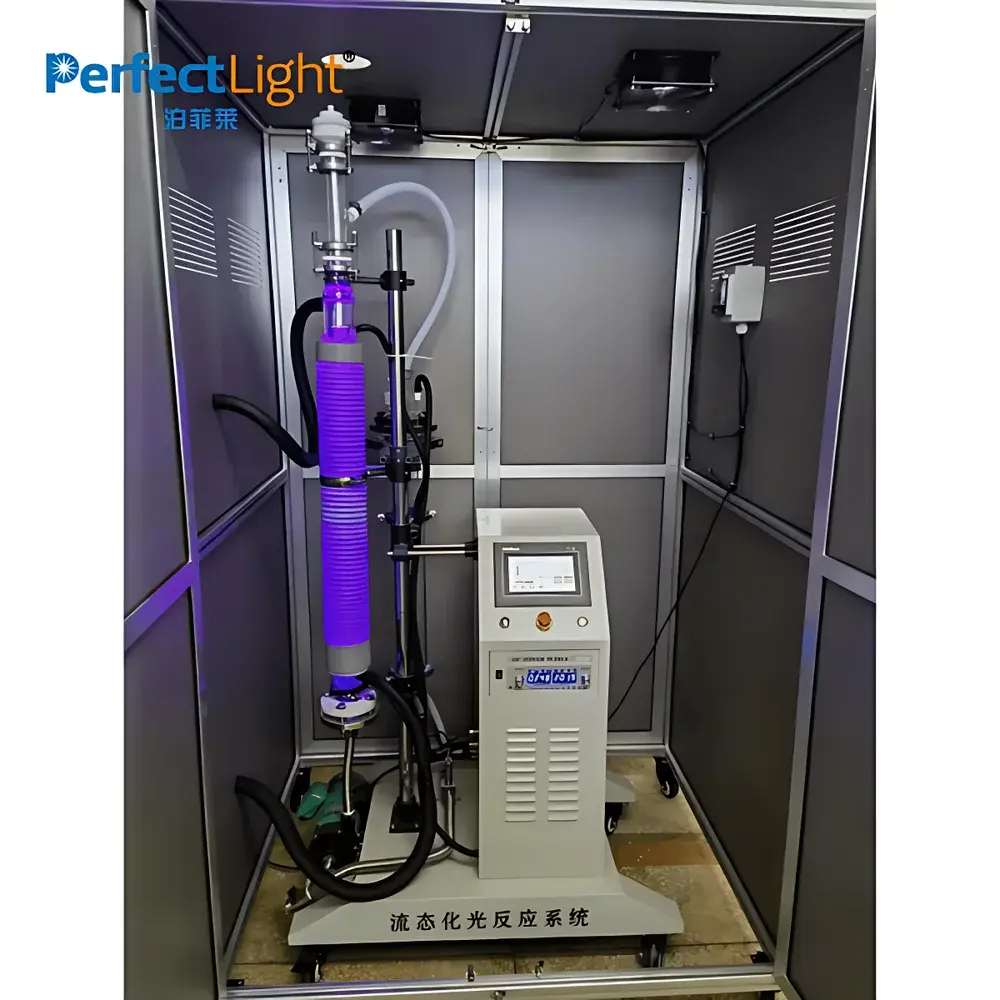
Fluidized Photoreactor System PF-LFR-1000
| Brand | PerfectLight |
|---|---|
| Origin | Beijing, China |
| Reactor Type | Tubular Fluidized-Bed Photoreactor |
| Effective Reaction Volume | ~1 L (customizable) |
| Operating Temperature | Ambient |
| Operating Pressure | Atmospheric |
| Temperature Control | Jacketed Water Bath |
| Solid Catalyst Loading Capacity | Up to 100 g per run |
| Fluidization Control | Adjustable Flow Rate & Cycle Timing |
| Particle Size Range | >3 mm (recommended) |
| Reservoir Tank Volume | 5 L |
| Light Source | 350 W UV-LED Array |
| Wavelength | 385 nm (optional wavelengths available) |
| Light Intensity Control | 10–99.99% stepless dimming |
| Cabinet Dimensions | 1000 × 700 × 1840 mm |
| Net Weight | ~100 kg |
Overview
The PerfectLight PF-LFR-1000 Fluidized Photoreactor System is an engineered solution for heterogeneous photocatalytic reactions under ambient temperature and atmospheric pressure conditions. It operates on the principle of fluidized-bed photoreaction dynamics, where solid photocatalysts—such as TiO₂, g-C₃N₄, or metal-organic frameworks—are suspended in a continuous liquid phase via precisely controlled upward flow. This configuration ensures uniform irradiation exposure across the catalyst surface while simultaneously enhancing mass transfer between the solid active sites and dissolved reactants. Unlike conventional slurry reactors requiring post-reaction filtration or fixed-bed systems suffering from channeling and light attenuation, the PF-LFR-1000 maintains high photon utilization efficiency through axial light penetration into the fluidized zone and minimizes catalyst attrition via optimized particle size selection (>3 mm). Its tubular geometry supports scalable hydrodynamic characterization and enables direct integration with inline UV-Vis monitoring or effluent sampling ports for kinetic studies.
Key Features
- Tubular fluidized-bed architecture designed for reproducible solid–liquid photocatalytic operation
- Integrated 350 W UV-LED array with center wavelength at 385 nm, offering narrow spectral bandwidth and long operational lifetime (>10,000 h)
- Stepless light intensity control (10–99.99%) enabling precise dosimetry for quantum yield determination
- Jacketed water bath temperature regulation system compatible with external chillers or heaters for extended thermal range validation
- Modular reservoir tank (5 L capacity) with level-sensing and recirculation pump supporting continuous or batch-recirculation modes
- Robust stainless-steel and borosilicate glass construction compliant with laboratory chemical resistance standards
- Front-access cabinet design (1000 × 700 × 1840 mm) facilitating maintenance, catalyst loading, and optical alignment
Sample Compatibility & Compliance
The PF-LFR-1000 accommodates a broad spectrum of solid photocatalysts—including granulated oxides, doped semiconductors, and supported noble metals—as long as particle dimensions exceed 3 mm to ensure stable fluidization without entrainment. It supports aqueous, alcoholic, and low-viscosity organic media (e.g., acetonitrile, methanol/water mixtures) with compatibility verified per ASTM D471 and ISO 1817 guidelines for elastomer seals. The system adheres to IEC 61000-6-3 (EMC emission limits) and IEC 61010-1 (safety requirements for electrical equipment for measurement, control, and laboratory use). While not certified for explosion-proof operation, it may be deployed in Class I, Division 2 environments when used with non-volatile solvents and proper ventilation.
Software & Data Management
The reactor integrates with PerfectLight’s optional PC-based control interface (PF-Control Suite v3.x), supporting real-time logging of flow rate, LED power output, bath temperature, and cumulative irradiation dose (J·cm⁻²). All parameters are timestamped and stored in CSV-compatible format for traceability. Audit trails comply with GLP documentation requirements, and data export functions support alignment with LIMS platforms. The software includes preconfigured protocols for common photocatalytic oxidation (e.g., phenol degradation per ISO 10678) and reduction assays (e.g., Cr(VI) to Cr(III)), facilitating method transfer across laboratories.
Applications
- Kinetic modeling of heterogeneous photocatalytic pathways under controlled hydrodynamics
- Screening of novel visible-light-responsive catalysts in continuous-flow configurations
- Photocatalytic water treatment studies targeting micropollutants (pharmaceuticals, endocrine disruptors)
- Solar fuel synthesis research, including CO₂ reduction and H₂ evolution using sacrificial reagents
- Stability and deactivation profiling of immobilized catalysts over extended operational cycles
- Scale-up correlation studies bridging benchtop fluidized photoreactors to pilot-scale units
FAQ
Can the PF-LFR-1000 operate under elevated pressure or temperature?
No—it is designed exclusively for ambient-temperature, atmospheric-pressure operation. Modifications for pressurized service require third-party engineering review and are outside standard warranty coverage.
Is the 385 nm light source replaceable with other wavelengths?
Yes—PerfectLight offers interchangeable LED modules spanning 254 nm to 525 nm; custom spectral profiles require lead-time consultation.
What is the minimum required liquid flow rate to achieve stable fluidization?
This depends on particle density and diameter; typical onset occurs at 0.8–1.2 cm/s for 3–5 mm spherical catalysts in water—verified experimentally during system commissioning.
Does the system include analytical interfaces for online monitoring?
Standard configuration includes 1/4″ Swagelok ports for in-line UV-Vis spectrophotometers or pH/conductivity probes; integration kits are available as accessories.
Is training provided for operation and maintenance?
Yes—PerfectLight delivers remote and on-site operator training covering safety protocols, fluidization tuning, light calibration, and routine seal inspection.



