
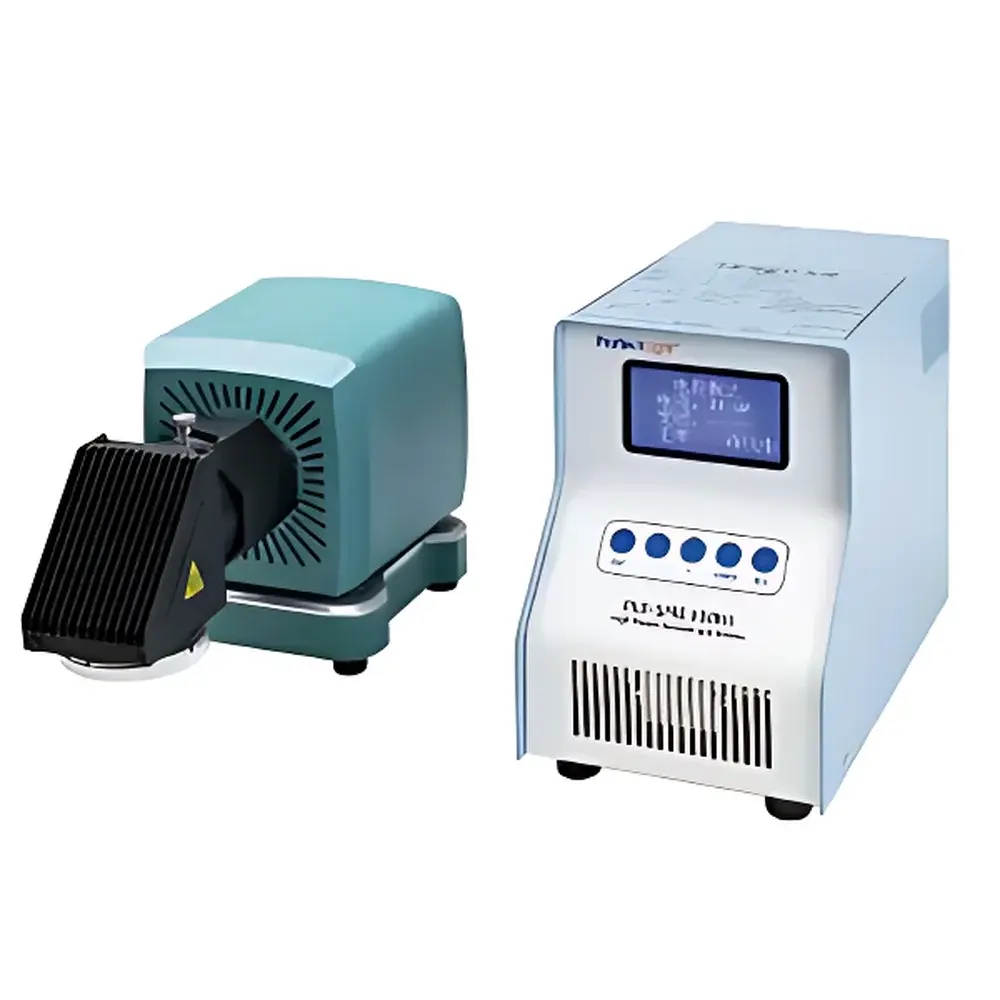
PLS-SME300E H1 Xenon Light Source
| Brand | PerfectLight |
|---|---|
| Origin | Beijing, China |
| Model | PLS-SME300E H1 |
| Light Source Type | Xenon Arc Lamp |
| Illumination Mode | External Irradiation |
| Lamp Power | 300 W |
| Total Optical Output | 50 W |
| Spectral Range | 320–780 nm (extendable to 2500 nm) |
| Beam Diameter | 30–60 mm |
| Maximum Irradiance | >4200 mW/cm² |
| Long-Term Stability | ≤±3% |
| Power Supply Stability | ±0.3% (instantaneous) |
| Current Limit Adjustment | up to 25 A |
| Lamp Lifetime | >1000 h |
| Triggering | Integrated High-Voltage Ignition (two-stage, no high-voltage cabling) |
| Control Modes | Constant Current / Constant Irradiance |
| Feedback System | Precision Optical Photometric Feedback |
| Cooling Architecture | Redesigned Forced-Air Thermal Management |
| Interface | RS232/Ethernet-enabled Host PC Software Control |
| Safety Features | Fan-fault shutdown, auto-startup, delayed shutdown, over-current/over-load protection |
| Compliance | Designed for GLP-compliant photoreactor integration and ISO/IEC 17025-aligned optical calibration workflows |
Overview
The PLS-SME300E H1 Xenon Light Source is a high-intensity, externally irradiating broadband light source engineered for precision photonic and photo-thermal catalytic research. It employs a stabilized 300 W short-arc xenon lamp operating under constant-current or constant-irradiance feedback control, delivering spectrally continuous output from 320 nm to 780 nm—with optional extension into the near-infrared up to 2500 nm via compatible optics. Its optical architecture integrates a proprietary collimation and homogenization pathway, achieving a maximum irradiance exceeding 4200 mW/cm² at the sample plane—more than double the typical irradiance of conventional xenon systems. This performance enables rigorous simulation of solar spectral irradiance (AM1.5G), while supporting demanding applications in photocatalysis, photoelectrocatalysis, and photothermal conversion where photon flux density, spectral fidelity, and temporal stability are critical parameters.
Key Features
- Optical photometric feedback loop enabling real-time irradiance stabilization (≤±3% over 8 h), independent of lamp aging or thermal drift
- Dual operational modes: constant current (for reproducible lamp electrical loading) and constant irradiance (for dose-controlled experiments)
- Integrated high-voltage ignition system with two-stage voltage ramping—eliminating hazardous high-voltage transmission through external cables
- Redesigned forced-air thermal management architecture, reducing thermal load on the lamp envelope and extending operational lifetime beyond 1000 hours
- RS232 and Ethernet interfaces supporting full remote control via Windows-based host software—including programmable timer shutdown, irradiance logging, and fault diagnostics
- Digital front-panel display with real-time current readout and status indicators for lamp ignition, cooling, and safety interlocks
Sample Compatibility & Compliance
The PLS-SME300E H1 is designed for seamless integration with standard photochemical and photothermal reactor platforms—including PerfectLight’s PLR-RP series reaction evaluation systems and PLR-PSTRⅡ photothermal reactors—via interchangeable optical couplers (e.g., right-angle light guides, lens assemblies, liquid light guides). Its external irradiation geometry avoids internal lamp heating of reaction vessels, preserving thermal integrity during coupled photo-thermal studies. The system complies with IEC 61000-6-3 (EMC emission standards) and incorporates safety interlocks aligned with IEC 61010-1 for laboratory electrical equipment. Its stable spectral output supports traceable calibration against NIST-traceable reference detectors, facilitating compliance with ISO/IEC 17025 requirements for photometric measurement uncertainty reporting in accredited labs.
Software & Data Management
The included host PC software provides a validated interface for experiment orchestration and data traceability. Users may define multi-step irradiation protocols with time-stamped start/stop triggers, set irradiance thresholds, and log real-time photometric output alongside system telemetry (fan RPM, lamp voltage, temperature sensors). Audit trails record all parameter changes, user logins, and system events—supporting adherence to FDA 21 CFR Part 11 principles when deployed in regulated R&D environments. Export formats include CSV and XML, enabling direct ingestion into LIMS or statistical analysis platforms (e.g., MATLAB, Python pandas). Firmware updates are delivered via signed binary packages with checksum verification.
Applications
- Photocatalysis: Water splitting (H₂/O₂ evolution), CO₂ reduction, and organic pollutant degradation under simulated solar illumination
- Photo-thermal catalysis: Coupled light-heat activation of plasmonic and semiconductor catalysts requiring high photon flux and thermal decoupling
- Photoelectrocatalysis: In situ illumination of working electrodes in three-electrode electrochemical cells
- Photobiology & materials science: UV–vis–NIR exposure studies for photopolymerization, photochromism, thin-film photostability, and quantum dot synthesis
- Calibration & metrology: Reference source for spectroradiometer validation, actinometry, and quantum yield determination
FAQ
What spectral range does the PLS-SME300E H1 cover, and can it be extended?
The base configuration delivers continuous output from 320 nm to 780 nm. With appropriate quartz optics and IR-transmitting filters, spectral coverage extends to 2500 nm.
How is irradiance stability maintained over time?
A closed-loop optical feedback system continuously monitors output using a calibrated photodiode, dynamically adjusting power supply output to maintain setpoint irradiance within ±3% over extended operation.
Is the system compatible with third-party reactors or custom optical setups?
Yes—the external irradiation design, modular beam delivery accessories (e.g., fiber couplers, homogenizers, adjustable apertures), and standard RS232/Ethernet protocols support integration with non-PerfectLight reactors and OEM instrumentation.
What safety certifications apply to this light source?
The unit conforms to IEC 61010-1 (safety of laboratory equipment) and IEC 61000-6-3 (EMC emissions). All high-voltage components are fully enclosed; no external HV cabling is required.
Can irradiance be measured directly at the sample position?
Yes—optional calibrated optical power meters and fiber-coupled spectroradiometers are available for in-situ, spatially resolved irradiance mapping and spectral characterization.






