
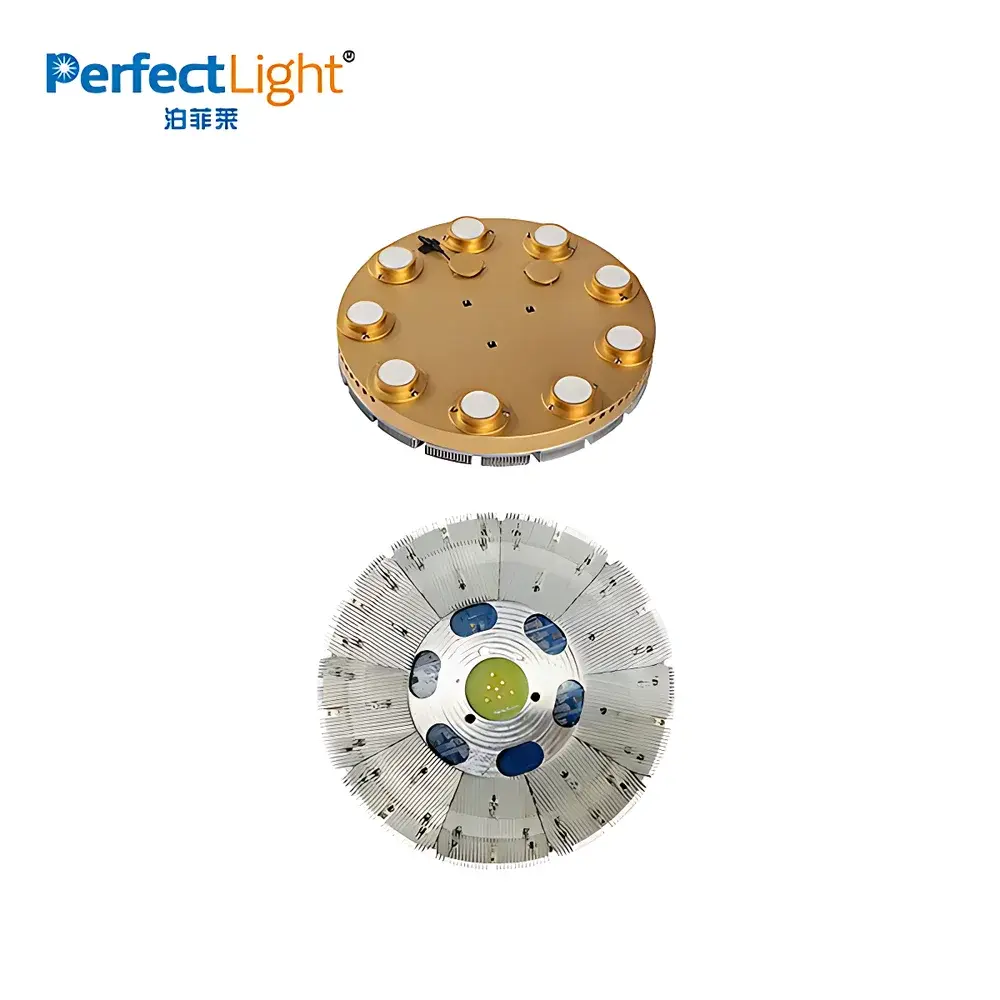
PerfecLight SLight Solar Simulator Light Disk
| Brand | PerfecLight |
|---|---|
| Origin | Beijing, China |
| Manufacturer Type | Authorized Distributor |
| Product Origin | Domestic (China) |
| Model | SLight |
| Light Source Type | Tunable Multi-LED Array |
| Illumination Mode | External Irradiation |
| Spectral Range | 360–760 nm (AM1.5G-UV), 400–760 nm (AM1.5G-V) |
| Spectral Match Accuracy | ±10% @ 50 nm bandwidth (exceeding IEC 60904-9 Class A requirement) |
| Irradiance Output | >250 mW/cm² |
| LED Module Power Rating | ≥18 W per unit |
| Constant-Current Driver Resolution | 1 mA |
| Absolute Current Accuracy | ±2 mA |
Overview
The PerfecLight SLight Solar Simulator Light Disk is a high-fidelity, externally mounted multi-LED light source engineered for precision photonic simulation in controlled laboratory environments. Unlike broadband arc lamps or filtered halogen sources, the SLight employs a spectrally programmable array of discrete high-power LEDs, each independently addressable and calibrated to deliver tunable irradiance across the 360–760 nm range. Its core function is to replicate the AM1.5G reference solar spectrum—defined by ASTM G173-03 and IEC 60904-3—with spectral match accuracy of ±10% over 50 nm intervals, surpassing the ±12.5% tolerance threshold required for Class A solar simulators per IEC 60904-9:2020. This performance is achieved through factory-traceable spectral radiometric calibration, with individual LED channel intensity controlled via high-stability constant-current drivers featuring 1 mA resolution and ±2 mA absolute current accuracy. The system operates in external irradiation mode, enabling non-invasive integration with optical benches, reaction chambers, and multi-channel photoreactor platforms such as the PCX50C Photoreactor System.
Key Features
- Spectrally programmable output: Users can define custom spectral profiles by adjusting relative intensities of discrete LED channels—enabling emulation not only of AM1.5G but also of AM0, AM1.0, or user-defined band-limited spectra (e.g., UV-selective, visible-only, or NIR-enhanced).
- High irradiance uniformity: Engineered optical collimation and beam homogenization ensure spatial irradiance uniformity better than ±5% across a 50 mm diameter target area at standard working distance.
- Thermal management architecture: Active forced-air cooling maintains LED junction temperature stability within ±2°C during continuous operation, minimizing spectral drift and intensity degradation over time.
- Modular scalability: The SLight disk supports expansion via additional LED module slots, allowing future spectral range extension into deep UV (760 nm) upon hardware upgrade and recalibration.
- Compliance-ready control interface: RS-485 and USB-C digital interfaces support integration with LabVIEW, Python-based automation frameworks, and SCADA systems—enabling synchronized triggering, real-time power logging, and audit-trail-capable operation under GLP/GMP workflows.
Sample Compatibility & Compliance
The SLight is compatible with standard quartz cuvettes, flat-panel photovoltaic test cells (e.g., Si, GaAs, perovskite), powder-coated photocatalyst films on glass substrates, and immobilized enzyme layers in optically transparent microreactors. Its external illumination geometry avoids thermal loading on sensitive samples—critical for quantum yield measurements where sample temperature must remain below 40°C. The device complies with key photometric and safety standards including IEC 62471 (Photobiological Safety), IEC 61000-6-3 (EMC Emission), and ISO/IEC 17025 traceability requirements when operated with NIST-traceable spectroradiometric validation reports. For regulated photovoltaic testing, spectral match data are provided in accordance with IEC 60904-9 Annex B reporting conventions.
Software & Data Management
The SLight is operated via PerfecLight’s LightControl v3.2 software suite, which provides GUI-driven spectral profile design, real-time irradiance monitoring, and automated calibration verification routines. All intensity setpoints, spectral configurations, and operational timestamps are logged in SQLite-formatted database files compliant with FDA 21 CFR Part 11 requirements—including electronic signatures, audit trails, and user-access-level permissions. Export options include CSV, HDF5, and XML formats suitable for downstream analysis in MATLAB, OriginLab, or Python (via Pandas/NumPy). Remote operation via TCP/IP is supported for integration into centralized lab informatics systems.
Applications
- Quantum yield determination of photocatalysts (e.g., TiO₂, g-C₃N₄, MOFs) under standardized AM1.5G illumination, per ISO 25922 and ASTM E261.
- Photoelectrochemical cell characterization, including incident photon-to-current efficiency (IPCE) mapping and stability testing under controlled spectral stress.
- Accelerated photostability assessment of organic semiconductors, OLED materials, and dye-sensitized solar cell components.
- Multi-wavelength kinetic studies in homogeneous and heterogeneous photochemistry, enabled by rapid spectral reconfiguration (<500 ms between profiles).
- Calibration reference source for spectroradiometers and imaging colorimeters requiring stable, repeatable spectral irradiance.
FAQ
What spectral calibration documentation is supplied with the SLight?
Each unit ships with a NIST-traceable spectroradiometric calibration certificate covering all default spectral modes (AM1.5G-UV, AM1.5G-V), including full spectral irradiance data (W/m²/nm) at 1 nm resolution and uncertainty budgets per CIE S 025/E:2015.
Can the SLight be used for UV-A/UV-B photobiological exposure studies?
Yes—when configured with optional 315–400 nm LED modules and operated with appropriate irradiance limiting and dosimetry validation, it supports protocols aligned with ISO 17166/CIE S 007/E and IEC 62471 risk group classification.
Is remote firmware update supported?
Yes—firmware updates are delivered via signed .bin packages through the LightControl software; updates preserve all user calibration data and require dual-user authentication.
How is long-term spectral stability verified?
The system includes an integrated reference photodiode with temperature-compensated responsivity; daily self-check routines compare real-time output against baseline calibration curves and trigger alerts if deviation exceeds ±1.5% RMS across the 360–760 nm band.
Does the SLight meet requirements for ISO/IEC 17025-accredited laboratories?
Yes—when deployed with documented calibration intervals (recommended annually), validated environmental controls (23±2°C, <60% RH), and full audit-log retention, it satisfies clause 6.4.10 (Equipment Verification) and clause 7.7.1 (Measurement Traceability) of ISO/IEC 17025:2017.




