
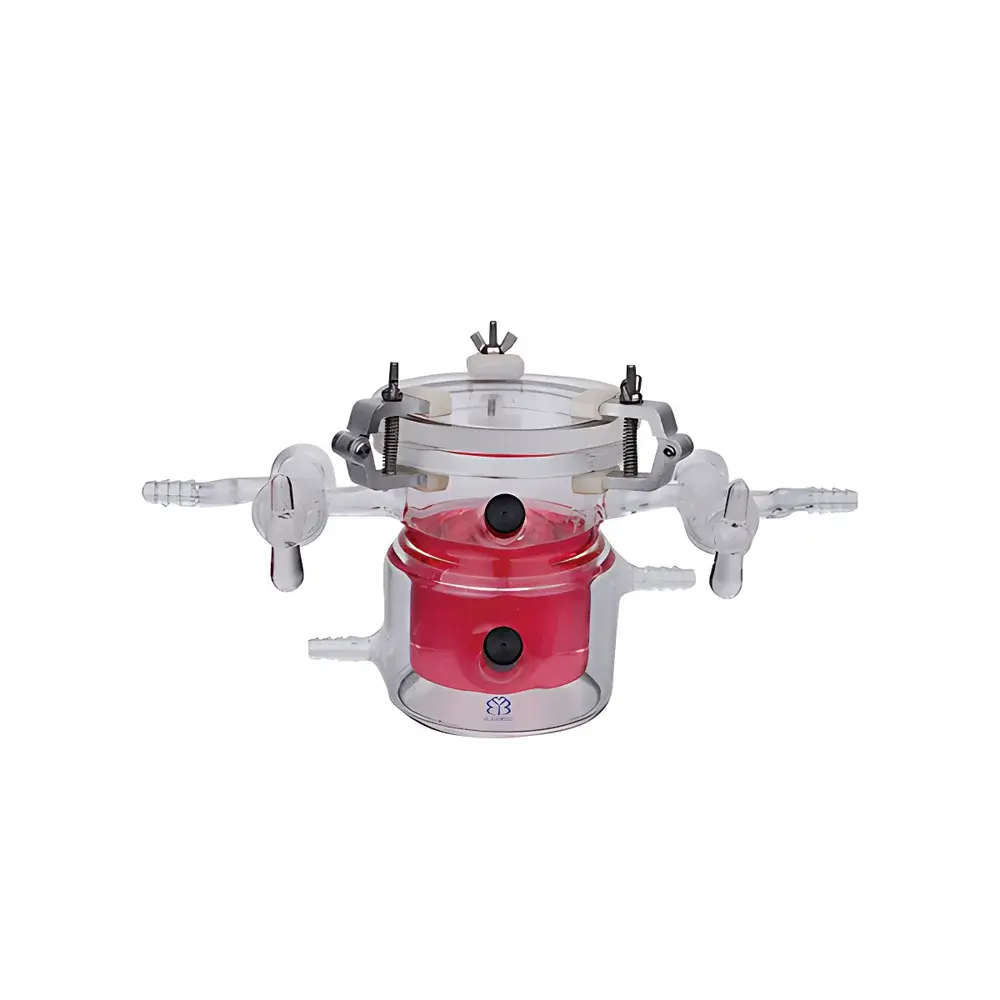
Photoreactor PQ256 by PerfectLight
| Brand | PerfectLight |
|---|---|
| Origin | Beijing, China |
| Manufacturer Type | Authorized Distributor |
| Origin Category | Domestic (China) |
| Model | PQ256 |
| Pricing | Upon Request |
| Reactor Type | Top-Illumination Photoreactor |
| Optical Window | JGS-2 Fused Quartz (Flat Plate or Double-Wall Quartz Jacket Options) |
| Reactor Body | 400 mL Borosilicate Glass |
| Effective Reaction Volume | ~250 mL |
| Sealing | Flanged Connection with Viton/EPDM O-Ring Seal |
| Gas Inlet/Outlet Ports | Equipped with Precision Needle Valves |
| Liquid Sampling Port | Glass External Thread + Silicone Septum (Non-Invasive Sampling) |
| Gas Purge Capability | Dual Inlet/Outlet for Inert/Reactive Atmosphere Control |
| Optional Add-ons | Standard Tapered Ground-Joint Expansion Ports (e.g., 14/20, 24/29), Glass Ball Valves, Additional Sampling Valves, Custom-Mounted Thermocouple Wells |
Overview
The PerfectLight PQ256 is a top-illuminated, bench-scale photoreactor engineered for controlled heterogeneous and homogeneous photocatalytic reactions under UV–visible irradiation. Designed around fundamental principles of photochemical kinetics and mass transfer, the PQ256 enables precise spatial and temporal control of photon flux delivery to the reaction medium while maintaining strict thermal and atmospheric regulation. Its core architecture follows the Couette-type illumination geometry—where incident light enters vertically through a high-transmittance JGS-2 fused quartz optical window—ensuring minimal spectral attenuation (<0.5% absorption at 185–2500 nm) and uniform irradiance distribution across the liquid–solid interface. The reactor operates as a sealed, pressure-tolerant vessel (rated to 0.3 MPa gauge), supporting both open-circuit gas exchange and closed-loop recirculation configurations. It is widely deployed in academic and industrial R&D laboratories investigating TiO₂-mediated organic pollutant degradation, CO₂ photoreduction, water splitting, and advanced oxidation processes (AOPs) compliant with ISO 10676:2021 and ASTM E2997–22 test protocols.
Key Features
- Top-illumination configuration with interchangeable JGS-2 quartz windows: flat plate (for collimated lamp systems) or double-wall jacket (for temperature-stabilized irradiation)
- 400 mL borosilicate glass body with ~250 mL effective working volume; calibrated meniscus mark for volumetric accuracy
- Integrated thermostatic water jacket with dual-port inlet/outlet (1/4″ NPT) compatible with external chillers or heating circulators (±0.2 °C stability)
- Flanged main seal using chemically resistant elastomeric O-rings (Viton standard; EPDM optional) ensuring leak rates <1×10⁻⁹ mbar·L/s He per ISO 20487
- Dual gas ports fitted with stainless steel needle valves (Swagelok SS-4S2) for controlled inertization (N₂, Ar) or reactive gas dosing (O₂, H₂, CO₂)
- Non-invasive liquid sampling port featuring 10 mm outer-thread glass stem and replaceable silicone septum—enabling repeated extraction without system depressurization
- Standard ground-joint expansion ports (14/20 and 24/29 taper options) for modular integration of condensers, reflux lines, pH electrodes, or online spectrophotometric flow cells
Sample Compatibility & Compliance
The PQ256 accommodates a broad range of sample matrices including aqueous suspensions (e.g., P25 TiO₂, g-C₃N₄ dispersions), organic solvent-based photocatalysts (acetonitrile, methanol), and multiphase emulsions. Its inert quartz/glass construction ensures compatibility with strong oxidants (H₂O₂, persulfate), acidic/basic media (pH 1–13), and halogenated compounds. All wetted materials comply with USP Class VI and ISO 10993–5 cytotoxicity requirements. The reactor design supports GLP-compliant workflows: traceable batch records, audit-ready sealing verification logs, and compatibility with FDA 21 CFR Part 11–enabled data acquisition systems when paired with validated sensors (e.g., dissolved O₂ probes, inline UV-Vis absorbance modules).
Software & Data Management
While the PQ256 is a hardware-centric platform, it integrates seamlessly with third-party process monitoring ecosystems. Analog outputs (0–5 V / 4–20 mA) from external thermocouples, pressure transducers, or gas analyzers can be logged via LabVIEW™, MATLAB® Data Acquisition Toolbox, or DeltaV™ DCS environments. Optional digital I/O modules support TTL-triggered shutter control synchronized with irradiance meters (e.g., ILT950UV). All mechanical interfaces adhere to SEMI F20–1998 standards for vacuum and fluid interconnects, facilitating reproducible setup replication across multi-lab consortia conducting interlaboratory validation studies (e.g., under OECD TG 316 or ISO/IEC 17025 accreditation).
Applications
- Kinetic modeling of semiconductor photocatalysis (e.g., apparent quantum yield determination per ISO 25813:2020)
- Screening of visible-light-responsive catalysts (e.g., BiVO₄, Cu₂O) under AM1.5G-simulated solar irradiation
- Long-term stability testing of photocatalytic coatings under cyclic illumination–dark conditions
- In situ FTIR or Raman spectroscopy coupling via side-arm optical access ports
- Photoelectrochemical cell pre-conditioning and dark-current baseline establishment
- Regulatory-compliant photostability assessment of pharmaceutical intermediates (ICH Q1B)
FAQ
Can the PQ256 be used under vacuum or elevated pressure?
Yes—the flanged assembly and O-ring seal are rated for operation between 1×10⁻³ mbar and 0.3 MPa gauge pressure.
Is the quartz window suitable for deep-UV (185 nm) irradiation?
Yes—JGS-2 fused quartz exhibits >85% transmission at 185 nm and is certified for ozone-generating mercury lamp applications.
How is temperature uniformity maintained across the reaction volume?
The integrated water jacket provides radial thermal conduction; combined with magnetic stirring (recommended ≥400 rpm), axial temperature gradients remain ≤±0.5 °C (measured at three radial positions).
Are custom port configurations available for OEM integration?
Yes—PerfectLight’s in-house reactor engineering team offers CAD-supported customization including DIN 2817–compliant flange layouts, welded sensor bosses, and laser-etched calibration markings.
Does the system include documentation for quality assurance audits?
Each unit ships with a Factory Acceptance Test (FAT) report, material traceability certificates (quartz lot #, glass annealing log), and dimensional inspection records per ISO 9001:2015 Annex A.
Related Products



