
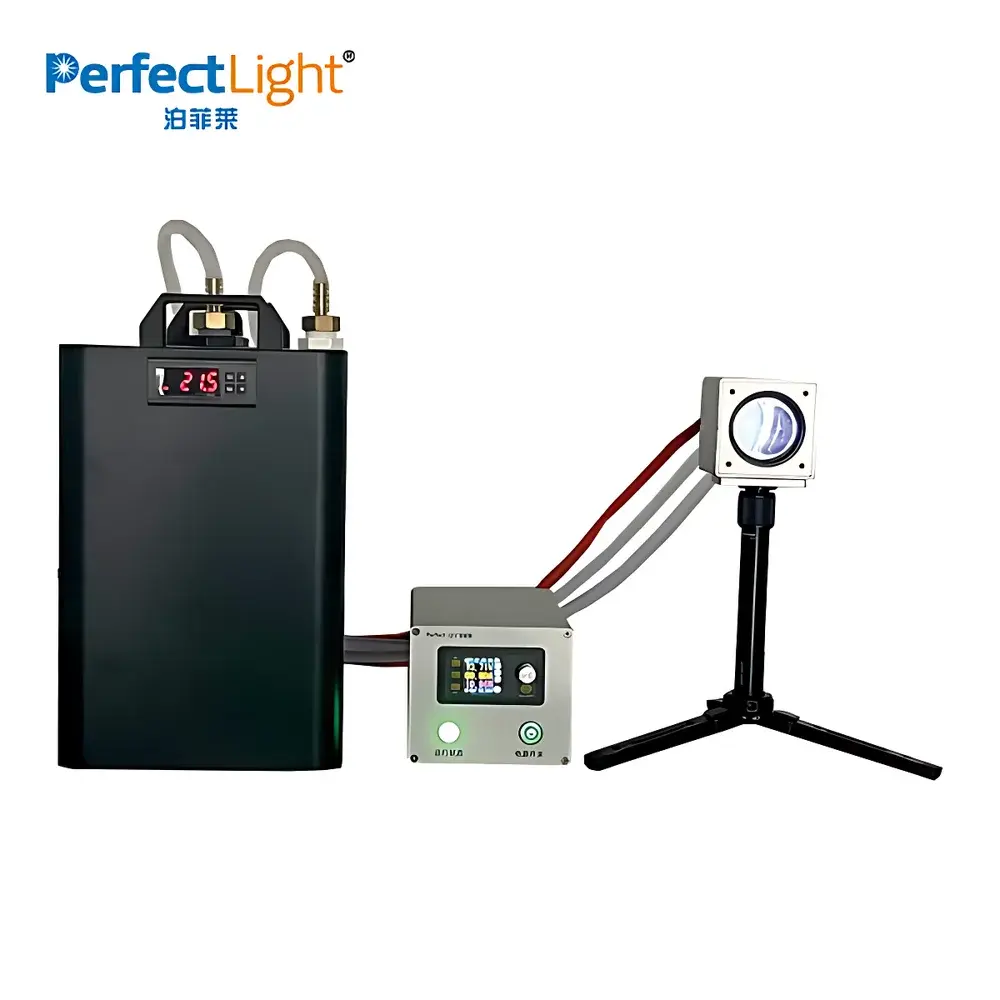
PerfecLight PLS-LCC Liquid-Cooled Collimated LED Light Source
| Brand | PerfecLight |
|---|---|
| Origin | Beijing, China |
| Manufacturer Type | Authorized Distributor |
| Product Category | Domestic |
| Model | PLS-LCC |
| Light Source Type | High-Power Narrow-Band LED |
| Illumination Mode | External Irradiation |
| Cooling Method | Active Liquid Cooling (Integrated Chiller) |
| Wavelength Options | 365 nm, 385 nm, 415 nm, 450 nm (±5 nm peak tolerance) |
| Spectral Bandwidth (FWHM) | ≤30 nm |
| Beam Divergence (Full Angle) | ≤9.5° |
| Output Uniformity | ≥90% over Ø29.5 mm (measured at exit aperture), ≥85% over Ø10 mm |
| Maximum Irradiance | ≥3.0 W/cm² @ 385 nm (at Ø15 mm output port, 108.3 W optical power) |
| LED Drive Current Range | Adjustable up to 7.5 A |
| Max. Electrical Power (Source) | 120 W |
| Max. Electrical Power (Controller) | 200 W |
| Chiller Setpoint Temperature | Default 15 °C (recommended ≤15 °C) |
| Operating Ambient | 0–30 °C, non-condensing, non-freezing |
| Storage Conditions | −10–60 °C, 30–85% RH (non-condensing) |
| Source Dimensions | 75 × 75 × 86 mm |
| Controller Dimensions | 120 × 103 × 200 mm |
| Chiller Model | PLS LED-LC200 |
Overview
The PerfecLight PLS-LCC Liquid-Cooled Collimated LED Light Source is an engineered illumination system designed for precision photochemical and photophysical experimentation in controlled laboratory environments. Unlike broadband arc lamps or uncollimated LEDs, the PLS-LCC integrates high-radiance monochromatic LED emitters with a precision collimation optic train and active liquid thermal management—enabling stable, directional, spectrally defined irradiation essential for quantitative photocatalysis, quantum yield determination, and optoelectronic device testing. Its core architecture follows collimated beam principles grounded in paraxial ray optics: light emitted from a high-power chip array passes through a custom-designed aspheric condenser and multi-element collimating lens group fabricated from fused silica and BK7 optical glass, minimizing chromatic aberration and maximizing spatial coherence. The system operates exclusively in external irradiation mode, delivering a near-parallel beam (full divergence ≤9.5°) suitable for coupling into reactor windows, integrating spheres, or optical benches without secondary focusing optics.
Key Features
- High spatial uniformity: ≥90% irradiance uniformity across Ø29.5 mm field (IEC 60825-1 compliant measurement zone), validated via NIST-traceable radiometric mapping; ≥85% uniformity maintained over central Ø10 mm region critical for microreactor illumination.
- Liquid-cooled thermal regulation: Integrated PLS LED-LC200 chiller maintains junction temperature stability within ±0.3 °C at setpoints down to 15 °C, suppressing wavelength drift (<0.02 nm/°C) and radiant flux decay (<0.5% over 8 h continuous operation).
- Wavelength-flexible platform: Interchangeable LED modules support discrete peaks at 365 nm (±5 nm), 385 nm, 415 nm, and 450 nm, each with FWHM ≤30 nm—enabling selective excitation aligned with absorption maxima of photocatalysts (e.g., TiO₂ UV-A response, g-C₃N₄ visible absorption) or photoinitiators.
- Ozone-free and low-EMI operation: Solid-state emission eliminates UV-C generation and associated ozone formation; EMI emissions comply with CISPR 11 Group 1 Class B limits for laboratory instrumentation.
- Passive safety architecture: Dual-stage thermal protection includes semiconductor junction monitoring and chiller flow interruption—automatically de-energizing the LED driver if coolant flow drops below 0.8 L/min or source housing exceeds 65 °C.
Sample Compatibility & Compliance
The PLS-LCC is compatible with standard quartz and fused silica optical interfaces (e.g., 25.4 mm or 50.8 mm diameter viewports) used in sealed photochemical reactors, including plate-type microchannel reactors, thin-film flow cells, and slurry-phase photocatalytic systems where catalyst beds exceed 15 mm depth from the irradiated surface. Its collimated output minimizes vignetting and angular intensity falloff in oblique-incidence configurations. The system conforms to IEC 61000-6-3 (emissions) and IEC 61000-6-2 (immunity) for industrial environments, and meets laser safety classification requirements per IEC 60825-1:2014 as Class 3R for all configured wavelengths when operated at maximum rated output—requiring no interlocked enclosures but mandating ANSI Z136.1-compliant eyewear during alignment. It supports GLP-aligned experimental traceability via timestamped controller logs (current, voltage, chiller temp) exportable in CSV format.
Software & Data Management
The LC-DKX-020150 controller features a front-panel OLED interface with real-time display of drive current, forward voltage, chiller setpoint/actual temperature, and operational status flags. All parameters are accessible via RS-485 Modbus RTU protocol (addressable up to 31 units on single bus) for integration into LabVIEW, Python (PyModbus), or MATLAB-based automation frameworks. Firmware supports programmable ramp profiles (0–100% current in 0.1% steps, min. ramp time 100 ms) and persistent parameter storage across power cycles. Audit trails—including user-initiated current changes, thermal fault events, and chiller runtime—are retained for ≥30 days with automatic overwrite. While not FDA 21 CFR Part 11 compliant out-of-the-box, the system can be deployed within validated environments when paired with third-party electronic lab notebook (ELN) systems supporting digital signature and role-based access control.
Applications
- Quantitative photocatalysis studies requiring reproducible actinic flux: e.g., CO₂ reduction, H₂ evolution, and organic pollutant degradation under ASTM E2057-22-defined irradiance conditions.
- Photopolymerization kinetics in microfluidic 3D printing platforms, where collimation ensures uniform depth-of-cure across layer thicknesses <50 µm.
- Photoelectrochemical cell characterization (PEC), particularly for bias-dependent incident photon-to-current efficiency (IPCE) measurements requiring stable, monochromatic illumination.
- Accelerated photostability testing of pharmaceuticals per ICH Q1B guidelines, using 365 nm or 385 nm bands to simulate UV degradation pathways.
- Calibration of spectroradiometers and reference photodiodes traceable to NIST SRM 2252 or similar transfer standards.
FAQ
What is the recommended chiller setpoint temperature for long-term LED lifetime?
We recommend operating the PLS LED-LC200 chiller at 15 °C or lower. Maintaining junction temperature ≤35 °C extends median LED lifetime to >20,000 hours (L70 rating per TM-21-11).
Can the PLS-LCC be synchronized with shutter systems or pulse generators?
Yes—the controller provides TTL-compatible external trigger input (5 V logic, opto-isolated) supporting gated operation down to 10 ms pulse width with jitter <1 µs.
Is spectral recalibration required after module replacement?
No. Each LED module is factory-calibrated with individual radiometric correction coefficients stored in its EEPROM; the controller auto-reads and applies these upon hot-swap insertion.
Does the system support vacuum or inert-gas purged reactor integration?
Yes—optical output is delivered via a hermetically sealed Ø39 mm quartz window (10 mm thick, AR-coated 350–450 nm); optional CF-35 flange mounting kits are available for UHV-compatible installations.
How is irradiance uniformity verified during factory acceptance testing?
Each unit undergoes full-field radiometric mapping using a calibrated CCD-based imaging spectroradiometer (Instrument Systems CAS 140D) at three axial positions (0 mm, +5 mm, −5 mm relative to focal plane), with data archived in the shipping certificate.





