
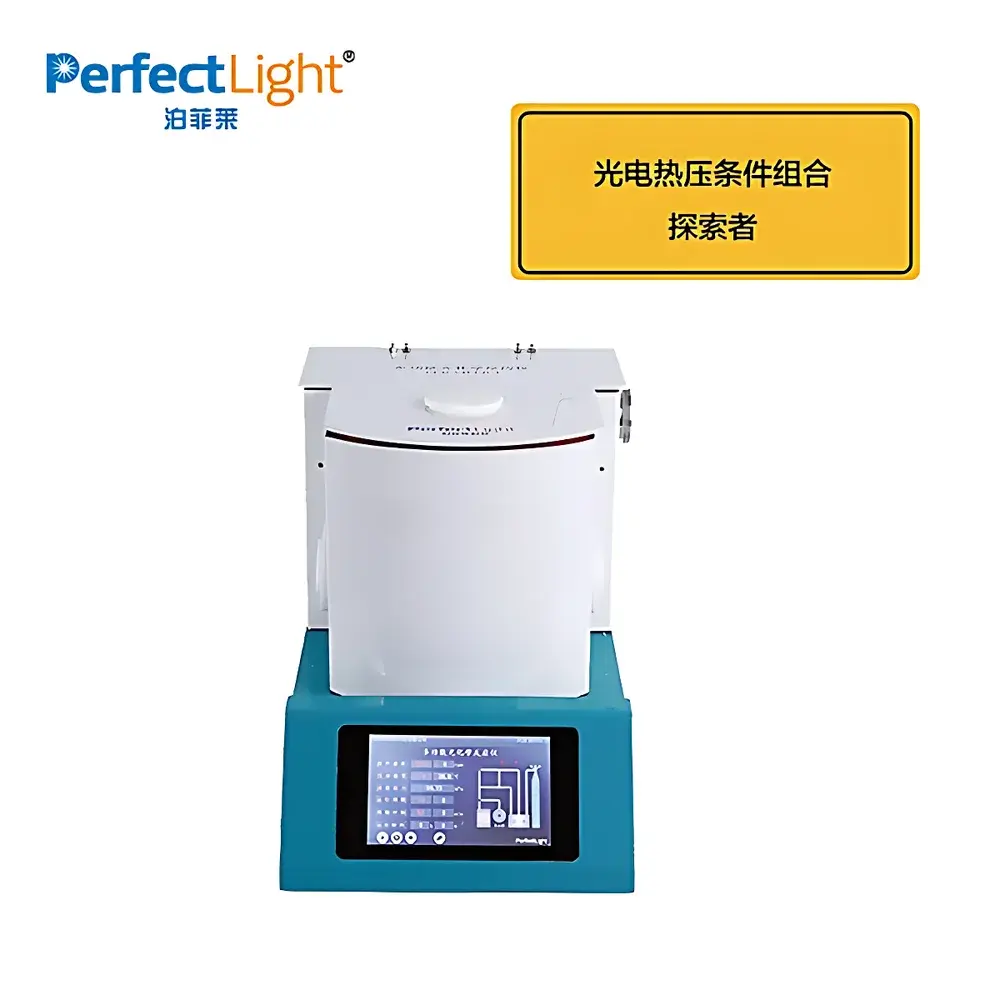
PerfectLight PLR MFPR-I Multifunctional Photochemical Reactor
| Brand | PerfectLight |
|---|---|
| Origin | Beijing, China |
| Model | PLR MFPR-I |
| Temperature Range | Ambient to 180 °C |
| Temperature Control Accuracy | ±0.5 °C |
| Operating Pressure Range | −50 kPa to 0.9 MPa (gauge), i.e., 50–1000 kPa (absolute) |
| Reaction Vessel Material | Stainless Steel with Borosilicate Glass Liner |
| Effective Reaction Volume | 100 mL (total internal volume: 120 mL) |
| Sampling Pressure Range | 80–900 kPa (absolute) |
| Minimum Sampling Interval | 3 min |
| Gas Sample Volume per Cycle | 100 μL |
| Gas Consumption per Sampling | ~0.5 mL |
| Magnetic Stirring Speed | 200–1500 rpm |
| Stirring Accuracy | ±1 rpm |
Overview
The PerfectLight PLR MFPR-I Multifunctional Photochemical Reactor is an engineered platform for controlled, high-fidelity photochemical and photoelectrochemical experimentation under combined thermal, pressure, optical, and electrochemical stimuli. Designed around Couette-type magnetic stirring and a dual-sealed, pressure-rated reactor architecture, it enables reproducible operation across heterogeneous reaction systems—including solid photocatalysts (powders or membranes), gas–liquid–solid triphasic environments, and liquid-phase electrochemical interfaces. Its core measurement paradigm integrates time-resolved photon delivery (via configurable irradiation geometry), precision thermal regulation, active pressure management, and automated gas-phase sampling—making it suitable for kinetic studies, quantum yield determination, and long-duration stability testing in compliance with ISO 15714 (photocatalytic air purification) and ASTM E2057 (quantum efficiency protocols).
Key Features
- Pressure-rated stainless steel reactor housing with chemically inert borosilicate glass liner—ensures compatibility with corrosive reagents, strong oxidants (e.g., H2O2, O3), and UV-transparent media without leaching or surface catalysis.
- Dual irradiation configuration: top-illuminated (collimated vertical beam path) and side-illuminated (radial quartz window) modes support both conventional suspension-based photocatalysis and thin-film or electrode-integrated PEC measurements.
- Integrated negative-pressure gas sampling system: fully automated, syringe-driven extraction at defined intervals (minimum 3 min) with precise 100 µL volumetric control; maintains system integrity during repeated sampling without manual venting or pressure equilibration.
- High-stability thermal management: PID-controlled heating jacket with ±0.5 °C accuracy over ambient to 180 °C, validated per IEC 61000-4-30 for thermal drift performance in extended experiments (>24 h).
- Programmable magnetic stirring: 200–1500 rpm range with ±1 rpm resolution, enabling laminar-to-turbulent transition control for mass-transfer-limited reactions while minimizing shear-induced catalyst attrition.
Sample Compatibility & Compliance
The PLR MFPR-I accommodates powdered semiconductors (e.g., TiO2, g-C3N4, MOFs), immobilized thin-film electrodes (FTO/TiO2, BiVO4/NiFeOx), and suspended colloidal systems. Its pressure-tight design (tested to 1.2 MPa burst pressure) supports safe operation under sub-atmospheric (−50 kPa gauge) and near-megapascal conditions—critical for CO2 reduction, high-boiling-point solvent photolysis, or low-volatility VOC degradation. The glass-lined interior complies with USP for extractables profiling and meets ISO 10993-12 requirements for non-cytotoxic material contact. Full traceability of temperature, pressure, stir speed, and sampling events satisfies GLP audit requirements per OECD Series on Principles of Good Laboratory Practice.
Software & Data Management
The reactor operates via a dedicated Windows-based control interface supporting synchronized logging of temperature, pressure, stir speed, irradiance (when paired with optional calibrated photodiode sensor), and sampling timestamps. All operational parameters are exportable in CSV/Excel format with ISO 8601 timestamping. Audit trails record user logins, parameter modifications, and emergency stop events—aligned with FDA 21 CFR Part 11 requirements for electronic records and signatures when deployed in regulated R&D environments. Optional LabVIEW or Python API integration allows third-party automation of multi-step reaction sequences (e.g., light-on/light-off cycles with concurrent gas sampling and potentiostat triggering).
Applications
- Photocatalytic water splitting (H2/O2 evolution) and overall water decomposition under controlled pO2/pH2 conditions.
- CO2 photoreduction to CH4, CO, or C2H4 using tunable pressure and co-catalyst loading strategies.
- Quantum yield determination per ISO 25922:2022 using calibrated actinometry and real-time GC/FID coupling.
- Photoelectrochemical (PEC) characterization of semiconductor electrodes under simulated solar illumination and applied bias.
- Gas-phase pollutant degradation (VOCs, NOx, SOx, formaldehyde) with in-line GC-TCD or MS detection.
- Aqueous-phase organic contaminant mineralization (dyes, phenols, pharmaceuticals) with simultaneous TOC and HPLC monitoring.
FAQ
What irradiation sources are compatible with the PLR MFPR-I?
Xenon arc lamps (with AM1.5G filters), LED arrays (365–850 nm), and mercury vapor lamps can be integrated via standardized optical ports. Custom collimation and fiber-coupled configurations are supported.
Can the system be used for electrochemical measurements?
Yes—the reactor includes three-electrode feedthroughs (working, counter, reference) rated to 1000 kPa absolute, enabling direct connection to commercial potentiostats for in-situ PEC analysis.
Is the glass liner replaceable and certified for UV transmission?
The borosilicate glass liner is user-replaceable and transmits >90% of incident light above 300 nm (per Schott BOROFLOAT® 33 specifications). UV-grade fused silica liners are available as optional accessories.
How is pressure calibration verified?
Each unit undergoes factory calibration against NIST-traceable deadweight testers; certificate of conformance includes pressure hysteresis and zero-drift data over 1000-cycle endurance testing.
Does the system support remote monitoring?
Ethernet and RS-485 interfaces enable remote parameter readout and basic control via Modbus TCP or ASCII protocol—suitable for integration into centralized lab automation networks.



