
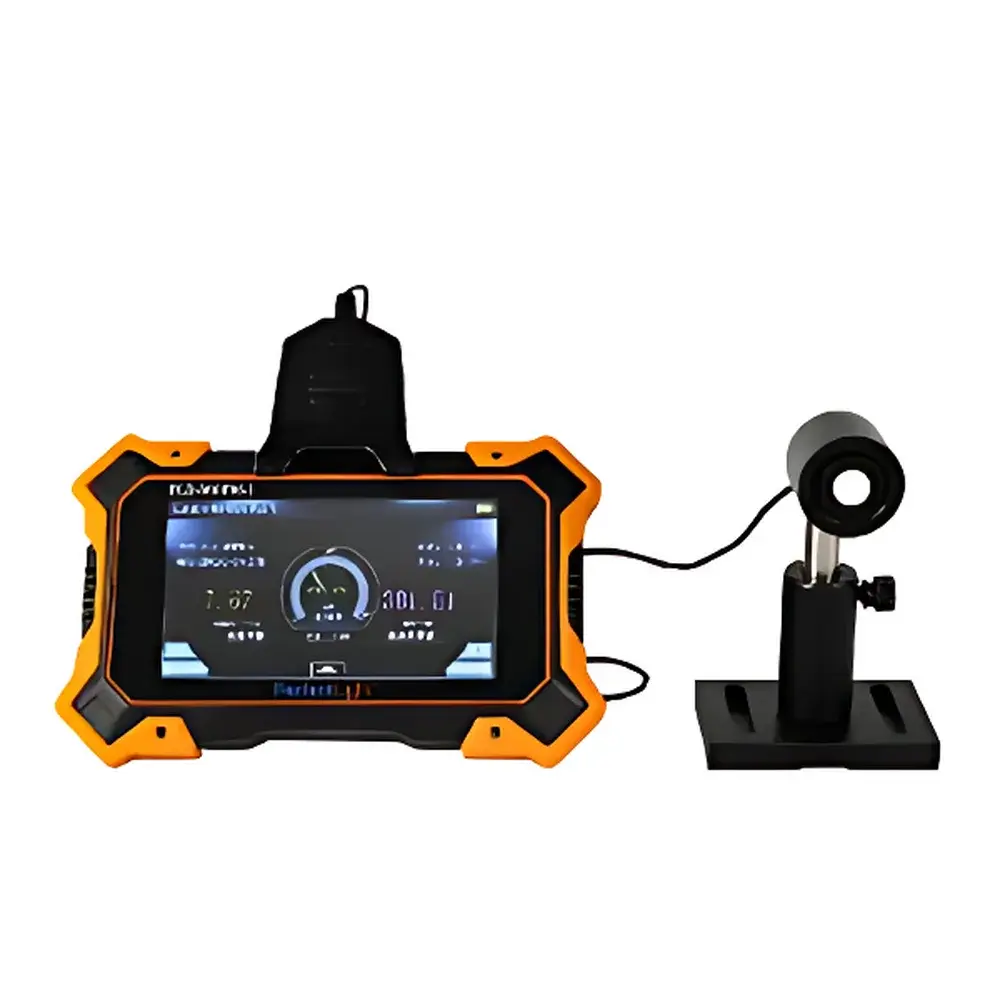
PLD MOPM-I Multifunctional Optical Power Meter
| Brand | PerfectLight (PoFaiLai) |
|---|---|
| Model | PLD MOPM-I |
| Wavelength Range | 400–1000 nm |
| Measurement Accuracy | < ±3% (VIS, certified by NIM, China) |
| Detector Compatibility | Photodiode & Thermopile Sensors |
| Display | 5-inch capacitive touchscreen |
| Battery Life | Up to 21 h standby |
| Operating Environment | Real-time probe temperature & ambient pressure monitoring |
| Measurement Modes | Direct, Spatial, Temporal, and Sequential |
| Quantum Flux Output | Supported for monochromatic & broadband irradiation |
| Equivalent Wavelength Input | User-configurable for spectral weighting |
| Data Output | Numerical & derived photometric/quantum metrics (e.g., photon flux, irradiance, spatial uniformity index) |
Overview
The PLD MOPM-I Multifunctional Optical Power Meter is a metrologically traceable instrumentation platform engineered for quantitative optical characterization in photochemical and photocatalytic research laboratories. It operates on the principle of calibrated radiant flux detection—utilizing NIM-certified photodiode and thermopile sensor modules—to deliver accurate, repeatable measurements of optical power (W), irradiance (W/m²), and photon flux (µmol·m⁻²·s⁻¹) across the 400–1000 nm spectral band. Unlike conventional single-mode power meters, the MOPM-I integrates four synchronized measurement paradigms—Direct, Spatial, Temporal, and Sequential—to address the dynamic, heterogeneous, and time-resolved nature of light sources used in solar fuel synthesis, quantum yield determination, and accelerated photostability testing. Its design directly responds to the critical need for experimental reproducibility in standardized photochemistry workflows where irradiance heterogeneity, spectral drift, and temporal instability significantly impact calculated performance indicators such as apparent quantum yield (AQY), solar-to-hydrogen efficiency (STH), incident-photon-to-current efficiency (IPCE), and absorbed-photon-to-electron efficiency (ABPE).
Key Features
- NIM-traceable calibration across 400–1000 nm with measurement uncertainty < ±3%—validated under ISO/IEC 17025-accredited conditions.
- Multi-sensor architecture supporting interchangeable photodiode (sub-µs response) and thermopile (broadband thermal stability) probes for optimal signal fidelity across pulsed, modulated, and continuous-wave illumination.
- Four operational modes: Direct mode delivers real-time irradiance and photon flux; Spatial mode enables grid-based mapping of non-uniform beams (e.g., elliptical or collimated xenon arcs) to compute spatial uniformity index and area-weighted average irradiance; Temporal mode captures long-term stability (hours) and short-term fluctuations (ms–s); Sequential mode logs time-stamped parameter sets for multi-stage irradiation protocols.
- On-device spectral weighting engine allows manual entry of monochromatic wavelength or selection of built-in equivalent wavelength algorithms for broadband sources—enabling direct calculation of photon-based metrics without external spectral deconvolution.
- Integrated environmental monitoring: real-time display of probe head temperature and ambient barometric pressure—critical for correcting thermal drift and atmospheric attenuation effects in high-precision irradiance reporting.
- 5-inch high-resolution capacitive touchscreen interface with intuitive icon-driven navigation, data logging toggle, and unit-switching functionality (W, W/m², µmol·m⁻²·s⁻¹, photons·cm⁻²·s⁻¹).
- Field-deployable power system: rechargeable lithium-ion battery supporting >21 h standby and continuous operation up to 8 h under active measurement—charged via standard 5 V / 2 A USB-C input.
Sample Compatibility & Compliance
The PLD MOPM-I is compatible with common laboratory light sources including xenon arc lamps (with and without AM1.5G filters), mercury-vapor lamps, LED arrays, and tunable monochromator outputs. Its sensor interchangeability ensures appropriate responsivity for both high-intensity broadband irradiation (>1000 mW/cm²) and low-flux quantum-limited applications. All factory calibrations are performed per GB/T 26177–2010 (Chinese national standard for optical power meters) and referenced to NIM’s primary radiometric standards. While not FDA 21 CFR Part 11–compliant out-of-the-box, audit-ready data export (CSV/Excel) supports GLP/GMP-aligned documentation when integrated into validated laboratory information management systems (LIMS). The device meets IEC 61000-6-3 (EMC emission) and IEC 61010-1 (electrical safety) requirements for laboratory instrumentation.
Software & Data Management
The MOPM-I operates autonomously without PC dependency, but includes a USB-C interface for firmware updates and bulk data export. Logged datasets include timestamp, measurement mode, sensor ID, raw voltage output, compensated irradiance/photon flux, environmental parameters, and user-defined metadata tags (e.g., lamp ID, filter code, sample position). Exported files comply with FAIR principles (Findable, Accessible, Interoperable, Reusable) and are structured to integrate natively with MATLAB, Python (NumPy/Pandas), and OriginLab for post-acquisition spectral analysis, stability trending, and quantum efficiency modeling. No proprietary software installation is required—data parsing scripts are publicly available in the manufacturer’s GitHub repository under MIT license.
Applications
- Quantitative irradiance validation prior to photocatalytic H₂ evolution or CO₂ reduction experiments.
- Spatial uniformity assessment of solar simulators per ASTM E927–22 and IEC 60904-9 Ed. 3 requirements.
- Time-resolved stability profiling of pulsed lasers and flash photolysis systems.
- Photon flux normalization for AQY calculations in heterogeneous photocatalysis (ISO 25037:2022).
- Calibration transfer between reference and field-deployed sensors in multi-lab collaborative studies.
- Environmental correction of irradiance readings during altitude- or temperature-variable experiments.
FAQ
Is the PLD MOPM-I suitable for measuring UV or NIR wavelengths outside 400–1000 nm?
No—the certified accuracy applies strictly within the 400–1000 nm range. For UV (1000 nm), alternate NIM-calibrated sensors must be selected and validated separately.
Can the device store measurement history internally?
Yes—it retains up to 10,000 timestamped records in non-volatile memory, accessible via the “History” menu or bulk export.
Does the spatial measurement mode require external positioning hardware?
No—manual probe repositioning is supported; optional motorized XY stage integration is available via third-party API (RS-232/Modbus RTU).
How is probe temperature used in irradiance compensation?
Photodiode responsivity exhibits known thermal drift; the embedded thermistor enables real-time correction using NIST-traceable coefficients stored per sensor serial number.
Is firmware update capability included?
Yes—updates are distributed as signed binary packages via the manufacturer’s secure portal and installed via USB-C connection with version rollback support.



