
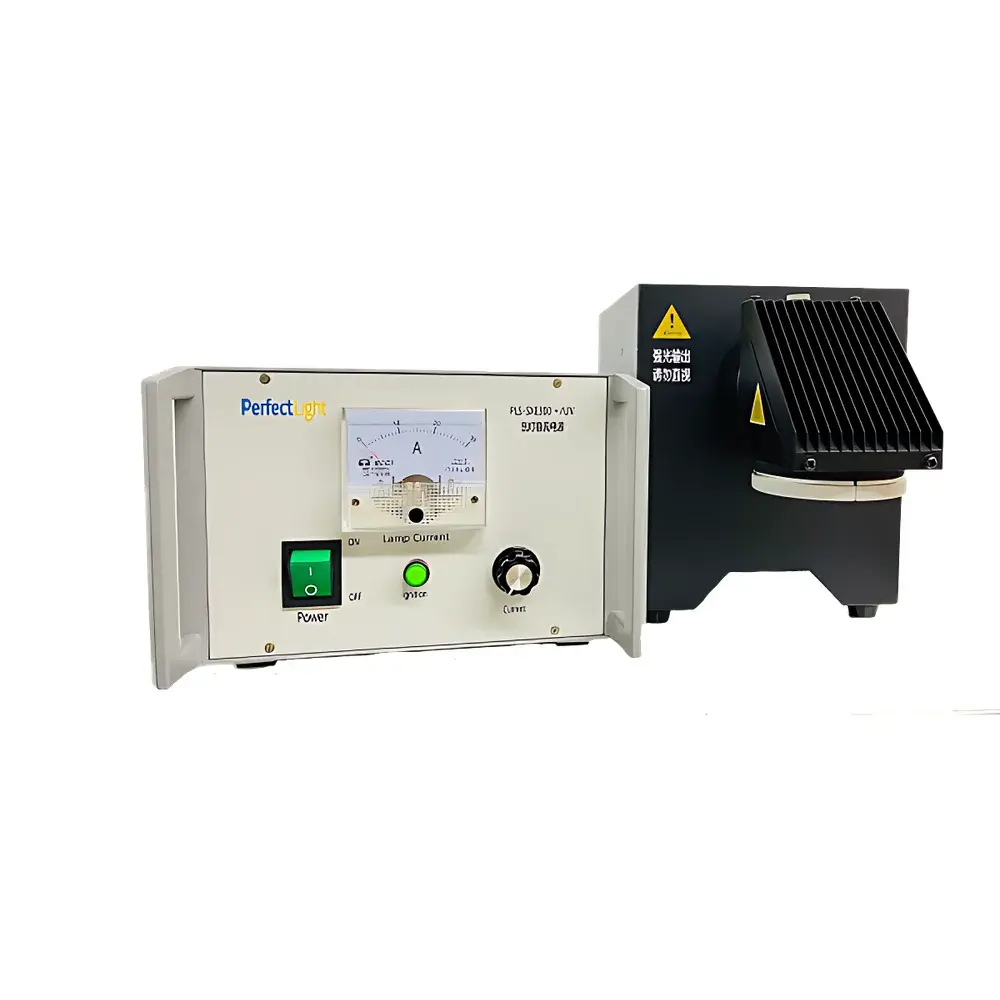
PerfectLight PL-VisPhoto Visible-Light Photocatalytic Xenon Light Source
| Brand | PerfectLight |
|---|---|
| Origin | Beijing, China |
| Manufacturer Type | Authorized Distributor |
| Product Origin | Domestic (China) |
| Model | PL-VisPhoto |
| Light Source Type | Xenon Arc Lamp |
| Illumination Mode | Internal Irradiation Configuration |
| Total Optical Power | 50 W |
| Spectral Range | 320–780 nm (extendable to 2500 nm) |
| Beam Divergence | Avg. 6° |
| Spot Diameter | 30–60 mm (distance-dependent) |
| Long-Term Irradiance Instability | ≤ ±3% |
| Lamp Power | 300 W |
| Power Adjustment Range | 150–300 W |
| Current Limit | 21 A |
| Lamp Lifetime | >1000 h (under standard photocatalytic operating conditions) |
| Trigger System | Integrated High-Voltage Ignition (dual-stage, no high-voltage cabling) |
| Housing | Shielded Metal Enclosure |
| Control Interface | Microprocessor-Based Digital Power Management System |
| Safety | Low-Voltage Interconnect Between Lamp Housing and Power Supply |
| Filter Compatibility | UV, Visible, NIR, and Narrowband Bandpass Filters |
Overview
The PerfectLight PL-VisPhoto is a purpose-engineered visible-light photocatalytic xenon light source designed for reproducible, stable, and spectrally controllable irradiation in laboratory-scale photocatalysis research. It operates on the principle of broadband arc discharge emission from a high-pressure xenon lamp, delivering continuous spectral output across the biologically and catalytically relevant 320–780 nm range—encompassing the full visible spectrum and extending into the near-UV and near-infrared regions. Unlike pulsed or LED-based systems, this source provides steady-state irradiance essential for kinetic studies, quantum yield quantification, and long-duration reaction monitoring. Its internal irradiation configuration ensures optimal photon delivery geometry for immersion-type photoreactors—commonly employed in gas-phase CO₂ reduction, aqueous-phase dye degradation, and particulate photocatalyst evaluation. The system is engineered for precision photonic delivery, not illumination aesthetics: spectral fidelity, temporal stability, and thermal management are prioritized over brightness alone.
Key Features
- Stable broadband xenon arc emission with ≤ ±3% irradiance drift over extended operation (>8 h), validated under constant-current regulation and active thermal load balancing.
- Optimized thermal architecture featuring large-area aluminum finned heat sinks and forced-air convection, enabling uninterrupted operation at rated power without thermal throttling or spectral shift.
- Digital microprocessor-controlled power supply with programmable current limiting (up to 21 A), real-time lamp voltage monitoring, and soft-start ignition sequencing to extend lamp service life beyond 1000 hours under typical photocatalytic duty cycles.
- Integrated high-voltage trigger module eliminates hazardous high-voltage transmission through interconnect cables; all lamp housing interfaces operate at safe low-voltage DC levels.
- EMI-shielded metal enclosure compliant with IEC 61000-6-3 radiated emissions limits, ensuring electromagnetic compatibility in sensitive electrochemical or spectroscopic lab environments.
- Modular optical interface supporting standardized filter mounts (e.g., Thorlabs SM1-threaded holders) for rapid spectral band selection—UV cutoff (λ > 400 nm), visible pass (400–700 nm), NIR extension (700–2500 nm), and narrowband interference filters (FWHM < 10 nm).
Sample Compatibility & Compliance
The PL-VisPhoto is compatible with standard quartz immersion wells (e.g., 10–25 mm OD), gas-phase flow reactors (e.g., fixed-bed or annular configurations), and slurry-based batch photoreactors. Its 6° average beam divergence enables uniform irradiance distribution across circular sample zones up to 60 mm diameter at 300 mm working distance. All optical components—including quartz exit windows and internal reflectors—are certified for UV transparency and thermal shock resistance per ISO 10110-7. The system meets CE marking requirements for electrical safety (EN 61010-1) and electromagnetic compatibility (EN 61326-1). While not inherently GLP-compliant, its digital control log and stable output support traceable experimental protocols aligned with ASTM E2938 (Standard Practice for Determining Quantum Yields in Photocatalytic Reactions) and ISO 22197-1 (Photocatalytic Air Purification Performance Testing).
Software & Data Management
The PL-VisPhoto employs embedded firmware with RS-232/USB-C serial interface for remote command execution (SCPI-compatible syntax). Users may configure ramp profiles, setpoint hold durations, and current/voltage thresholds via terminal or custom Python/Matlab scripts. No proprietary GUI is required; however, optional LabVIEW drivers and JSON-based API wrappers are available for integration into automated reactor control platforms. All operational parameters—including cumulative lamp-on time, peak current events, and thermal sensor readings—are logged locally and exportable as CSV. Audit trails meet minimum requirements for 21 CFR Part 11–aligned workflows when paired with timestamped external data acquisition systems.
Applications
- Primary use: H₂/O₂ evolution via water splitting using TiO₂, g-C₃N₄, or perovskite photocatalysts under AM 1.5G-simulated visible irradiance.
- CO₂ photoreduction to CH₄, CO, or C₂H₄ using Cu/TiO₂ or MOF-based catalysts in sealed gas-phase reactors.
- Gas-phase VOC abatement (formaldehyde, NOₓ, SO₂) and liquid-phase organic pollutant degradation (methylene blue, phenol, benzene derivatives) under controlled irradiance dosimetry.
- Secondary applications include photoelectrochemical cell (PEC) bias-dependent IPCE measurements, photocatalytic membrane fouling studies, and light-induced isomerization kinetics in azobenzene or spiropyran systems.
FAQ
What spectral calibration documentation is provided with the PL-VisPhoto?
A NIST-traceable spectral irradiance certificate (measured with calibrated CCD spectroradiometer) is included for the unfiltered output at 300 mm working distance. Optional factory recalibration every 250 lamp-hours is available.
Can the PL-VisPhoto be synchronized with transient absorption or time-resolved fluorescence systems?
Yes—TTL-compatible external trigger input supports synchronization with pump-probe lasers or gated detectors; jitter < 100 ns typical.
Is the lamp replaceable by the end user?
Yes—lamp replacement requires only standard hex tools and follows ISO 11146-aligned alignment procedure documented in the maintenance manual.
Does the system support automated filter wheel integration?
Not natively, but the RS-232 interface allows third-party filter wheel controllers (e.g., Thorlabs KDC101) to be daisy-chained via TTL handshaking.
How is irradiance uniformity verified across the illuminated area?
Uniformity is characterized using a calibrated silicon photodiode array (±2% spatial uncertainty); flatness exceeds 92% over central 80% of specified spot diameter.





