
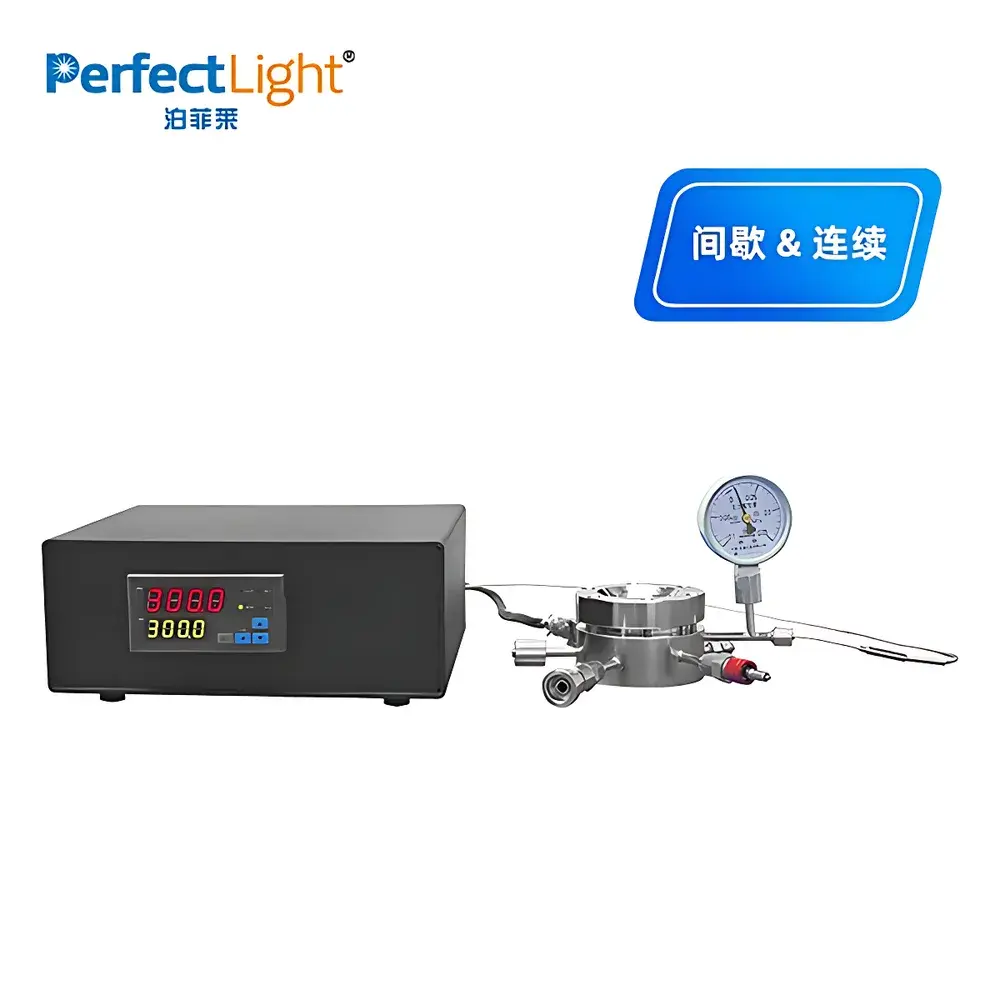
PerfecLight PLR-GPTR Series Gas-Solid Phase Photo-Thermal Reactor
| Brand | PerfecLight |
|---|---|
| Origin | Beijing, China |
| Manufacturer Type | Authorized Distributor |
| Country of Origin | China |
| Model | PLR-GPTR (Gas-Phase) |
| Pressure Rating | 0.3 MPa |
| Volumes Available | 25 mL, 50 mL, 100 mL, 200 mL |
| Built-in Catalyst-Zone Heating | Optional (denoted by “T” suffix) |
| Max. Heating Temperature | 300 °C |
| Temperature Control | 10-segment programmable, ±0.5 °C accuracy |
| Sensors | Integrated pressure transducer and catalyst bulk temperature sensor |
| Reactor Geometry | Flat-bottomed, low-diffusion-height design |
| External Modularity | Compatible with humidity control, mass flow controllers, and online gas analyzers (e.g., GC, FTIR, MS) |
Overview
The PerfecLight PLR-GPTR Series Gas-Solid Phase Photo-Thermal Reactor is an engineered platform for mechanistic investigation and quantitative evaluation of heterogeneous photocatalytic and photo-thermal CO₂ reduction under controlled gaseous environments. Designed explicitly for gas–solid phase reactions, it operates on a batch-mode, sealed-vessel principle with optically accessible quartz windows enabling uniform irradiation of immobilized catalysts (e.g., TiO₂, g-C₃N₄, Cu/TiO₂, perovskite oxides) while maintaining precise thermal and pressure conditions. Its flat-bottomed reactor geometry minimizes the diffusion path length for CO₂ molecules—reducing mass-transfer resistance and enhancing collision frequency between reactant gas and active catalytic sites. This architecture supports rigorous discrimination between purely thermal, purely photonic, and synergistic photo-thermal contributions to reaction kinetics—a prerequisite for ISO/IEC 17025-compliant catalytic mechanism studies.
Key Features
- Stainless steel construction rated to 0.3 MPa working pressure, certified for safe operation with CO₂, H₂, CH₄, and other reactive gases under elevated conditions.
- Flat-profile reactor body (height-to-diameter ratio < 0.4) optimized for short gas-phase diffusion distances—validated via computational fluid dynamics (CFD) simulations for improved interfacial contact efficiency.
- Dual-sensor integration: high-stability piezoresistive pressure transducer (0–0.5 MPa range, ±0.25% FS) and embedded Pt100 RTD directly embedded in catalyst bed for real-time measurement of catalyst bulk temperature—not ambient or jacket temperature.
- Optional T-series configuration features localized resistive heating elements embedded beneath the catalyst support plate, enabling independent thermal control of the catalytic zone without heating the entire gas volume—critical for isolating photonic effects in Arrhenius-based comparative experiments.
- 10-segment programmable temperature profile with ramp/soak capability and ±0.5 °C steady-state accuracy—fully compliant with ASTM E2068 protocols for thermal protocol reproducibility.
- Standardized 1/4″ Swagelok ports and NPT threaded interfaces allow seamless integration with external modules: humidity generators (dew point control ±0.5 °C), precision mass flow controllers (MFCs) for CO₂/H₂/N₂/O₂ blending, and online gas analyzers including quadrupole mass spectrometers (QMS) and Fourier-transform infrared (FTIR) spectrometers.
Sample Compatibility & Compliance
The PLR-GPTR accommodates powdered, pelletized, or monolithic solid catalysts (particle size: 20 nm – 2 mm; loading capacity up to 1.5 g in 200 mL variant). It supports inert and reducing atmospheres (Ar, N₂, H₂/CO₂ mixtures) and is compatible with trace O₂ (< 10 ppm) for oxidative side-reaction monitoring. All wetted parts are electropolished 316L stainless steel or fused silica—meeting USP Class VI and FDA 21 CFR Part 11 requirements for material traceability when paired with validated data acquisition software. The system satisfies GLP audit requirements for catalyst testing laboratories through full electronic record retention of sensor logs, temperature setpoints, pressure traces, and timestamped experimental metadata.
Software & Data Management
Data acquisition is performed via USB-connected analog/digital I/O module with 16-bit resolution and 10 Hz sampling rate. Raw sensor streams (pressure, catalyst temperature, lamp power, ambient temperature) are time-synchronized and logged in CSV/SQLite format. Optional LabVIEW-based control suite enables automated execution of comparative photo/thermal protocols—including dark-heated baselines matched to illuminated runs at identical catalyst temperatures. Audit trails include user login, parameter changes, and calibration events—supporting compliance with ISO 17025 Clause 7.7 (Results Reporting) and EU Annex 11 (Computerised Systems).
Applications
- Quantitative CO₂ photoreduction to CO, CH₄, CH₃OH, or C₂H₄ under simulated solar irradiation (AM 1.5G) or monochromatic LED sources.
- Mechanistic deconvolution of photo-thermal synergy via paired illumination/dark experiments at iso-thermal conditions—enabling calculation of apparent quantum yield (AQY) and photo-enhancement factor (PEF).
- Heterogeneous hydrogenation of CO₂ to formic acid precursors using Ru- or Ni-based catalysts under mild thermal input.
- VOC abatement (e.g., formaldehyde, toluene) and NOₓ reduction under visible-light activation.
- Electron-transfer studies in solid-state nitrogen fixation (N₂ → NH₃) and sulfur capture (SO₂ → elemental S) under UV–vis irradiation.
- Reaction engineering validation for continuous-flow reactor scale-up—using kinetic parameters derived from well-characterized batch data.
FAQ
Does the PLR-GPTR series support both batch and continuous-flow operation?
Yes—the base configuration operates as a sealed batch reactor, but optional flow-through adapters enable pseudo-steady-state operation with regulated inlet/outlet gas streams.
Can the built-in heating function be used independently of light irradiation?
Yes—T-series models decouple thermal actuation from optical input, allowing strictly thermal control experiments without illumination.
Is water-jacket cooling available as a factory option?
No standard water jacket is included; however, custom-engineered cooling jackets can be specified at order entry for exothermic reaction management.
What spectral ranges are supported for illumination?
The quartz window transmission spans 190–2500 nm—compatible with UV-C, UV-A, visible, and near-IR sources, including 365 nm LEDs, Xe lamps with AM 1.5G filters, and tunable laser systems.
How is catalyst temperature measured, and where is the sensor located?
A Pt100 RTD is embedded directly into the catalyst support plate, ensuring measurement reflects the actual thermal state of the active layer—not gas-phase or wall temperature.



