
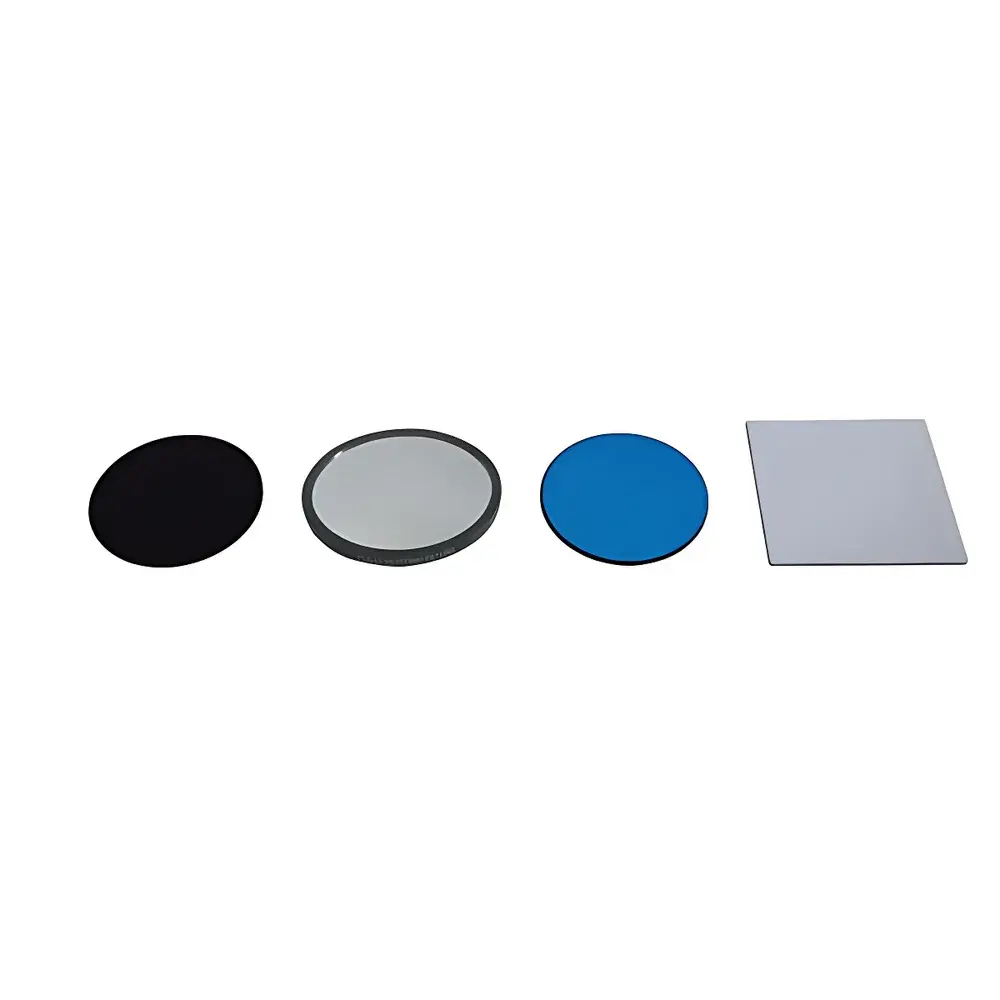
PerfectLight DT Series Bandpass Optical Filters for UV-Vis-NIR Spectroscopy
| Brand | PerfectLight |
|---|---|
| Model | DT-Series (e.g., DT 350, DT 405, DT 550, etc.) |
| Substrate Material | Fused Silica |
| Diameter | 63 mm |
| Clear Aperture | >57 mm |
| Center Wavelength Range | 320–700 nm (UV-Vis) |
| Full Width at Half Maximum (FWHM) | 20 nm ±3 nm |
| Blocking Range | OD ≥4 from 200–1200 nm (typical) |
| Surface Quality | 20–10 scratch-dig |
| Parallelism | <3 arcsec |
| Transmission Peak | >85% (typical) |
| Operating Temperature | –20 °C to +70 °C |
| Compliance | ISO 9001-manufactured, RoHS-compliant |
Overview
PerfectLight DT Series bandpass optical filters are precision thin-film interference filters engineered for spectral selection in UV-Vis-NIR spectroscopic systems. Based on the principle of constructive and destructive interference within multilayer dielectric coatings deposited onto high-purity fused silica substrates, these filters transmit a narrow, well-defined wavelength band while rejecting adjacent spectral regions with high optical density (OD ≥4). Designed for integration into spectrometers, fluorescence detection modules, photometric analyzers, and custom optical benches, the DT Series supports rigorous laboratory applications requiring stable, repeatable spectral isolation between 320 nm and 700 nm — covering deep ultraviolet through visible light. Unlike grating- or prism-based dispersion methods, filter-based spectral selection offers zero moving parts, minimal alignment sensitivity, and immunity to mechanical drift — making it ideal for fixed-wavelength quantitative assays, LED-based excitation control, and multi-channel sensor arrays.
Key Features
- Fused silica substrate ensures low autofluorescence, high transmission (>85% at peak), and excellent UV stability down to 200 nm
- Tight center wavelength tolerance (±1.5 nm standard; tighter upon request) and consistent FWHM of 20 nm ±3 nm across batch production
- High out-of-band rejection: OD ≥4 from 200–1200 nm, minimizing stray light contribution in low-signal measurements
- 63 mm outer diameter with >57 mm clear aperture enables compatibility with standard lens mounts, collimators, and fiber-coupled spectrometers
- Surface quality rated at 20–10 scratch-dig and parallelism <3 arcsec support wavefront preservation in imaging and interferometric applications
- Available in 15 standardized center wavelengths (DT 350, DT 365, …, DT 700), with custom center wavelengths and bandwidths available under NRE agreement
Sample Compatibility & Compliance
The DT Series is compatible with solid, liquid, and gaseous samples when used in transmission geometry — particularly suited for cuvette-based absorbance measurements, flow-cell monitoring, and reflectance probe configurations. Filters are routinely deployed in university teaching labs, pharmaceutical QC workflows, environmental photometry, and photochemical reaction monitoring where regulatory traceability is required. Manufacturing adheres to ISO 9001:2015 quality management standards. While the filters themselves are passive optical components, their use in analytical instrumentation supports compliance with ISO/IEC 17025 method validation requirements when paired with calibrated light sources and detectors. No electrical safety certification applies, as no power input is required.
Software & Data Management
As passive hardware components, DT filters do not incorporate embedded firmware or require driver software. Their spectral performance is fully characterized via NIST-traceable spectrophotometric calibration reports (available upon request), including full transmittance curves (320–1100 nm) and blocking spectra. Users integrate these filters into existing data acquisition environments — such as OceanInsight OceanView, Thermo Fisher OMNIC, or custom LabVIEW/Python-based platforms — by assigning known center wavelengths and FWHM values to measurement channels. For GLP/GMP-regulated environments, filter lot numbers and calibration certificates can be linked to instrument logbooks and electronic lab notebooks (ELNs) to satisfy audit trail requirements per FDA 21 CFR Part 11.
Applications
- Wavelength-specific photolysis studies in photocatalysis and solar fuel research
- Multi-wavelength absorbance ratioing for concentration determination in colorimetric assays
- Excitation filtering in steady-state and time-resolved fluorescence setups
- Spectral channel definition in multi-spectral imaging systems for plant phenotyping and material sorting
- Reference channel stabilization in dual-beam UV-Vis spectrophotometers
- Calibration verification of broadband detectors using monochromatic reference bands
FAQ
Are DT filters suitable for laser line selection?
Yes — provided the laser’s nominal wavelength falls within the specified center wavelength tolerance and peak transmission region. For pulsed lasers, verify pulse energy density against fused silica damage threshold specifications (typically >500 mJ/cm² for 10 ns pulses at 355 nm).
Can I use DT filters in reflection mode?
No — DT filters are optimized for transmission geometry. Reflective use introduces angular dependence, polarization sensitivity, and reduced blocking performance; dedicated edge or dichroic filters are recommended instead.
Do you provide spectral calibration data for each individual filter?
Standard shipments include batch-level spectral characterization. Lot-specific calibration reports with measured transmittance curves are available as an optional add-on service.
What is the maximum operating temperature for continuous exposure?
The filters maintain specification integrity up to +70 °C ambient. Prolonged exposure above this threshold may induce coating stress and shift center wavelength; thermal cycling should remain within –20 °C to +70 °C limits.
How does humidity affect long-term performance?
Fused silica substrates and oxide-based dielectric coatings exhibit negligible hygroscopic response. Filters meet MIL-C-48497A environmental stability requirements and require no hermetic sealing under standard laboratory conditions.





