
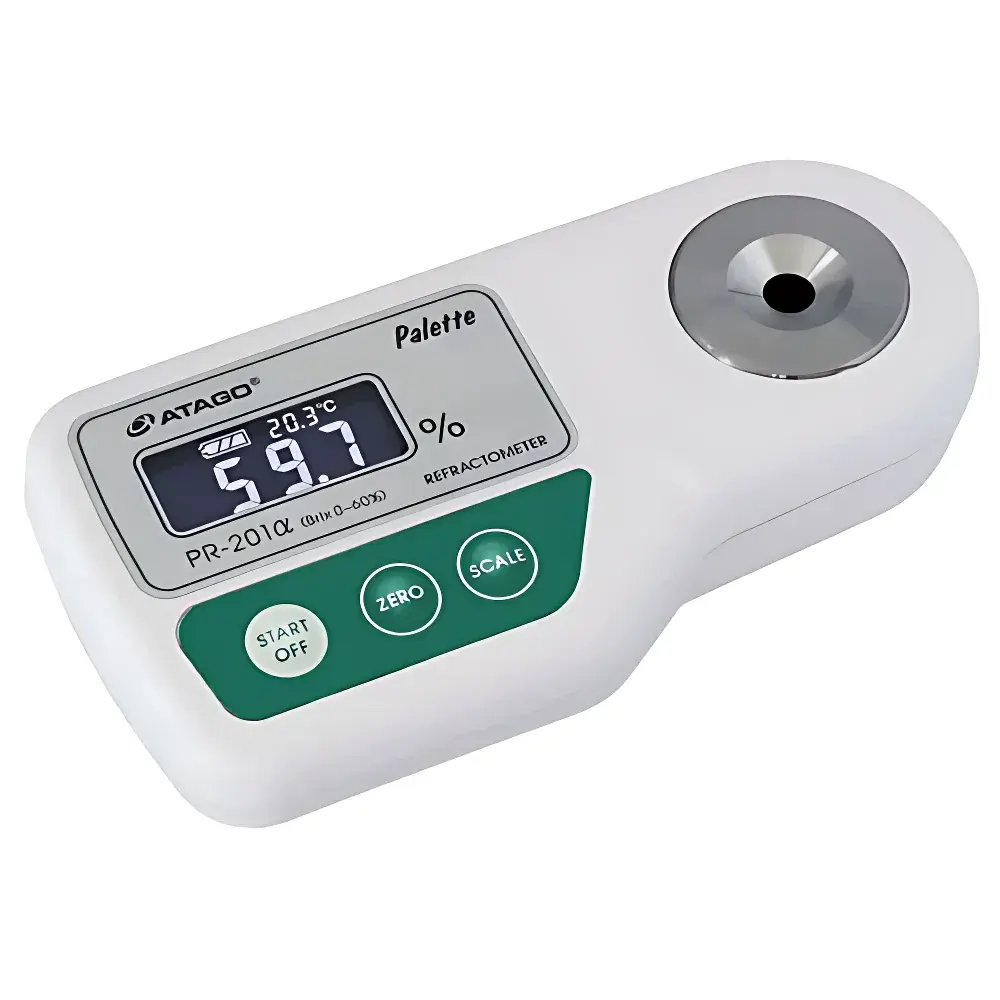
ATAGO PR-201α Portable Wide-Range Digital Refractometer
| Brand | ATAGO |
|---|---|
| Origin | Japan |
| Model | PR-201α (Wide-Range) |
| Product Type | Handheld Refractometer |
| Temperature Compensation | Automatic (ATC, 10–40°C) |
| Display | Digital LCD |
| Measurement Range | Brix 0.0–60.0% |
| Accuracy | ±0.1% Brix |
| Resolution | 0.1% Brix |
| Operating Temperature | 10–40°C |
| Power Supply | 9V Alkaline Battery (006P) |
| IP Rating | IP64 |
| Dimensions & Weight | 17 × 9 × 4 cm, 300 g (main unit only) |
Overview
The ATAGO PR-201α is a precision-engineered handheld digital refractometer designed for rapid, field-deployable concentration analysis of aqueous and semi-viscous liquid samples across industrial, food & beverage, pharmaceutical, and manufacturing environments. It operates on the fundamental optical principle of critical angle refraction: incident light passes through a sapphire prism in contact with the sample, and the resulting refraction angle—directly correlated to the sample’s refractive index—is converted into a Brix concentration value via calibrated internal algorithms. Equipped with Automatic Temperature Compensation (ATC) spanning 10–40°C, the PR-201α ensures measurement stability without external thermostatic control, making it suitable for dynamic production-floor or on-site quality verification where ambient conditions fluctuate. Its wide 0.0–60.0% Brix range enables reliable quantification of both dilute solutions (e.g., soft drinks, cleaning agents) and highly concentrated media (e.g., fruit concentrates, glycol-based coolants, lubricating oil emulsions), eliminating the need for multiple instruments across varying concentration tiers.
Key Features
- Wide measurement range: 0.0–60.0% Brix with ±0.1% accuracy and 0.1% resolution — validated per ISO 2173 and AOAC Official Method 932.12 for refractometric sugar analysis.
- Integrated ATC system compensates for sample temperature drift between 10°C and 40°C, ensuring traceable results without manual correction tables.
- ELI (Enhanced Light Immunity) optical design minimizes interference from ambient lighting, enabling stable readings under direct sunlight or factory-floor illumination—critical for outdoor or unshielded inspection points.
- Four-scale capability: native Brix scale plus three user-definable scales (Scale 2, 3, 4); supports linear coefficient-based conversion (Concentration = Brix × k) for proprietary formulations such as pharmaceutical excipient solutions or custom coolant blends.
- Rugged IP64-rated enclosure resists dust ingress and water splashes; optimized ergonomics and 300 g mass ensure fatigue-free operation during extended shift use.
- One-touch zero calibration using distilled water; automatic display of last calibration temperature for audit readiness and GLP-compliant recordkeeping.
Sample Compatibility & Compliance
The PR-201α accommodates a broad spectrum of transparent to mildly turbid liquids—including fruit juices, syrups, dairy-based beverages, aqueous metalworking fluids (e.g., water-soluble cutting oils), heat-transfer fluids (ethylene/propylene glycol solutions), pharmaceutical aqueous suspensions, and industrial cleaning agents. It is not intended for strongly opaque, highly viscous (>500 mPa·s), or volatile organic solvents (e.g., acetone, ethanol >20% v/v) due to evaporation-induced refractive instability. The instrument conforms to IEC 61010-1 safety standards for portable electrical measuring equipment and meets the mechanical robustness requirements outlined in ASTM D1218 for refractometer durability testing. Calibration traceability aligns with NIST-traceable sucrose reference standards (SRM 84d), supporting compliance with FDA 21 CFR Part 11 when integrated into electronic lab notebooks (ELN) with audit-trail-enabled software.
Software & Data Management
While the PR-201α operates as a standalone, battery-powered instrument with no built-in data logging, its standardized output format and repeatable manual workflow support seamless integration into regulated quality systems. Users may document measurements manually in paper-based or electronic batch records (e.g., LIMS or MES platforms) with full traceability to operator ID, time stamp, calibration status, and environmental temperature. The zero-calibration function stores the most recent calibration temperature—accessible via key combination—for retrospective validation. For facilities requiring automated data capture, optional third-party USB-to-serial adapters (e.g., FTDI-based interfaces) can be used with custom Python or LabVIEW scripts to parse serial ASCII output (Brix value + temperature flag), enabling CSV export and statistical process control (SPC) charting aligned with ISO 9001 and ICH Q7 guidelines.
Applications
- Food & Beverage QC: Rapid Brix verification of incoming fruit pulp, post-pasteurization juice blends, syrup dilution ratios, and finished beverage consistency.
- Industrial Fluid Monitoring: Real-time concentration checks of water-glycol antifreeze mixtures, alkaline cleaning solutions, and semi-synthetic metalworking fluids to maintain corrosion inhibition and lubricity thresholds.
- Pharmaceutical Manufacturing: On-the-spot assay of aqueous active pharmaceutical ingredient (API) solutions, excipient concentrations (e.g., sucrose, dextrose, PEG), and buffer stock preparations prior to filtration or filling.
- R&D Labs: Comparative formulation screening of prototype emulsions, hydrogels, or polymer solutions where refractive index correlates with molecular weight or solute loading.
- Agricultural Extension: Field-side assessment of harvest maturity in orchards and vineyards via fruit juice Brix, supporting harvest scheduling decisions per USDA Fruit Quality Standards.
FAQ
What is the recommended calibration frequency?
Calibration shall be performed before each daily use, after significant ambient temperature shifts (>5°C), and following battery replacement—per ATAGO’s GLP-aligned operational guidance and ISO/IEC 17025 Clause 7.7 requirements.
Can the PR-201α measure non-sugar solutes accurately?
It provides accurate Brix-equivalent readings only for sucrose-water systems. For non-sucrose solutes (e.g., NaCl, glycerol), users must apply validated, substance-specific conversion coefficients derived from empirical calibration curves—not default k=1.00.
Is the prism surface resistant to chemical corrosion?
Yes—the optical interface uses sapphire (Mohs hardness 9), offering superior resistance to abrasion and mild acidic/alkaline exposure typical of food-grade cleaners and pharmaceutical buffers; however, prolonged contact with strong oxidizers (e.g., HNO₃) or HF-containing solutions is prohibited.
How does ELI technology improve measurement reliability?
ELI employs dual-wavelength photodetection and adaptive signal thresholding to reject ambient photon noise, reducing standard deviation in outdoor measurements by up to 40% compared to conventional LED-based refractometers—validated under 10,000 lux illumination per JIS Z 8120 testing protocols.
Does the device support regulatory audit trails?
While the unit itself lacks internal memory, its deterministic zero-calibration sequence, visible temperature recall, and consistent key-driven scale selection enable full procedural reproducibility—satisfying FDA 21 CFR Part 11 §11.10(a) requirements for “trustworthy, attributable, legible, and contemporaneous” manual records when paired with controlled documentation practices.




