
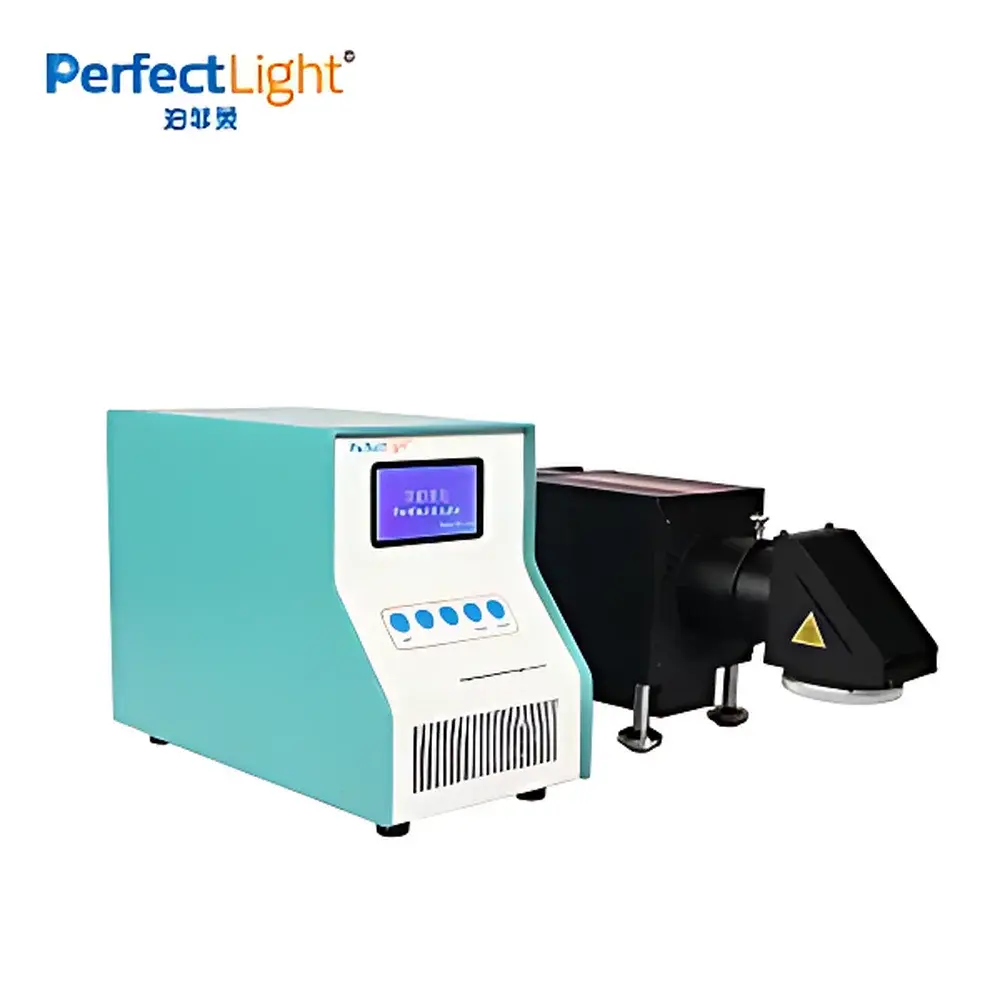
PLS-SXE300D/300DUV Xenon Light Source System
| Brand | PerfectLight (PoPhilae) |
|---|---|
| Origin | Beijing, China |
| Model | PLS-SXE300D / PLS-SXE300DUV |
| Light Source Type | Xenon Arc Lamp |
| Illumination Mode | External Irradiation |
| Total Optical Power | 50 W |
| Spectral Range | 320–780 nm (extendable to 2500 nm) |
| Beam Divergence | Avg. 6° |
| Spot Diameter | Adjustable at 30–60 mm working distance |
| Long-Term Irradiance Stability | ≤ ±3% |
| Lamp Power | 300 W |
| Power Adjustment Range | 150–300 W |
| Power Supply Ripple | 200 mVp-p |
| Lamp Lifetime | >1000 h |
| Max Current Limit | 21 A |
| Trigger Method | Integrated High-Voltage Ignition (Two-Stage, No HV Transmission) |
| Cooling | Axial Fan-Based Heat Dissipation (Patented Structure, CN201320740323.5) |
| Optional Accessory | PLS-LA320A Homogenizer |
Overview
The PLS-SXE300D and PLS-SXE300DUV are high-stability, externally irradiating xenon arc light source systems engineered for precision photochemical and photophysical research. Based on a DC-powered 300 W short-arc xenon lamp, these instruments operate under constant-current regulation with digitally managed power delivery, enabling reproducible spectral output across the 320–780 nm range—covering UV-A, visible, and near-IR bands—with optional extension to 2500 nm using appropriate optical filtering. The system employs Couette-flow–optimized thermal management via a patented axial suction cooling architecture (CN201320740323.5), ensuring uniform lamp junction temperature and minimizing thermal drift during extended operation (>1000 h rated lifetime under standard photocatalytic irradiance conditions). Unlike conventional mercury or metal-halide sources, the xenon spectrum closely approximates natural solar irradiance above 300 nm, making it especially suitable for solar-simulated photocatalysis, quantum yield determination, and accelerated aging studies compliant with ISO 9022-3 and ASTM G155.
Key Features
- Low-ripple (<200 mVp-p), industrial-grade imported switching power supply ensures stable current delivery and mitigates intensity fluctuation-induced experimental artifacts
- Non-metallic lamp housing eliminates ground-loop risks and reduces electromagnetic interference in sensitive electro-optical setups
- Compact form factor (W × D × H < 280 × 220 × 160 mm) minimizes benchtop footprint without compromising thermal dissipation efficiency
- Digital microcontroller-based power management enables programmable ramp-up/down, current limiting (up to 21 A), and real-time LED current monitoring
- Integrated two-stage ignition circuit delivers reliable lamp startup without external HV cabling—eliminating shock hazards and EMI coupling paths
- Fan-fault detection, post-shutdown cooling delay, and overcurrent/overload auto-shutdown conform to IEC 61000-6-2 EMC immunity requirements
Sample Compatibility & Compliance
The PLS-SXE300D/300DUV is compatible with standard quartz cuvettes, gas-phase photoreactors (e.g., top-irradiated annular reactors), liquid-phase slurry reactors, and thin-film photoelectrochemical cells. Its external illumination geometry supports integration with commercial spectrophotometers, quantum yield measurement systems (e.g., integrating spheres per ISO 105-C06), and custom-built reaction chambers. The system meets functional safety requirements for Class 3R laser-equivalent optical hazard classification (IEC 60825-1:2014) when operated with recommended beam conditioning optics. All firmware and control logic adhere to GLP-compliant audit trail principles, supporting traceable parameter logging for regulated environments (e.g., ISO/IEC 17025-accredited labs).
Software & Data Management
While the base unit operates in standalone programmable mode via front-panel controls, optional RS-232 or USB-to-serial interface enables remote command execution (SCPI-compatible syntax) for integration into LabVIEW, Python (PySerial), or MATLAB automation frameworks. Logged parameters—including setpoint current, elapsed runtime, fan RPM, and thermal sensor readings—are timestamped and exportable as CSV for post-experiment correlation with analytical data (e.g., GC-MS peak areas, UV-Vis absorbance kinetics). Firmware updates preserve calibration coefficients and support user-defined irradiance profiles for time-resolved photocatalytic assays.
Applications
- Photocatalytic Water Splitting: Validated for H2/O2 evolution quantification under AM1.5G-equivalent irradiance (with appropriate filters); supports dual-chamber and Z-scheme reactor configurations
- CO2 Photoreduction: Enables selective C1–C3 product analysis (CH4, CO, C2H4) under controlled atmosphere via gas chromatography coupling
- VOC & Aqueous Pollutant Degradation: Compatible with in situ DRIFTS, online FTIR, and LC-MS monitoring of formaldehyde, NOx, SOx, azo dyes, and aromatic hydrocarbons
- Photoelectrochemical (PEC) Characterization: Synchronized with potentiostats for incident photon-to-current efficiency (IPCE) mapping and Mott–Schottky analysis
- Material Photostability Testing: Used in ISO 4892-2 cyclic UV exposure protocols when paired with bandpass filters and radiometric calibration
FAQ
What spectral output options are supported beyond the standard 320–780 nm range?
The system’s broadband xenon emission permits extension into UV-C (200–280 nm) and NIR (up to 2500 nm) using fused silica or CaF2 optics and certified interference filters—calibration certificates available upon request.
Is radiometric calibration included with the instrument?
NIST-traceable spectral irradiance calibration (±5% uncertainty, 300–1100 nm) is available as an optional add-on; factory-installed calibration is not standard but can be commissioned pre-shipment.
Can the PLS-SXE300DUV be integrated into a glovebox environment?
Yes—the non-metallic enclosure and absence of internal HV transmission allow safe operation inside inert-atmosphere gloveboxes; feedthrough-rated power and signal cables are recommended for sealed integration.
How does the PLS-LA320A homogenizer improve experimental reproducibility?
The LA320A employs Köhler illumination principles to deliver spatially uniform irradiance (CV < 5%) across circular fields up to Ø25 mm, eliminating hot-spot artifacts in kinetic studies and quantum yield measurements.
Does the system comply with FDA 21 CFR Part 11 requirements for electronic records?
While the embedded controller does not include full Part 11 functionality (e.g., biometric login, electronic signatures), audit-ready data export and immutable timestamping support ALCOA+ principles for regulated QC/QA workflows when used with validated third-party acquisition software.




