
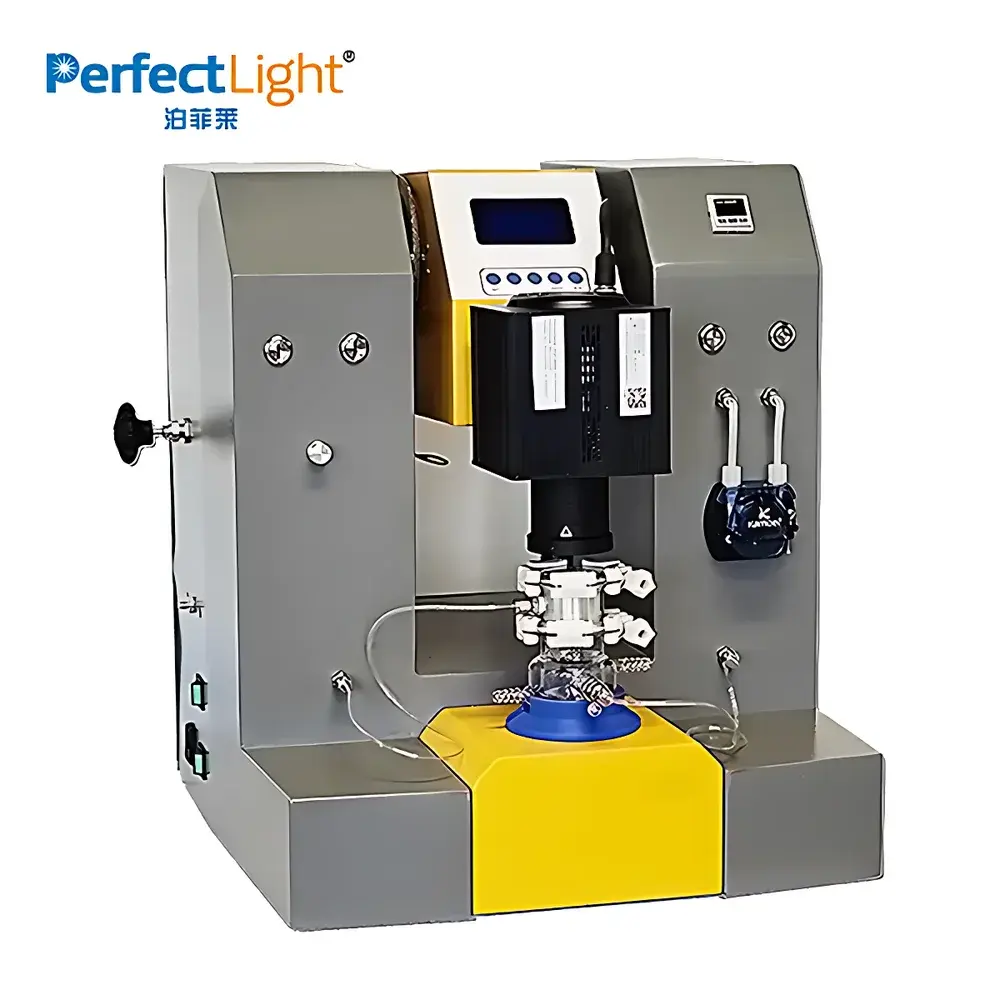
Perfetlight PLC-GDHC I Gas-Diffusion Multiphase Continuous Photocatalytic Reaction Platform
| Brand | Perfetlight |
|---|---|
| Origin | Beijing, China |
| Manufacturer Type | Authorized Distributor |
| Product Origin | Domestic (China) |
| Model | PLC-GDHC-I |
| Pricing | Upon Request |
Overview
The Perfetlight PLC-GDHC I Gas-Diffusion Multiphase Continuous Photocatalytic Reaction Platform is an engineered research system designed to advance fundamental and applied studies of heterogeneous gas–solid photocatalysis—particularly CO2 photoreduction under continuous-flow conditions. Unlike conventional slurry-based liquid-phase reactors, the PLC-GDHC I implements a structured gas-diffusion electrode (GDE)-inspired architecture to establish controlled interfacial contact between gaseous reactants (e.g., CO2/H2O vapor mixtures) and solid photocatalysts. Its core operational principle relies on laminar gas transport through a hydrophobic, porous diffusion layer that simultaneously regulates local reactant concentration gradients, mitigates competitive hydrogen evolution via water management, and enhances mass transfer kinetics at the catalyst surface. This platform enables precise spatiotemporal control over gas composition, residence time, and irradiance distribution—critical parameters for quantifying intrinsic activity, selectivity toward C2+ products (e.g., CH3OH, C2H5OH, HCOOH), and mechanistic deconvolution in artificial photosynthesis research.
Key Features
- Gas-diffusion reactor with integrated hydrophobic porous diffusion layer: Supports uniform gas dispersion, suppresses liquid water flooding of active sites, and improves CO2 accessibility to catalyst surfaces.
- Recirculating gas-diffusion manifold: Provides regulated, low-shear gas flow to sustain dynamic reactant delivery and prompt desorption of volatile products—minimizing surface poisoning and enabling steady-state kinetic analysis.
- Integrated motorized LED light source: Built-in high-power white-light LED (400–800 nm), with interchangeable spectral filters and programmable vertical positioning (±0.1 mm resolution) for reproducible irradiance calibration per ISO 17025-compliant optical alignment.
- Modular functional workstation: Accepts optional add-ons including precision temperature control (±0.5 °C), bottom-illuminated photoelectrochemical cells, and real-time in-line gas sensing interfaces (e.g., FTIR or GC-TCD coupling).
- Standardized flange-based reactor interchangeability: Accommodates multiple reactor geometries (flat-plate, tubular, monolith) for comparative studies across catalyst morphologies and loading configurations.
Sample Compatibility & Compliance
The PLC-GDHC I accommodates powder, thin-film, and supported photocatalysts (e.g., TiO2, g-C3N4, Cu/TiO2, MOF-derived composites) mounted on conductive or insulating substrates. It operates under ambient to moderate pressure (≤2 bar gauge) and supports humidified gas streams (RH 10–90%) without condensation-induced performance drift. The system adheres to CE safety directives (2014/30/EU EMC, 2014/35/EU LVD) and incorporates fail-safe gas shutoff valves compliant with ISO 10565:2020 for laboratory-scale catalytic gas handling. All wetted components are constructed from electropolished 316L stainless steel or PTFE-lined fittings to ensure chemical inertness during long-term exposure to acidic or reducing atmospheres.
Software & Data Management
The platform integrates with Perfetlight’s LabControl v3.2 software suite for synchronized control of gas flow rates (mass flow controllers, ±1% FS accuracy), LED intensity (0–100% PWM), stage position, and optional thermal modules. Data logging occurs at 10 Hz resolution with timestamped metadata (including ambient temperature, humidity, and power supply stability). Export formats include CSV and HDF5, supporting traceability under GLP and FDA 21 CFR Part 11 requirements when paired with validated user access controls and electronic audit trails. Optional API integration allows direct interfacing with third-party gas chromatographs or quadrupole mass spectrometers for closed-loop reaction monitoring.
Applications
- Photocatalytic CO2 reduction to C1–C2+ hydrocarbons and oxygenates (CH4, CO, CH3OH, C2H5OH, HCOOH)
- Gas-phase ammonia synthesis via photocatalytic N2 fixation under ambient conditions
- VOC abatement: Oxidative degradation of formaldehyde, benzene, NOx, and SOx in air streams
- Photoelectrochemical co-catalyst screening under simulated solar illumination
- Kinetic isotope effect (KIE) studies using 13CO2 or D2O-labeled feeds
FAQ
Can the PLC-GDHC I be used for operando spectroscopic characterization?
Yes—the reactor body includes standardized optical viewports (CaF2 or quartz, Ø25 mm) compatible with DRIFTS, Raman, and UV-Vis absorption probes.
Is catalyst loading standardized across different reactor configurations?
Catalyst area is normalized to 1.0 cm² active surface; substrate mounting fixtures ensure repeatable geometric exposure regardless of reactor module selection.
Does the system support isotopic labeling experiments?
All gas inlets feature dual-channel MFCs with independent calibration certificates, enabling precise blending of 13CO2/Ar or D2O(v)/N2 mixtures for mechanistic tracer studies.
What maintenance intervals are recommended for the gas-diffusion layer?
Hydrophobic diffusion layers are consumable components; replacement is advised after 200 h of continuous operation or following any observed pressure-drop deviation >15% from baseline.
Is remote operation supported?
LabControl v3.2 includes secure TLS-encrypted remote desktop access and RESTful API endpoints for integration into automated lab infrastructure (e.g., robotic sample changers or AI-driven reaction optimization workflows).



