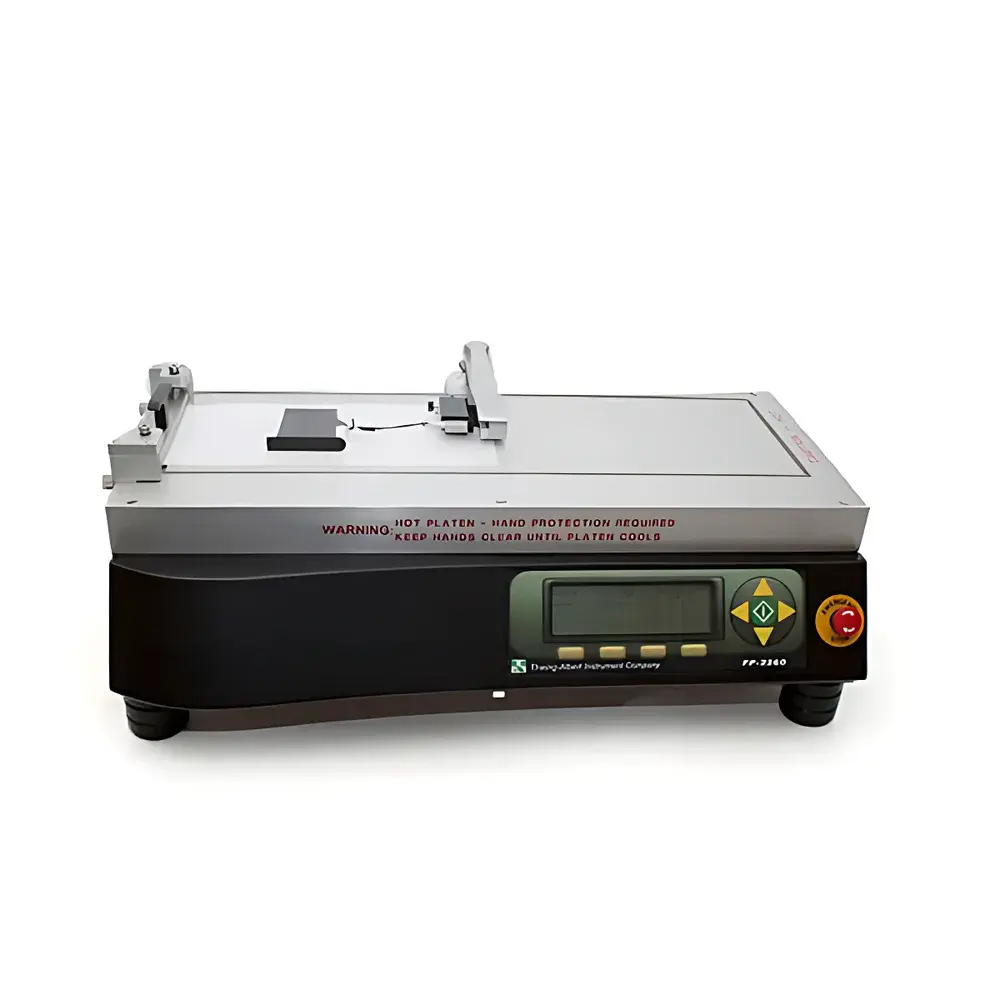
Thwing-Albert FP-260 Coefficient of Friction and Peel Tester
| Origin | USA |
|---|---|
| Manufacturer Type | Authorized Distributor |
| Origin Category | Imported |
| Model | FP-260 |
| Price Range | USD 13,500 – 68,000 |
Overview
The Thwing-Albert FP-260 is a precision-engineered, benchtop coefficient of friction (COF) and peel testing system designed for rigorous quality control and R&D applications in packaging, flexible materials, and adhesive development. Built upon the fundamental principles of ASTM D1894 and ISO 8295—measuring static and kinetic friction via horizontal sled-drag methodology—the FP-260 integrates a thermally regulated upper platen to enable controlled-temperature COF evaluation from ambient (21 °C) up to 176.7 °C (350 °F). This capability is critical for simulating real-world processing conditions such as hot-fill packaging, heat-seal integrity assessment, and high-temperature extrusion lamination. Unlike single-function testers, the FP-260 operates as a modular mechanical test platform: its dual-load-cell architecture, programmable crosshead travel (up to 356 mm / 14″), and interchangeable force transducers (1 kg, 2 kg, 5 kg, and 10 kg full-scale) support standardized COF, 90° peel, 180° peel, T-peel, seal strength (ASTM F88), and light-duty tensile testing—all within a single instrument footprint.
Key Features
- Heated upper platen with precise temperature control (21–176.7 °C / 70–350 °F), calibrated per ASTM E220 and traceable to NIST standards
- High-resolution graphical LCD display (240 × 64 pixels) with intuitive membrane keypad navigation
- Auto-sensing load cell recognition—no manual configuration required when swapping transducers
- Motorized crosshead with programmable speed range (0.1–1200 mm/min), adjustable longitudinal and lateral positioning
- Automatic crosshead return-to-start and electronic over-travel protection for operator and sample safety
- Multi-unit force reporting: selectable units include g, kg, lbf, oz, and N; resolution down to 0.01% of full scale
- Onboard data storage for up to 128 test records with timestamp, method ID, and environmental metadata
- Dual communication interfaces: USB 2.0 (virtual COM port) and RS-232 (DB9), compatible with Windows-based LIMS and ELN systems
- Test area dimensions: 225 mm × 350 mm (8.86″ × 13.78″), accommodating standard ASTM and ISO specimen sizes
Sample Compatibility & Compliance
The FP-260 accommodates a broad spectrum of flexible substrates—including biaxially oriented polypropylene (BOPP), polyester (PET), polyethylene (PE), metallized films, laminates, pressure-sensitive adhesives, wax-coated board, corrugated fiberboard, coated papers, foils, nonwovens, and leather. Its mechanical design conforms to the dimensional and kinematic requirements of over 25 internationally recognized test standards. These include ASTM D1894 (plastic film COF), ASTM D4521 (corrugated board COF), ASTM D6862 (90° peel resistance), ASTM F88 (seal strength of flexible barrier materials), ISO 8295 (plastics COF), ISO 6383 (tear resistance), TAPPI T816 (corrugated COF), FINAT FTM 1–6/10/11, AFERA 4001 P11, PSTC 101 series, and TLMI L-IA1–L-IA3. The system supports GLP-compliant operation through user-accessible audit trails, password-protected method editing, and exportable CSV reports with raw force-displacement curves.
Software & Data Management
While the FP-260 operates autonomously via embedded firmware, it fully interoperates with Thwing-Albert’s optional PC-based software suite (v4.2+), which provides method library management, statistical process control (SPC) charting, comparative analysis across batches or suppliers, and automated report generation compliant with FDA 21 CFR Part 11 requirements—including electronic signatures, audit logs, and data integrity validation. All test data—including peak force, average force, coefficient calculation, displacement at break, and slope-derived modulus values—are stored with full traceability. Export formats include CSV, PDF, and XML, enabling seamless integration into enterprise quality management systems (QMS) and laboratory information management systems (LIMS).
Applications
The FP-260 serves as a primary qualification tool across packaging R&D labs, contract manufacturing organizations (CMOs), and regulatory submission teams. Typical use cases include: evaluating slip additives (e.g., erucamide, oleamide) migration kinetics under thermal stress; validating hot-tack performance of heat-seal layers; assessing peel initiation and propagation behavior in medical device pouches; benchmarking label adhesion on HDPE bottles across seasonal humidity variations; verifying COF consistency in roll-to-roll converting processes; and supporting root-cause analysis during packaging line jams or misfeeds. Its versatility extends beyond packaging into automotive interior trim bonding validation, pharmaceutical blister foil delamination studies, and food-grade film compatibility testing per USP and EU Pharmacopoeia Chapter 3.2.1.
FAQ
Does the FP-260 meet ASTM D1894 and ISO 8295 requirements for COF testing?
Yes—the instrument’s sled geometry, platen flatness (<0.02 mm deviation), and force measurement uncertainty (<±0.5% FS) comply with the mechanical and metrological specifications outlined in both standards.
Can the FP-260 perform both static and kinetic COF measurements in a single test run?
Yes—its real-time force acquisition at 100 Hz enables automatic detection of static breakaway force and subsequent dynamic plateau force, calculating both coefficients without operator intervention.
Is temperature calibration traceable to national standards?
Yes—each heated platen is supplied with a NIST-traceable calibration certificate covering the full operating range, with annual recalibration recommended per ISO/IEC 17025 guidelines.
What is the maximum specimen thickness the FP-260 can accommodate?
The system accepts specimens up to 12.7 mm (0.5″) thick between platens, verified using ASTM D6252-compliant fixture configurations.
Does the FP-260 support GMP/GLP documentation workflows?
Yes—when used with validated software and configured with audit trail logging, electronic signatures, and secure user roles, it satisfies core elements of 21 CFR Part 11 and Annex 11 compliance for regulated environments.