
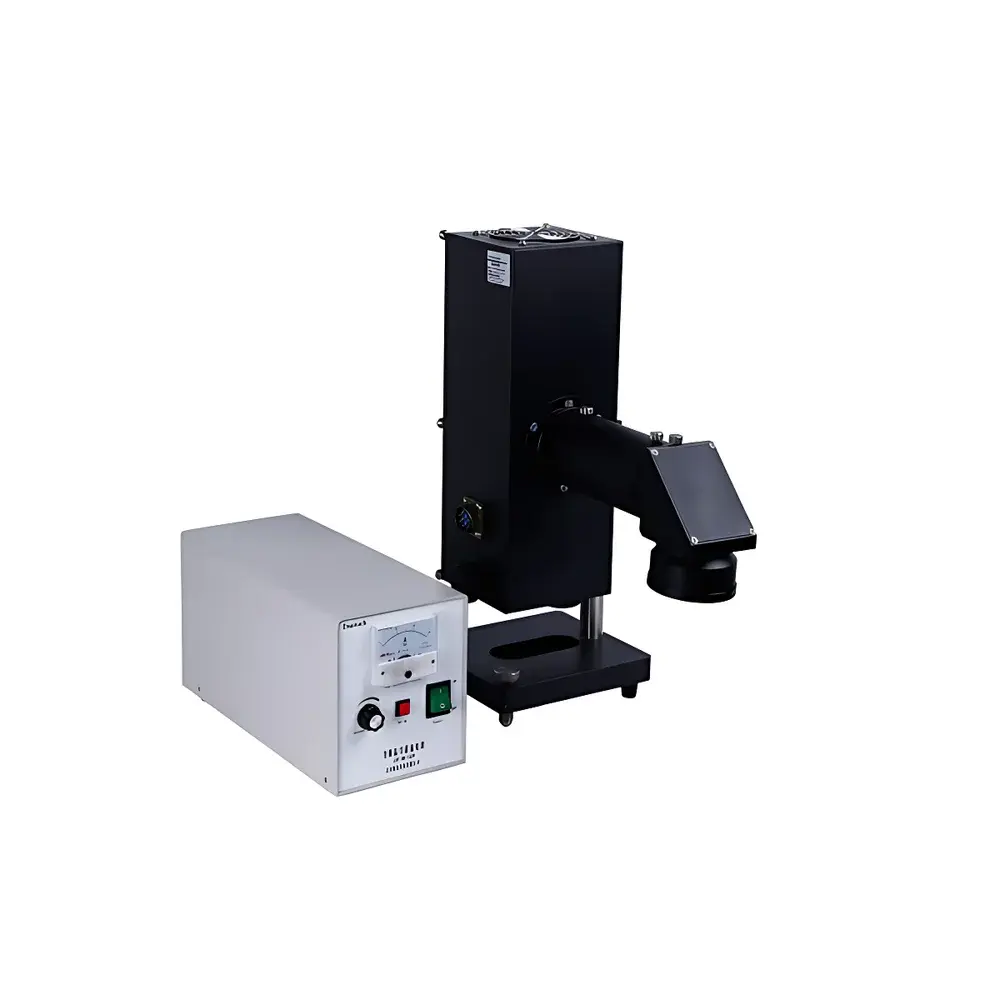
PerfectLight CHF-XM500 Xenon Light Source
| Brand | PerfectLight |
|---|---|
| Origin | Beijing, China |
| Model | CHF-XM500 |
| Light Source Type | Xenon Lamp |
| Illumination Mode | External Irradiation |
| Optical Output Modes | Point Source, Collimated Beam, Fiber Coupling |
| Point Source Diameter | 4–6 mm |
| Collimated Beam Diameter | 50 mm (adjustable up to Φ60 mm) |
| Beam Divergence | ≤0.85° (at working distance <250 mm) |
| Spectral Range | 300–1100 nm |
| Spectral Continuity | Continuous UV-Vis-NIR output (200–2000 nm typical lamp emission) |
| Beam Uniformity | ≤±11% over Φ60 mm area |
| Local Uniformity | ≤±5% over 2 cm × 2 cm region |
| Optional Accessories | Fiber coupling kits (two fiber types), bandpass/longpass/shortpass filters, high-pressure xenon lamps (35 W to 500 W), calibrated optical power meter, UV-blocking safety goggles, lens cleaning cloth |
Overview
The PerfectLight CHF-XM500 Xenon Light Source is a high-stability, externally irradiating broadband illumination system engineered for quantitative photochemical and optoelectronic research. It operates on the principle of high-intensity arc discharge in pressurized xenon gas, delivering continuous spectral irradiance from the deep ultraviolet (300 nm) through the visible and into the near-infrared (1100 nm), with intrinsic emission extending from 200 nm to 2000 nm. Unlike pulsed or LED-based sources, the CHF-XM500 provides steady-state, spectrally stable output essential for quantum yield determination, time-resolved photocurrent measurement, and standardized solar simulation protocols. Its design emphasizes beam homogeneity, spectral fidelity, and mechanical adaptability—critical parameters for reproducible photoreactor calibration, solar cell I-V characterization, and spatially resolved photoelectrochemical (PEC) studies.
Key Features
- Triple-output flexibility: Switch seamlessly between point-source mode (4–6 mm diameter, high irradiance density), collimated-beam mode (50 mm nominal aperture, ≤0.85° divergence), and fiber-coupled output—enabling integration with monochromators, spectrophotometers, and remote irradiation setups.
- High spatial uniformity: Achieves ≤±11% irradiance variation across a Φ60 mm collimated beam and ≤±5% over a 2 cm × 2 cm test area—meeting ASTM E927-22 requirements for Class AAA solar simulator uniformity in small-area device testing.
- Broadband spectral continuity: Delivers uninterrupted photon flux from 300–1100 nm without discrete peaks or gaps; exhibits strong emission intensity in the 800–1200 nm NIR region—valuable for studying silicon-based photovoltaics and NIR-responsive photocatalysts.
- Modular lamp compatibility: Supports interchangeable high-pressure xenon lamps ranging from 35 W to 500 W, allowing users to optimize irradiance level, thermal load, and lifetime per application—e.g., low-wattage lamps for long-duration quantum efficiency measurements, high-wattage variants for accelerated photocatalytic degradation kinetics.
- Optical scalability: Optional accessories include precision filter wheels (UV-cut, VIS-bandpass, NIR-transmitting), calibrated NIST-traceable power meters, and dual-type fiber interfaces (SMA905 and FC/PC) for spectral delivery to confined or hazardous environments.
Sample Compatibility & Compliance
The CHF-XM500 is routinely deployed in ISO/IEC 17025-accredited laboratories for photostability testing, photocatalytic activity benchmarking (per ISO 22197-1 for NO removal and ISO 22197-2 for acetaldehyde degradation), and solar simulator validation (IEC 60904-9 Ed. 3). Its external irradiation geometry enables direct coupling with custom-built quartz reactors, electrochemical cells with optically transparent electrodes, and multi-junction solar cell test fixtures. The system complies with EN 62471 (Photobiological Safety) when used with supplied UV-blocking goggles and adheres to GLP documentation requirements via optional audit-ready power logging modules. All lamp housings meet IP20 environmental protection standards and are designed for stable operation under continuous duty cycles exceeding 1,000 hours at rated wattage.
Software & Data Management
While the CHF-XM500 operates as a hardware-controlled light source without embedded firmware, it is fully compatible with third-party data acquisition platforms including LabVIEW, Python (via PyVISA), and MATLAB for synchronized irradiance logging, shutter control, and closed-loop intensity regulation. When paired with a calibrated thermopile-based power meter (e.g., Ophir PD300-UV), users can generate time-stamped irradiance reports traceable to NIST SRM 2210. All filter configurations and lamp operating parameters (current, voltage, elapsed runtime) are manually recorded in laboratory notebooks per FDA 21 CFR Part 11–compliant SOPs—ensuring full experimental traceability during regulatory audits.
Applications
- Quantum yield measurement in heterogeneous photocatalysis (e.g., TiO₂, g-C₃N₄, MOFs)
- Photoelectrochemical (PEC) characterization of semiconductor electrodes under simulated AM1.5G illumination
- I-V curve tracing and external quantum efficiency (EQE) mapping of single- and multi-junction photovoltaic devices
- Gas-phase photocatalytic oxidation of VOCs (formaldehyde, toluene, NOₓ) in flow-through reactors
- Liquid-phase degradation kinetics of organic dyes (methylene blue, rhodamine B) and aromatic pollutants (phenol, benzene derivatives)
- UV-Vis-NIR spectroelectrochemistry and transient absorption spectroscopy pump-probe alignment
- Photopolymerization and photoinitiated crosslinking of functional thin films
FAQ
What spectral range is actively utilized in standard operation?
The CHF-XM500 delivers usable irradiance from 300 nm to 1100 nm; while the xenon arc emits from ~200 nm to 2000 nm, fused silica optics and standard lamp envelopes attenuate below 300 nm and above 1100 nm.
Can this source be used for accelerated aging tests per ISO 4892-2?
Yes—when equipped with appropriate UV-enhancing filters and radiometric calibration, it satisfies the spectral irradiance requirements for xenon-arc exposure testing of polymeric materials.
Is the collimated output compliant with IEC 60904-9 for solar simulator classification?
The ≤±5% local non-uniformity over 2 cm × 2 cm meets Class AAA spatial uniformity criteria for small-area PV devices; full-classification requires additional spectral match and temporal stability verification using reference cells.
How is lamp aging compensated during long-term experiments?
Users perform periodic recalibration using a traceable power meter; lamp runtime and operating current are logged to estimate spectral drift—typical xenon lamp output declines by ≤5% over first 100 hours and stabilizes thereafter.
Are optical safety interlocks available?
No integrated interlock is included, but the unit features a rear-panel TTL-compatible shutter trigger port for external safety circuit integration per EN 61511.





