
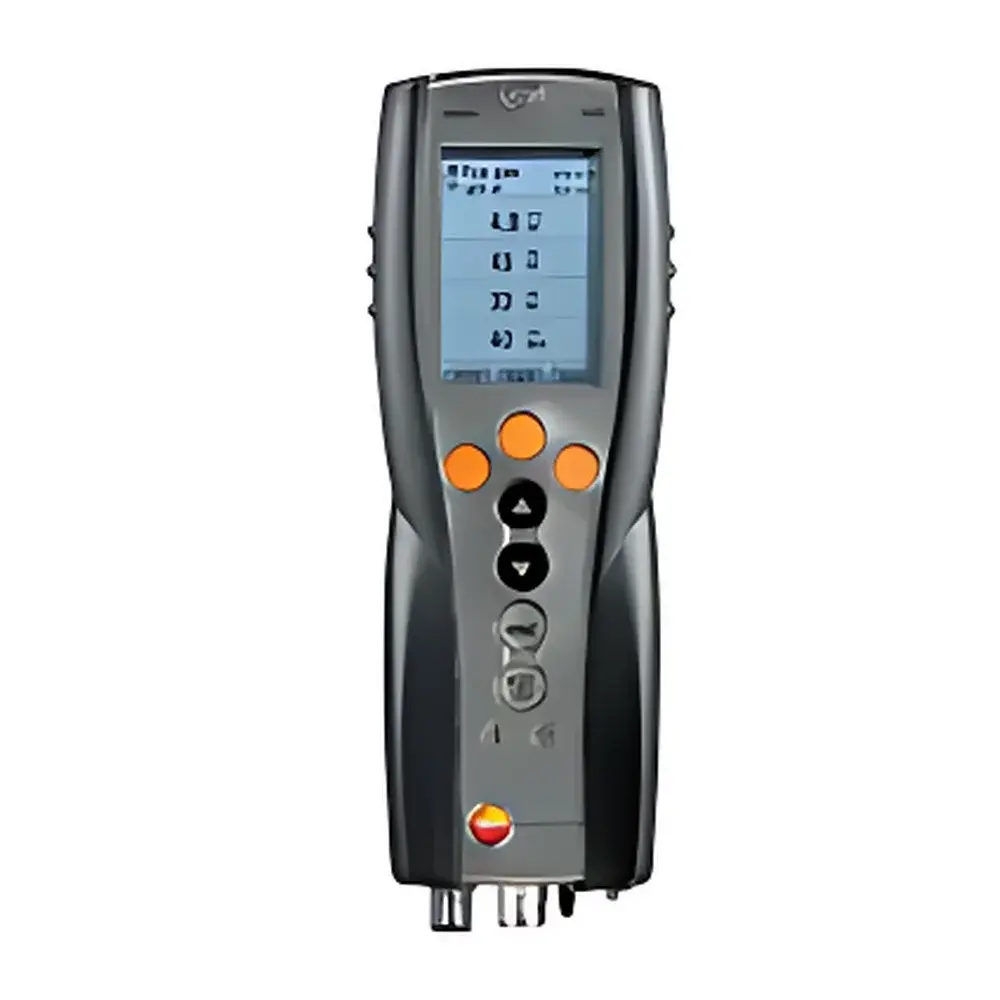
testo 340 Portable Flue Gas Analyzer
| Origin | Germany |
|---|---|
| Manufacturer Type | Authorized Distributor |
| Origin Category | Imported |
| Model | testo 340 |
| Pricing | Upon Request |
| Display | Graphical, 160 × 240 pixels |
| Operating Temperature | −5 to +50 °C |
| Storage Temperature | −20 to +50 °C |
| Weight | 960 g |
| Standard Sensors | O₂, Differential Pressure / Flow Velocity |
| Sensor Slots | 3 configurable (O₂ pre-installed |
| Expandable Range | Single-sensor or full-sensor range extension option |
| Pump | Automatic flow-controlled sampling pump |
| Data Logging | Internal memory |
| Connectivity | USB interface for easyEmission PC software (optional) |
| Fuel Library | 10 preloaded + 10 user-defined fuels |
| Compliance | Designed for EN 50379-1/2, DIN EN 15548-1, VDI 3862, and applicable EU emission monitoring directives |
Overview
The testo 340 Portable Flue Gas Analyzer is an engineered solution for precision combustion efficiency assessment and regulatory-compliant flue gas emission monitoring in industrial, commercial, and municipal heating systems. Based on electrochemical sensor technology and differential pressure–based velocity calculation, the instrument delivers real-time, trace-level quantification of key combustion gases—including O₂, CO, NO, NO₂, SO₂, and COlow—alongside flue gas temperature, draft pressure, and volumetric flow rate. Its modular architecture enables field-configurable sensor combinations, supporting both routine maintenance diagnostics and compliance verification under evolving environmental regulations such as the EU Industrial Emissions Directive (IED 2010/75/EU) and national implementation standards like Germany’s TA Luft. The device operates within a rigorously validated thermal envelope (−5 °C to +50 °C), ensuring stable electrochemical response across seasonal operational environments.
Key Features
- Modular sensor platform with one fixed O₂ channel and three interchangeable sensor slots—enabling flexible configuration for application-specific gas matrices (e.g., CO/NO/SO₂ for coal-fired boilers; COlow/NO/NO₂ for low-emission gas turbines).
- Integrated differential pressure and Pitot-static flow measurement module, enabling direct calculation of flue gas velocity and volumetric flow without external transducers.
- Auto-ranging electrochemical sensors with optional single-channel or full-array span extension—maintaining measurement integrity across wide concentration gradients (e.g., CO from 0–100 ppm up to 0–10,000 ppm).
- Intelligent flow-controlled sampling pump with automatic adjustment to probe backpressure, ensuring consistent sample draw rate and minimizing condensation-induced sensor drift.
- High-contrast graphical display (160 × 240 pixels) with intuitive icon-driven menu navigation—designed for glove-compatible operation in confined boiler rooms or rooftop mechanical spaces.
- Robust industrial housing (IP54-rated) and 960 g mass optimized for extended handheld use during multi-point stack surveys or continuous commissioning tasks.
Sample Compatibility & Compliance
The testo 340 is validated for use with dry and moderately humid flue gases from solid, liquid, and gaseous fuel combustion sources—including natural gas, light oil, biomass, and anthracite. It meets the functional safety and metrological requirements of EN 50379-1 (portable gas analyzers) and EN 50379-2 (performance criteria), and supports measurement traceability per DIN EN 15548-1 for combustion efficiency calculations. Its built-in fuel library—comprising 10 standardized fuels (e.g., natural gas G20, diesel G30) and 10 customizable entries—facilitates stoichiometric air ratio (λ) and excess air correction per VDI 3862 and ISO 5167. All sensor calibrations are factory-traceable to NIST- or PTB-certified reference gases, and calibration certificates are included with each unit.
Software & Data Management
Data acquisition and reporting are managed via the optional easyEmission PC software (Windows-based), which connects seamlessly via USB. The software provides GLP-compliant data logging—including time-stamped sensor readings, ambient conditions, probe position metadata, and operator ID fields. It supports automated report generation compliant with DIN EN 15318 and EU Monitoring Plan templates, with export options to CSV, PDF, and XML formats. Audit trail functionality records all parameter changes, calibration events, and firmware updates—meeting documentation expectations for ISO 17025-accredited labs and facilities operating under EU ETS or local air quality permitting regimes.
Applications
- Combustion optimization of residential, commercial, and district heating boilers—reducing fuel consumption and NOₓ emissions through λ tuning and CO minimization.
- Periodic emission verification for stationary engines and gas turbines under national BAT conclusions and IED Annex II monitoring schedules.
- Pre-commissioning and post-maintenance flue gas benchmarking—validating burner alignment, heat exchanger integrity, and draft system performance.
- Educational and vocational training in HVAC engineering programs, where modular sensor reconfiguration supports pedagogical exploration of stoichiometry and pollutant formation kinetics.
- Third-party energy audits conducted under ISO 50002 or national energy service company (ESCO) frameworks.
FAQ
What is the minimum number of sensors required for operation?
The testo 340 requires at least two active sensors—including the pre-installed O₂ sensor—to calculate combustion parameters such as excess air, efficiency, and CO₂ concentration.
Can the instrument measure flue gas velocity directly?
Yes—the integrated differential pressure sensor and Pitot-static probe interface enable real-time velocity calculation using Bernoulli’s principle and measured ΔP across a known probe geometry.
Is the testo 340 suitable for wet flue gas sampling?
It is designed for use with conditioned (dried) or low-humidity flue gases; for high-moisture applications, pairing with a heated sampling line and condensate trap is recommended to prevent sensor saturation.
Does the device support 21 CFR Part 11 compliance?
While the hardware itself does not include electronic signature capability, the easyEmission software offers configurable user access levels, audit trails, and electronic record retention aligned with FDA expectations for regulated environments.
How often must the electrochemical sensors be recalibrated?
Testo recommends functional verification before each measurement series using certified span gas; full recalibration is advised every 6–12 months depending on usage intensity and exposure to corrosive species such as SO₂ or HCl.







