
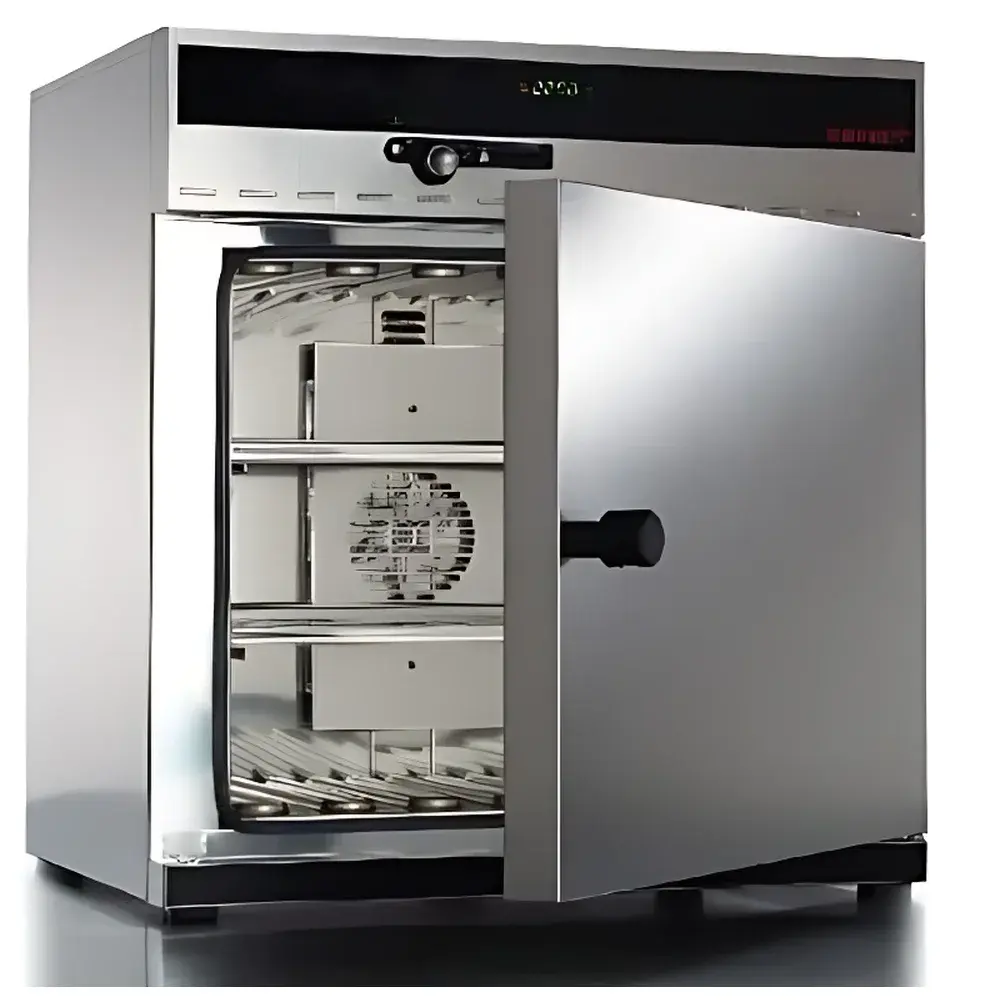
Memmert UFB500 Forced Convection Drying Oven
| Origin | Germany |
|---|---|
| Manufacturer Type | Authorized Distributor |
| Origin Category | Imported |
| Model | UFB500 |
| Pricing | Upon Request |
Overview
The Memmert UFB500 Forced Convection Drying Oven is an engineered solution for precision thermal processing in research laboratories, quality control environments, and industrial R&D facilities. Designed and manufactured in Germany to DIN 12880 (Class 1.5) and EN 61000-6-3 standards, the UFB500 employs a robust forced-air circulation system driven by a maintenance-free, brushless centrifugal fan—ensuring uniform temperature distribution and rapid thermal response across its 108 L working chamber. Its core operating principle relies on controlled convective heat transfer, where heated air is actively circulated through adjustable inlet/outlet dampers and a precisely balanced airflow path, minimizing thermal gradients and enabling reproducible drying, curing, sterilization, and aging protocols. The oven operates within a temperature range of ambient +5 °C (minimum 30 °C) to 220 °C (optionally up to 300 °C), with stability and homogeneity validated per DIN 12880 methodology. All structural components—including the interior chamber, sliding shelves, and door frame—are fabricated from 1.4301 stainless steel (ASTM A240 Type 304), offering full resistance to corrosion, repeated cleaning agents, and long-term thermal cycling.
Key Features
- 108 L usable chamber volume with dimensions (W × H × D): 560 × 480 × 400 mm; external footprint (with castors): 710 × 760 × 550 mm
- Triple-layer safety architecture: mechanical temperature limiter (TB Class 1), redundant electronic overtemperature cut-off (±10 °C above setpoint for U/S variant; ±3 °C for I variant), and microprocessor-based Pt100 A-class sensor monitoring with automatic fault diagnosis
- Four-wire Pt100 temperature sensor (A-class accuracy) integrated into dual-loop control—providing ±0.5 °C display and setting resolution, and ≤±0.5 °C temperature deviation at 150 °C (U/S) or ≤±0.2 °C at 37 °C (I)
- Adjustable fresh-air damper (manual or servo-motor controlled), programmable fan speed (0–100% in 10% increments), and optional P-level airflow modulation for process-critical applications
- Three control tiers: Basic (B), Enhanced (E), and Premium (P)—supporting single-point operation, multi-segment ramp/soak programming, and full GLP-compliant data logging
- Integrated 1024 kB circular memory buffer storing real-time temperature, time, setpoints, alarms, and error events at user-defined intervals (down to 1 min); data retention ≈6 months at 1-min sampling
Sample Compatibility & Compliance
The UFB500 accommodates standard laboratory sample formats—including Petri dishes, glassware, metal trays, and polymer test specimens—on five load-rated stainless steel sliding shelves (30 kg max per shelf, 60 kg total chamber load). Its corrosion-resistant 1.4301 chamber surface complies with ISO 8502-3 for cleanliness validation and supports routine decontamination using ethanol, hydrogen peroxide vapor, or low-concentration alkaline solutions. The unit meets CE marking requirements under Directive 2014/30/EU (EMC) and 2014/35/EU (LVD), and conforms to IEC 61010-1 for laboratory equipment safety. Optional STERI chip cards enable automated 160 °C/4 h internal sterilization cycles—validated for microbiological containment compliance. For regulated environments, the Celsius 2007 software (Windows NT4 through Windows 10 compatible) provides audit-trail-capable configuration, calibration history, and exportable CSV/PDF reports compliant with FDA 21 CFR Part 11 when used with password-protected user roles and digital signature modules.
Software & Data Management
The UFB500 integrates seamlessly with Memmert’s Celsius 2007 software suite—freely available for Windows platforms—which enables remote configuration, unlimited multi-step program creation (ramp, soak, cooling, fan/damper sequencing), and real-time visualization of chamber dynamics. Data logging supports simultaneous tracking of temperature, fan speed, damper position, and alarm status. Export functionality includes timestamped .csv files for statistical process control (SPC) analysis and PDF-formatted validation reports meeting ISO/IEC 17025 documentation requirements. The oven features a parallel printer port (PCL3-compatible) for direct hardcopy output, with optional USB-to-parallel adapters available. Internal memory retains full operational history even during power loss, and firmware updates are performed via SD card (XL format, 32 KB capacity) or direct PC connection—ensuring long-term maintainability without hardware modification.
Applications
The UFB500 serves critical functions across pharmaceutical QC (moisture content determination per USP ), materials science (polymer curing kinetics, catalyst activation), electronics manufacturing (PCB pre-baking, conformal coating drying), and food safety labs (AOAC moisture loss assays). Its high-precision thermal control and documented homogeneity support ASTM D1654 (coating corrosion testing), ISO 188 (rubber aging), and EN 13823 (fire reaction testing) protocols. In biotechnology settings, it facilitates sterile instrument storage (via STERI cycle), media preparation drying, and lyophilization pre-conditioning. The P-level configuration further enables dynamic environmental simulation—such as accelerated aging of medical device packaging per ISO 11607-1.
FAQ
What is the maximum certified operating temperature of the UFB500?
The standard UFB500 model is certified for continuous operation up to 220 °C; an optional high-temperature version extends this to 300 °C with modified insulation and sensor calibration.
Does the UFB500 support GLP/GMP-compliant data integrity?
Yes—when paired with Celsius 2007 software, configurable user access levels, electronic signatures, and tamper-evident audit trails satisfy ALCOA+ principles and 21 CFR Part 11 requirements.
Can the oven be validated for IQ/OQ/PQ protocols?
Absolutely—the unit ships with a single-point calibration certificate (center-point at 160 °C for U/S or 37 °C for I), and its documented temperature uniformity (≤±2.7 °C at 150 °C per DIN 12880) forms the basis for formal qualification.
Is remote monitoring possible without dedicated cabling?
While the base model uses RS232/parallel interfaces, Ethernet and Wi-Fi connectivity modules are available as factory-installed options for integration into centralized lab infrastructure.
How does the UFB500 handle power interruptions?
All active programs and logged data are retained in non-volatile memory; upon power restoration, the unit resumes operation from the last valid state or enters safe standby mode per user-configurable policy.



