
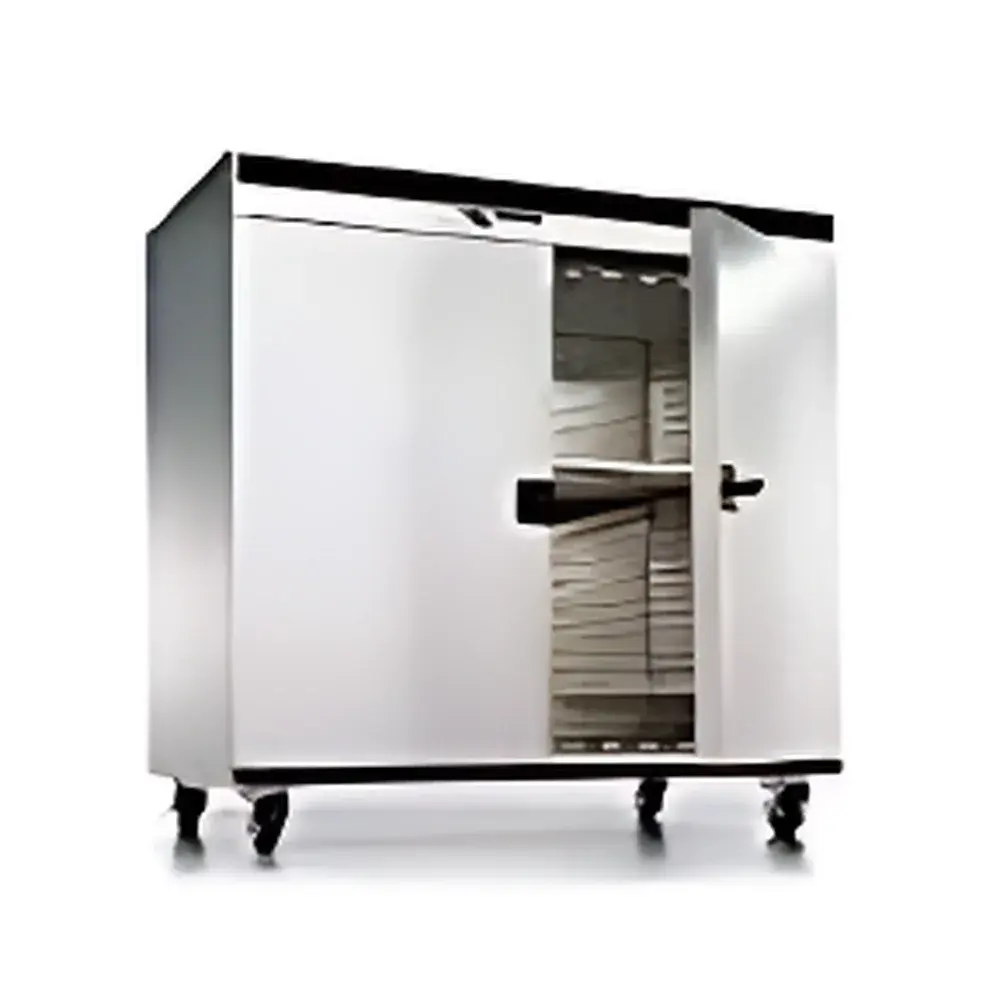
Memmert UFE800 Forced Convection Drying Oven
| Origin | Germany |
|---|---|
| Manufacturer Type | Authorized Distributor |
| Origin Category | Imported |
| Model | UFE800 |
| Pricing | Upon Request |
| Internal Volume | 749 L |
| External Dimensions (W×H×D) | 1190 × 1620 × 750 mm |
| Net Weight | 170 kg |
| Temperature Range | RT +5 °C (min. 30 °C) to 220 °C / 300 °C (optional) |
| Temperature Uniformity (DIN 12880) | ≤ ±2.2 °C at 150 °C |
| Control System | E-Class (Enhanced Electronic PID with Fuzzy Logic) |
| Sensor Configuration | Dual 4-wire Pt100 (Class A) |
| Data Logging | 1024 kB circular memory, 1-min intervals, ≥6 months retention |
| Interface | RS232, optional USB via converter |
| Software | Celsius 2007 (Windows NT4/2000/XP/Vista compatible) |
| Compliance | TB Class 1, TWW Class 3.1, TWB Class 2, GLP-ready audit trail support |
Overview
The Memmert UFE800 Forced Convection Drying Oven is an industrial-grade, DIN-compliant thermal processing system engineered for precision drying, heat treatment, aging studies, and stability testing in regulated laboratory and quality control environments. Utilizing forced-air convection driven by a high-efficiency turbine fan, the UFE800 ensures rapid thermal equilibration and exceptional temperature homogeneity across its 749 L working chamber—validated per DIN 12880 at ≤ ±2.2 °C at 150 °C. Constructed entirely from electropolished 1.4301 stainless steel (ASTM A240/A312 Grade 304), both interior and exterior surfaces resist corrosion, withstand repeated cleaning with ethanol or hydrogen peroxide, and comply with ISO 14001 material recyclability requirements. The unit operates within a certified temperature range of ambient +5 °C (minimum operational setpoint 30 °C) to 220 °C standard, extendable to 300 °C upon configuration—making it suitable for accelerated shelf-life testing (ASLT), polymer curing, moisture loss analysis (e.g., ASTM D2244, USP <641>), and residual solvent removal under GMP/GLP conditions.
Key Features
- Robust 1.4301 stainless steel chamber and door—deep-drawn, fully welded (no spot welding), ensuring structural integrity and long-term dimensional stability
- Dual independent 4-wire Pt100 Class A temperature sensors with automatic fault detection and redundant operation: one active sensor maintains control while the second provides continuous monitoring and fail-safe redundancy
- E-Class microprocessor controller featuring fuzzy-logic PID algorithm, three-point auto-calibration, and adaptive ramp-soak programming with up to 40 programmable segments (via front panel or Celsius 2007 software)
- Three-tier overtemperature protection: mechanical safety limiter (TB Class 1), electronic cut-off (TWW Class 3.1), and microprocessor-based dynamic monitoring (TWB Class 2) with ASF (Automatic Setpoint Following) functionality
- Adjustable fresh-air inlet damper (manually or servo-motor actuated) and 10–100% stepwise fan speed control (10% increments) for precise atmosphere management during sensitive thermal processes
- Integrated 1024 kB non-volatile memory logging all setpoints, actual values, alarms, timestamps, and error codes at user-defined intervals (default: 1 minute); data retention exceeds six months
- RS232 serial interface with native support for Celsius 2007 software—enabling remote configuration, real-time monitoring, electronic signature-capable report generation, and 21 CFR Part 11 compliant audit trails when deployed with validated IT infrastructure
Sample Compatibility & Compliance
The UFE800 accommodates diverse sample formats—including Petri dishes, glass vials, aluminum weighing pans, stainless-steel trays, and polymer test coupons—on fourteen adjustable sliding stainless-steel shelves (max. load 30 kg/shelf, total chamber capacity 160 kg). Its sealed, low-leakage chamber design minimizes cross-contamination and supports applications requiring controlled oxidative environments. Regulatory alignment includes conformity with EN 61010-1 (safety), EN 61326-1 (EMC), and adherence to key pharmacopeial standards: USP <1211> (Sterility Assurance), EP 2.6.27 (Thermal Sterilization), and ISO 17025 clause 5.10.2 (data integrity). Optional STERI card integration enables automated 4-hour, 160 °C internal chamber sterilization cycles—critical for microbiological incubation pre-conditioning in cleanroom-adjacent QC labs.
Software & Data Management
Celsius 2007 serves as the validated platform for full lifecycle instrument control and data governance. It supports unlimited segment programming, multi-parameter scheduling (temperature, airflow, damper position), and export of timestamped CSV or PDF reports with embedded digital signatures. The software implements role-based access control (RBAC), electronic audit trails tracking all parameter changes, user logins, and calibration events—fully traceable per FDA 21 CFR Part 11 Annex 11 and EU GMP Annex 11 requirements. Raw log files are stored in encrypted binary format; conversion utilities ensure compatibility with LIMS and ELN systems. All firmware updates undergo rigorous version-controlled validation prior to deployment.
Applications
- Pharmaceutical: Residual moisture determination (ICH Q5C), excipient drying, stability chamber qualification (ICH Q1A–Q1E), and depyrogenation validation
- Materials Science: Thermal aging of composites, catalyst activation, ceramic sintering pre-bake, and polymer degradation kinetics
- Food & Agriculture: Moisture content analysis (AOAC 950.46), fat extraction residue drying, and mycotoxin reference standard conditioning
- Electronics: PCB pre-baking prior to conformal coating, solder paste storage conditioning, and humidity preconditioning per IPC/JEDEC J-STD-033
- Academic Research: Kinetic modeling of desorption isotherms, Arrhenius-based shelf-life prediction, and thermogravimetric method development
FAQ
What is the maximum allowable operating temperature for the UFE800?
The standard configuration supports up to 220 °C; a factory-configured 300 °C option is available upon order specification.
Does the UFE800 meet GLP/GMP data integrity requirements?
Yes—when used with Celsius 2007 under validated IT infrastructure, it fulfills ALCOA+ principles and provides complete audit trails, electronic signatures, and secure data export per 21 CFR Part 11.
Can the chamber be sterilized in situ?
Yes—using the optional STERI chip card, the internal chamber undergoes a validated 4-hour cycle at 160 °C, documented with time-temperature profiles and pass/fail verification.
How is temperature uniformity verified and documented?
Each unit ships with a Single-Point Calibration Certificate (center-point, 160 °C), and full mapping per ISO/IEC 17025 can be performed using external calibrated probes and Memmert’s optional mapping kit.
Is remote monitoring supported without third-party middleware?
Yes—native RS232 communication allows direct connection to PCs or PLCs; no proprietary gateways or cloud dependencies are required for real-time telemetry or alarm notification.



