
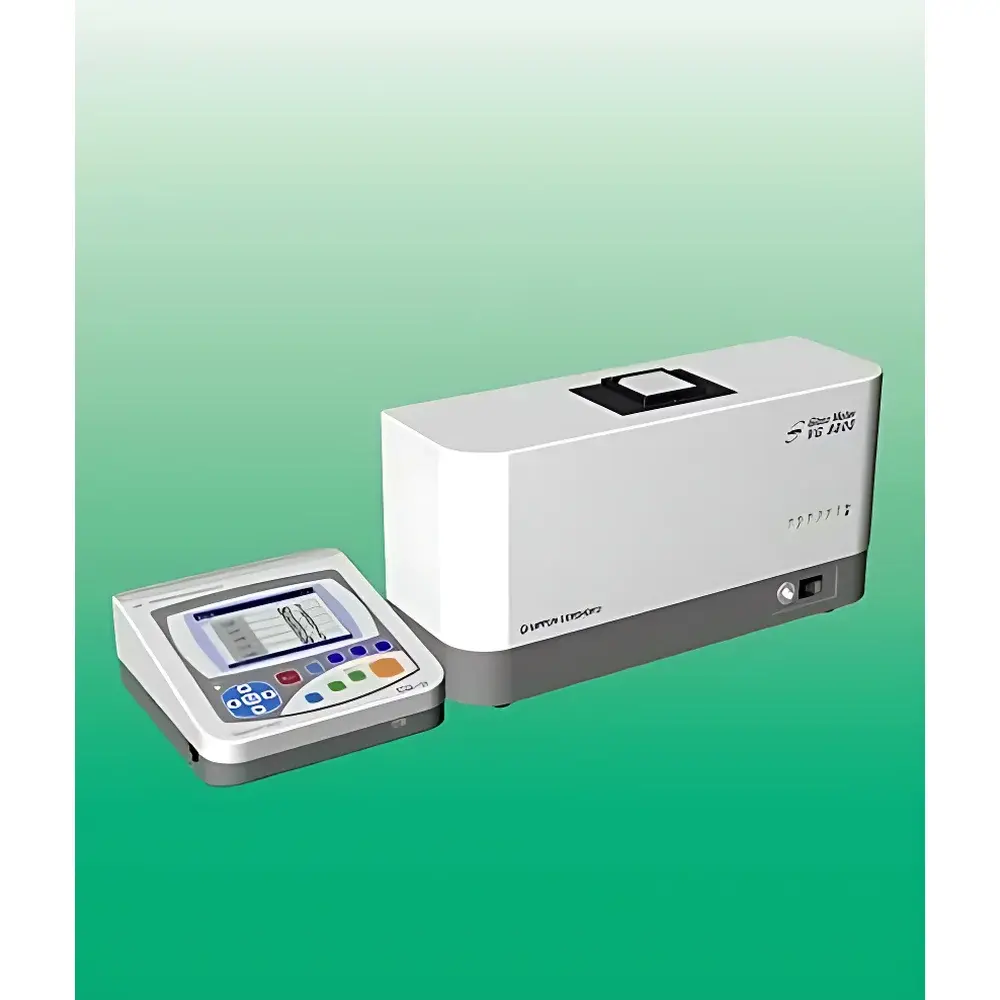
NIPPON DENSHOKU VG8000 Advanced Multi-Angle Gloss Meter
| Brand | NIPPON DENSHOKU |
|---|---|
| Origin | Japan |
| Model | VG8000 |
| Measurement Angles | 20°, 45°, 60°, 75°, 85° |
| Gloss Range | 0.1–2038 GU (20°) to 0.1–162 GU (85°) |
| Aperture | 14 mm × 45 mm |
| Measurement Time | ≤1 s (single angle), ≤4 s (five angles) |
| Accuracy | ±0.1% after 30-min warm-up (vs. standard white tile) |
| Repeatability | ≤0.1% (20 measurements, 10-s interval, 23°C) |
| Operating Environment | 10–40°C, 30–80% RH (non-condensing) |
| Power Supply | 100–240 V AC, 50/60 Hz, 20 W |
| Dimensions | 483 × 157 × 240 mm (W×D×H) |
| Weight | ~13 kg |
| Compliance | ISO 8254-1, ISO 8254-3, JIS Z 8741, JIS P 8142, TAPPI T 480 |
Overview
The NIPPON DENSHOKU VG8000 is a high-precision, multi-angle gloss meter engineered for rigorous surface quality control in industrial R&D and production environments. It operates on the principle of specular reflectance measurement—quantifying the ratio of reflected luminous flux at a defined geometry relative to that from a reference black glass standard (defined as 100 GU at 60°). Unlike single-angle instruments, the VG8000 supports five standardized incident/viewing angles (20°, 45°, 60°, 75°, and 85°), enabling comprehensive characterization of surface optical behavior across matte, semi-gloss, and high-gloss materials. Its optical architecture features a stable white LED light source and a fast-response silicon photodiode detector, ensuring consistent spectral output and minimal thermal drift. The instrument is calibrated traceably to NIST-traceable standards and validated per ISO/IEC 17025-accredited procedures at the manufacturer’s Japanese facility. Designed for integration into QC workflows compliant with ISO 9001 and IATF 16949, the VG8000 delivers metrological reliability required for supplier audits, internal specification enforcement, and regulatory documentation.
Key Features
- Five-user-selectable measurement angles (20°, 45°, 60°, 75°, 85°) conforming to ISO 8254-1/-3, JIS Z 8741, JIS P 8142, and TAPPI T 480
- Large rectangular aperture (14 mm × 45 mm) optimized for heterogeneous surfaces including corrugated board, textured plastics, and coated metal sheets
- Integrated footswitch as standard—enabling hands-free operation during high-throughput sampling or glove-required environments
- Front-panel LED angle indicator—providing immediate visual confirmation of active geometry without menu navigation
- Thermally stabilized optical path with 30-minute warm-up protocol; achieves ±0.1% accuracy against certified reference tiles under controlled lab conditions (23°C ±2°C, 50% RH)
- Robust mechanical housing (aluminum alloy chassis) rated for continuous use in factory-floor environments with vibration damping mounts
Sample Compatibility & Compliance
The VG8000 accommodates flat and slightly curved specimens up to 30 mm thickness, with no minimum size restriction when using auxiliary fixtures. It is routinely deployed for gloss evaluation of paperboard (ISO 8254-1, JIS P 8142), automotive clearcoats (SAE J1546), architectural glass (EN 1096-2), injection-molded polypropylene housings (ISO 2813), and laminated vinyl flooring (ASTM D523). All firmware and calibration routines comply with ISO/IEC 17025 requirements for measurement uncertainty estimation. Device-level traceability includes full documentation of calibration history, reference standard certificates (certified black glass tiles, NIST-traceable), and environmental monitoring logs—supporting GLP/GMP audit readiness and FDA 21 CFR Part 11 data integrity requirements when paired with CU-1 control unit and validated software.
Software & Data Management
The VG8000 communicates via RS-232C serial interface to the optional CU-1 Control Unit or third-party SCADA/LIMS systems. The CU-1 provides real-time statistical process control (SPC) functions—including X-bar/R charts, capability indices (Cp/Cpk), and automated pass/fail flagging against user-defined upper/lower limits. Raw measurement data (angle, GU value, timestamp, operator ID, sample ID) is exportable in CSV or XML format for traceability. Firmware supports configurable audit trails with user authentication (password-protected access levels), electronic signatures, and immutable log storage—meeting ALCOA+ principles (Attributable, Legible, Contemporaneous, Original, Accurate) for regulated industries. No cloud dependency: all processing occurs locally to ensure data sovereignty and network isolation.
Applications
- Quality assurance of coated paper and folding cartons in packaging manufacturing (JIS P 8142, ISO 8254-1)
- Gloss uniformity mapping across automotive body panels and trim components (SAE J1546, ISO 2813)
- Batch-to-batch consistency verification of extruded PVC profiles and decorative laminates
- R&D of anti-glare optical films and matte-finish display cover glasses
- Supplier qualification testing for aerospace composite surface finishes (AMS 2420)
- Regulatory submission support for medical device packaging transparency specifications (ISO 11607-1)
FAQ
Does the VG8000 require annual recalibration?
Yes—NIPPON DENSHOKU recommends annual recalibration by an ISO/IEC 17025-accredited service center, including verification against primary reference standards and full uncertainty budget analysis.
Can it measure curved surfaces?
It is designed for flat specimens; slight curvature (<±2° deviation over 50 mm) is tolerable with reduced repeatability—use of vacuum sample holders or custom jigs is advised for reproducible positioning.
Is RS-232 the only communication interface?
Yes—no USB, Ethernet, or Bluetooth options are available; RS-232 ensures deterministic timing and electromagnetic compatibility in industrial settings.
What is the warranty coverage?
Standard 24-month limited warranty covering parts and labor for defects in materials and workmanship, excluding consumables and damage from misuse or unauthorized modification.
How is traceability documented?
Each unit ships with a Certificate of Calibration listing measured values vs. NIST-traceable standards, uncertainty budgets, environmental conditions during calibration, and technician accreditation details.





