
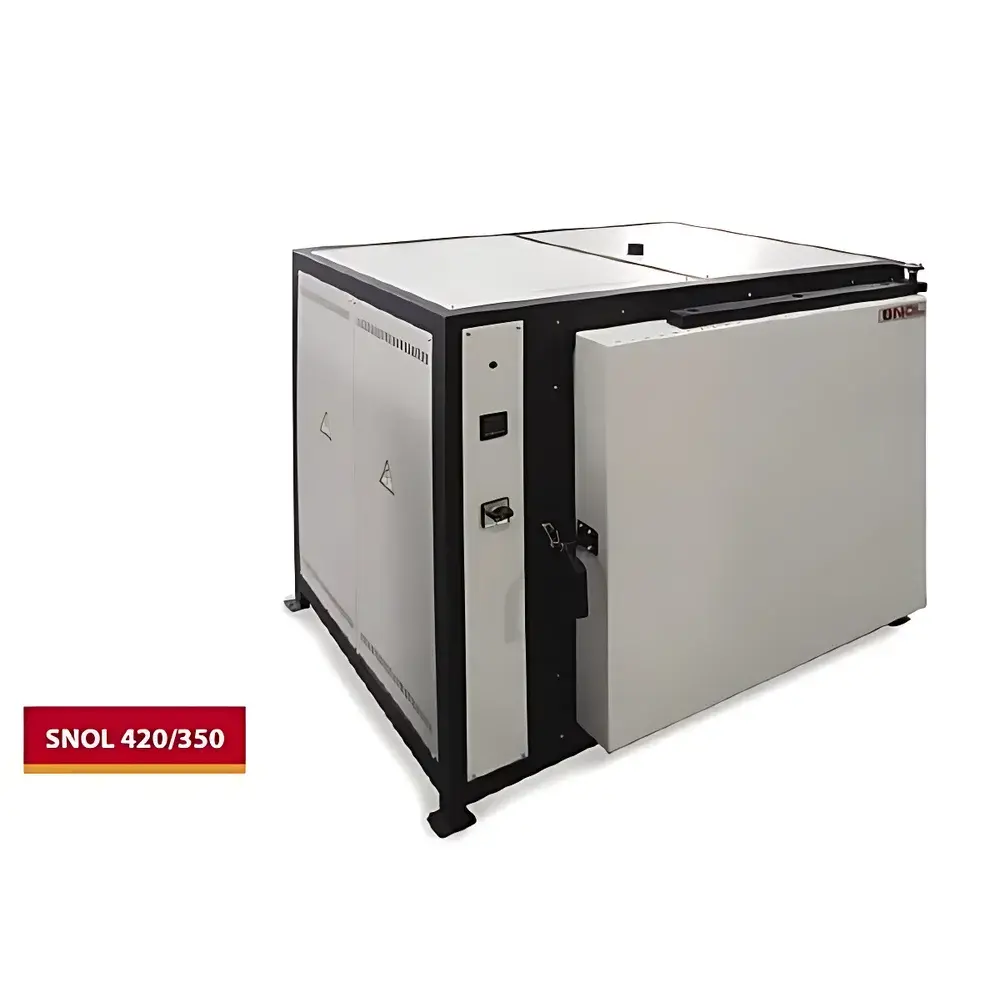
SNOL Industrial Low-Temperature Electric Drying Oven
| Origin | Imported |
|---|---|
| Manufacturer Type | Authorized Distributor |
| Model Series | SNOL 200/250/300/350 |
| Temperature Range | 200–350 °C |
| Temperature Uniformity | ±0.5 °C |
| External Dimensions (W×D×H) | 2200 × 2400 × 1990 mm |
| Internal Chamber Dimensions (W×D×H) | 1200 × 1800 × 1000 mm |
| Air Circulation | Horizontal or Vertical Forced Convection |
| Construction | Stainless Steel Inner Chamber |
| Control System | Microprocessor-Based PID Temperature Controller |
| Surface Finish | RAL 7035 Powder-Coated Exterior (Black Frame) |
| Standard Accessories | Two Adjustable Stainless Steel Shelving Units |
| Compliance | Designed for GLP/GMP-aligned thermal processing environments |
Overview
The SNOL Industrial Low-Temperature Electric Drying Oven is a precision-engineered forced-convection thermal processing system designed for reliable, repeatable heat treatment operations up to 350 °C. Operating on the principle of controlled air recirculation—either horizontal or vertical depending on model configuration—the oven ensures uniform thermal distribution across the entire working chamber, minimizing axial and radial temperature gradients. This architecture supports critical industrial processes including polymer curing, solvent evaporation, pre-baking of electronic components, stress-relief annealing of metallic substrates, and moisture removal from composite preforms. Unlike natural-convection ovens, the SNOL series integrates a high-efficiency centrifugal blower with adjustable airflow modulation, enabling rapid thermal equilibration and consistent dwell-time performance. All models are engineered for continuous-duty operation in production laboratories, QC facilities, and pilot-scale manufacturing lines where traceability, repeatability, and regulatory compliance are mandatory.
Key Features
- Forced-air convection system with selectable horizontal or vertical airflow orientation—optimized per model to match load geometry and thermal mass distribution
- Microprocessor-based PID temperature controller with real-time setpoint adjustment, ramp-soak programming, and auto-tuning capability
- Double-wall construction featuring high-density ceramic fiber insulation and stainless steel inner chamber (AISI 304 standard), ensuring low surface temperature rise and long-term dimensional stability
- Tightly sealed, right-hinged door with multi-point latching mechanism and high-temperature silicone gasketing for minimal thermal leakage
- Two standard adjustable stainless steel shelving units included; all shelves rated for ≥25 kg loading per level
- Energy-efficient heating elements mounted within insulated ductwork—reducing radiant hot spots and enhancing thermal response time
- Powder-coated RAL 7035 exterior finish (anthracite gray) with black structural framing—resistant to abrasion, corrosion, and chemical exposure in industrial lab environments
- Comprehensive safety architecture: over-temperature cut-off (independent mechanical thermostat), door-open interlock, and ground-fault circuit interruption
Sample Compatibility & Compliance
The SNOL drying oven accommodates a broad range of sample types—including PCB assemblies, injection-molded thermoplastics, sintered metal powders, ceramic green bodies, coated substrates, and pharmaceutical excipient blends—without risk of oxidation or contamination. Chamber volume options span from 75 L to 6480 L, supporting both benchtop validation runs and full-scale batch processing. All units comply with IEC 61000-6-3 (EMC emissions) and IEC 61000-6-2 (immunity) standards. The control firmware supports audit-ready operation under GLP and GMP frameworks, with optional RS232/RS-485/USB interfaces enabling integration into centralized monitoring systems. When equipped with the digital data logger and calibrated Pt100 sensor package, the oven meets requirements for ISO 17025-compliant calibration records and FDA 21 CFR Part 11–aligned electronic signatures (with appropriate software configuration).
Software & Data Management
While the base controller operates via intuitive front-panel interface, optional connectivity modules enable seamless integration with laboratory information management systems (LIMS) and SCADA platforms. The RS232/RS-485 serial interface supports Modbus RTU protocol for remote parameter readout, alarm status polling, and real-time temperature logging at user-defined intervals (1–60 s). USB-enabled models allow direct export of CSV-formatted thermal profiles—including setpoint, actual chamber temperature, ramp rate, and dwell duration—to external PCs without proprietary drivers. Optional data recorders provide timestamped, tamper-evident logs compliant with ALCOA+ principles (Attributable, Legible, Contemporaneous, Original, Accurate, Complete, Consistent, Enduring, Available). Calibration certificates—traceable to NIST or EU-accredited national metrology institutes—are provided with each unit upon factory verification.
Applications
- Pre-drying of moisture-sensitive electronic encapsulants prior to reflow soldering
- Curing of epoxy, silicone, and polyimide coatings on aerospace-grade composites
- Thermal conditioning of calibration standards (e.g., reference weights, optical filters)
- Accelerated aging studies per ASTM D573 and ISO 188 for elastomer stability assessment
- Residual solvent removal from lithium-ion battery electrode slurries
- Stabilization annealing of thin-film sensors and MEMS devices
- Batch drying of ceramic powder compacts before sintering
- Controlled dehydration of botanical extracts in nutraceutical R&D
FAQ
What is the maximum operating temperature for the SNOL 200-series ovens?
The SNOL 200-series is rated for continuous operation up to 200 °C; higher-temperature variants (SNOL 250, 300, 350) extend the upper limit to 250 °C, 300 °C, and 350 °C respectively.
Can the oven be validated for IQ/OQ/PQ protocols?
Yes—each unit ships with a Factory Acceptance Test (FAT) report. Optional IQ/OQ documentation packages—including temperature mapping templates, sensor calibration records, and installation checklists—are available upon request.
Is vertical airflow available across all model sizes?
Vertical convection is standard on larger-volume models (≥1300 L) due to improved thermal stratification control; smaller units default to horizontal airflow unless specified otherwise.
What maintenance intervals are recommended for the blower assembly?
The centrifugal blower requires biannual inspection of bearing integrity and impeller balance; lubrication is not required as it employs sealed-for-life bearings.
Does the oven support programmable multi-step thermal profiles?
Yes—the microprocessor controller supports up to 16 segments per program, including ramp, soak, and hold functions, with independent settings for rate (°C/min) and duration (minutes/hours).



