
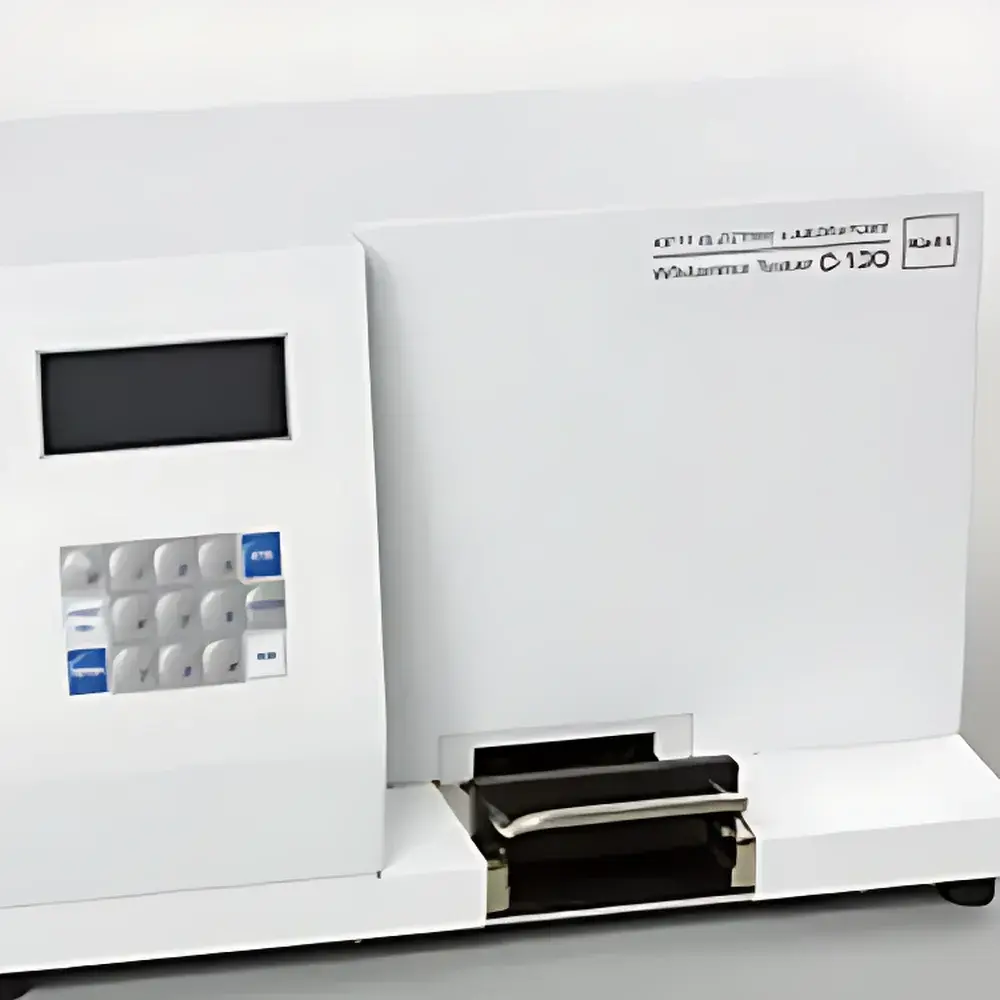
KETT C-130 Powder Whiteness Meter
| Brand | KETT |
|---|---|
| Origin | Japan |
| Manufacturer Type | Authorized Distributor |
| Origin Category | Imported |
| Model | C-130 |
| Pricing | Upon Request |
| Measurement Principle | Reflectance-based whiteness determination using blue LED illumination |
| Sample Type | Dry powdered materials (e.g., starch, flour, sugar, pharmaceutical powders, cement) |
| Measurement Range | 5.0–120.0 (whiteness index, scale-dependent on CIE/ISO/JIS reference conditions) |
| Sample Mass | ~5.5 g (for starch |
| Display | Digital fluorescent display, resolution 0.1 unit |
| Light Source | High-stability blue LED (λ ≈ 457 nm), compliant with ISO 2470-1 and JIS Z 8722 requirements for whiteness measurement |
| Calibration & Adjustment | Auto-sensitivity notification triggered by verification against included certified white standard tile |
| Data Handling | User-defined calibration curves, averaging function (up to 10 measurements), optional printer output via RS-232 interface |
| Power Supply | AC 100–120 V / 220–240 V, 50/60 Hz |
| Power Consumption | ≤16 W (typical operation: 4 W) |
| Dimensions | 375(W) × 220(D) × 250(H) mm |
| Weight | 7.0 kg |
Overview
The KETT C-130 Powder Whiteness Meter is a dedicated reflectance-based optical instrument engineered for precise, repeatable whiteness evaluation of free-flowing dry powders in industrial quality control and R&D environments. It operates in accordance with the fundamental principles defined in ISO 2470-1 (Paper, board and pulps — Measurement of diffuse blue reflectance factor), JIS Z 8722 (Methods of test for whiteness of pigments and powders), and ASTM E313 (Standard Practice for Calculating Yellowness and Whiteness Indices from Instrumentally Measured Color Coordinates). The C-130 employs a stable, narrow-band blue LED source centered at approximately 457 nm — the spectral region most sensitive to optical brightening agents (OBAs) and intrinsic pigment scattering — ensuring metrological consistency across batches and laboratories. Unlike broad-spectrum or xenon-based systems, this LED architecture minimizes thermal drift, eliminates warm-up time, and maintains long-term photometric stability without lamp replacement. Its compact footprint and reduced mass (7.0 kg) reflect a re-engineered mechanical layout optimized for benchtop deployment in QC labs, pilot plants, and regulatory-compliant manufacturing suites.
Key Features
- Blue LED illumination (457 nm) meeting ISO/JIS spectral bandwidth requirements for whiteness index calculation
- Integrated auto-sensitivity notification system: prompts user only when deviation from baseline calibration exceeds predefined tolerance, verified using supplied NIST-traceable white standard tile
- Tool-free maintenance access: sliding drawer removal and rear-tilt design expose bottom-mounted glass filter and sample rail for rapid cleaning with included lint-free cloth and soft brush
- Digital fluorescent display with 0.1-unit resolution and real-time numeric readout; no analog interpolation required
- User-definable calibration curves to accommodate material-specific reflectance behavior (e.g., high-scatter starch vs. low-reflectance cement)
- Averaging function for up to 10 consecutive measurements to improve statistical robustness in heterogeneous samples
- Low-power operation (4 W typical, ≤16 W max) enabling continuous use without thermal load concerns in temperature-controlled labs
Sample Compatibility & Compliance
The C-130 is validated for use with granular and powdered materials exhibiting particle sizes ranging from 500 µm (e.g., coarse granulated sugar), provided samples are homogeneously packed into the fixed-volume sample cup (~5.5 g for starch; mass adjusted per bulk density). It complies with GLP documentation requirements through traceable calibration logs and operator-verified standard tile checks. While not FDA 21 CFR Part 11–certified out-of-the-box, its manual calibration workflow supports audit-ready records when integrated into SOPs aligned with ICH Q5, USP , and ISO/IEC 17025–accredited testing protocols. The instrument does not require environmental humidity control but is rated for operation at 10–35°C and ≤80% RH (non-condensing).
Software & Data Management
The C-130 operates as a standalone hardware platform with no embedded operating system or cloud connectivity. All data handling occurs locally via front-panel controls. Measurement results can be exported via RS-232 serial interface to external PCs or label printers (e.g., for batch release tags). The averaging and user-curve functions are stored in non-volatile memory and persist through power cycles. No proprietary software driver is required for basic data capture; terminal emulation (e.g., Tera Term) suffices for ASCII-formatted output. For regulated environments, laboratories may implement CSV logging and version-controlled calibration records manually — a practice consistent with Annex 11 (EU GMP) and ALCOA+ data integrity principles.
Applications
- Quality assurance of food-grade starches and flours for consistency in baking performance and visual appeal
- Pharmaceutical excipient release testing (e.g., microcrystalline cellulose, lactose monohydrate) per USP general chapter
- In-process monitoring of titanium dioxide pigment dispersion in paint and coating formulations
- Raw material acceptance testing for cement and lime products where whiteness correlates with CaO purity and calcination efficiency
- Batch-to-batch comparison of optical brighteners in detergent powder manufacturing
- Academic research on light scattering mechanisms in particulate systems governed by Mie theory approximations
FAQ
Does the C-130 support multiple whiteness scales (e.g., CIE, Ganz, ASTM E313)?
No — it reports a single whiteness index calibrated against the included standard tile under fixed 457 nm illumination, aligned with ISO 2470-1 and JIS Z 8722. Conversion to other indices requires post-processing using known spectral reflectance data.
Is the white standard tile NIST-traceable?
Yes — each unit ships with a certified white ceramic tile, individually calibrated and documented with uncertainty values traceable to NMIJ (National Metrology Institute of Japan).
Can the C-130 measure wet pastes or slurries?
No — it is strictly designed for dry, free-flowing powders. Liquid-phase measurement introduces uncontrolled path-length and specular reflection artifacts incompatible with its fixed-geometry optical train.
What is the recommended recalibration frequency?
Per KETT’s technical bulletin TB-C130-Rev.3, recalibration is performed only upon auto-notification or after physical impact, filter cleaning, or relocation — typically every 3–6 months in stable lab conditions.
Is service support available outside Japan?
Yes — authorized KETT distributors in North America, EMEA, and APAC provide calibration verification, spare parts (e.g., replacement filters, sample cups), and technical documentation in English.



