
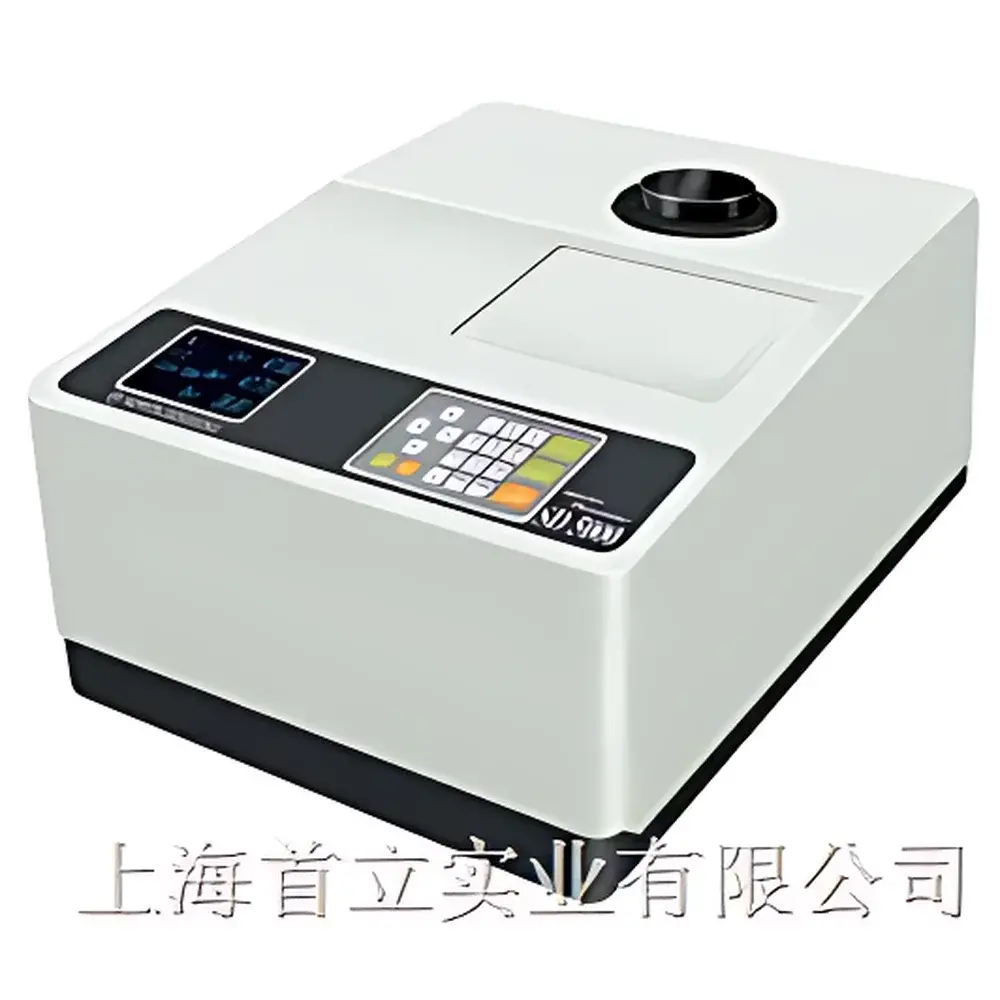
NIPPON DENSHOKU SD-5000 Benchtop Spectrophotometric Colorimeter
| Brand | NIPPON DENSHOKU |
|---|---|
| Origin | Japan |
| Model | SD-5000 |
| Instrument Type | Benchtop |
| Optical Geometry | 8°/diffuse (d) |
| Light Source | Tungsten Halogen Lamp |
| Spectral Range | 380 nm – 780 nm |
| Product Category | Spectrophotometric Colorimeter |
| Compliance | ISO 7724, CIE No. 15, ASTM E308, JIS Z 8722 |
Overview
The NIPPON DENSHOKU SD-5000 is a high-precision benchtop spectrophotometric colorimeter engineered for rigorous color measurement and quality control in industrial, R&D, and regulatory-compliant environments. Based on the CIE standard 8°/diffuse (d) optical geometry—commonly referred to as “sphere” configuration—the instrument captures total reflectance (including specular component excluded, SCE mode) across the full visible spectrum (380–780 nm) using a stabilized tungsten halogen lamp and a grating-based monochromator system. This architecture ensures stable spectral output, minimal thermal drift, and high photometric linearity—critical for inter-laboratory reproducibility and long-term calibration integrity. Designed for compliance with ISO 7724-1 (Colorimetry — Part 1: CIE standard colorimetric observers), CIE Publication No. 15 (Colorimetry, 3rd Edition), ASTM E308 (Standard Practice for Computing the Colors of Objects by Using the CIE System), and JIS Z 8722 (Method of color measurement for surface colors), the SD-5000 delivers traceable, metrologically sound data required for QC release, formulation matching, and supplier qualification.
Key Features
- Multi-metric color space display: Real-time visualization of spectral reflectance curves, ΔEab, ΔEcmc, ΔE94, ΔE00, L*a*b*, L*u*v*, Yxy, and Hunter Lab coordinates.
- Integrated statistical analysis engine: On-device computation of mean, standard deviation, min/max, and CPK indices—eliminating dependency on external spreadsheet tools for routine SPC charting.
- CSV export capability: Raw spectral data (10 nm or 20 nm intervals), color coordinates, and metadata exported directly to comma-separated values for seamless integration with LIMS, ERP, or custom analytics platforms.
- Flexible data import: Manual entry of reference spectra or target values enables retrospective comparison against legacy datasets or vendor-provided standards without re-measurement.
- Configurable pass/fail tolerance logic: User-definable acceptance criteria per parameter—including ΔL*, Δa*, Δb*, ΔEab, ΔEuv, and ΔELabE—with visual alerts and audit-trail logging aligned with GLP/GMP documentation requirements.
- Advanced search functionality: Indexed retrieval by sample ID, operator tag, timestamp, batch number, or measured value ranges—supporting rapid root-cause investigation during nonconformance events.
- Cross-application data interoperability: Copy-paste support for spectral plots and numeric tables into Microsoft Excel, PowerPoint, or statistical software—preserving formatting and units without manual transcription errors.
Sample Compatibility & Compliance
The SD-5000 accommodates a broad range of physical sample types without modification: flat or curved opaque solids (e.g., painted panels, plastic housings), translucent films, liquid cuvettes (10 mm pathlength), powdered specimens in standardized holders, coated paper stocks, and metallized surfaces—including those with directional gloss or texture-induced scattering. Its large-diameter integrating sphere (≥150 mm) and optimized baffling minimize edge effects and stray light, enabling reliable measurements on textured, brushed, or anodized metal substrates per ASTM D2244 and ISO 18314-2. All firmware and calibration routines adhere to NIST-traceable reference standards (e.g., BCRA Series II tiles, NPL-certified liquid standards), and the instrument supports optional IQ/OQ documentation packages for regulated industries subject to FDA 21 CFR Part 11 or EU Annex 11 requirements.
Software & Data Management
While fully functional as a standalone instrument, the SD-5000 interfaces natively with NIPPON DENSHOKU’s proprietary Color Analysis Software (CAS v4.x) via USB 2.0 or RS-232. CAS provides extended capabilities including spectral database management, multi-instrument fleet calibration synchronization, trend analysis with Shewhart control charts, and automated report generation compliant with ISO/IEC 17025 clause 7.8. Audit trails record all user actions—including parameter changes, calibration events, and result modifications—with time stamps, operator IDs, and digital signatures. Data encryption (AES-256) and role-based access control ensure alignment with enterprise IT security policies and data governance frameworks.
Applications
The SD-5000 serves critical functions across sectors where color consistency is a functional or regulatory requirement: automotive OEM paint shop validation; pharmaceutical tablet coating uniformity assessment (per USP ); food packaging ink verification; textile dye lot approval; cosmetic emulsion shade matching; and architectural coating formulation development. Its robust mechanical design—featuring vibration-damped optical baseplate, temperature-compensated detector array, and sealed optical path—ensures stability in production-floor environments with ambient fluctuations up to ±5°C/hour.
FAQ
Does the SD-5000 support both SCE and SCI measurement modes?
No—the SD-5000 operates exclusively in SCE (Specular Component Excluded) mode due to its fixed 8°/d geometry with matte-black sphere coating. For SCI-capable instruments, consider the NIPPON DENSHOKU CM-700d series.
Can the instrument be calibrated using third-party reference standards?
Yes—provided the standards are certified for reflectance or transmittance per ISO 13655 and accompanied by NIST-traceable spectral data. Full calibration requires use of NIPPON DENSHOKU’s proprietary calibration kit for optimal sphere characterization.
Is remote firmware update supported?
Firmware updates must be performed locally via USB-connected PC using CAS software. Over-the-air (OTA) updates are not implemented for metrological integrity reasons.
What is the typical warm-up time before first measurement?
A minimum 30-minute stabilization period is recommended after power-on to ensure thermal equilibrium of the halogen source and detector electronics—consistent with CIE TR 159 guidance.
Does the SD-5000 meet requirements for ISO/IEC 17025 accredited laboratories?
Yes—when operated with documented calibration procedures, environmental monitoring logs, and staff competency records, the SD-5000 satisfies Clause 6.4 (Equipment) and Clause 7.7 (Uncertainty of Measurement) under ISO/IEC 17025:2017.



