
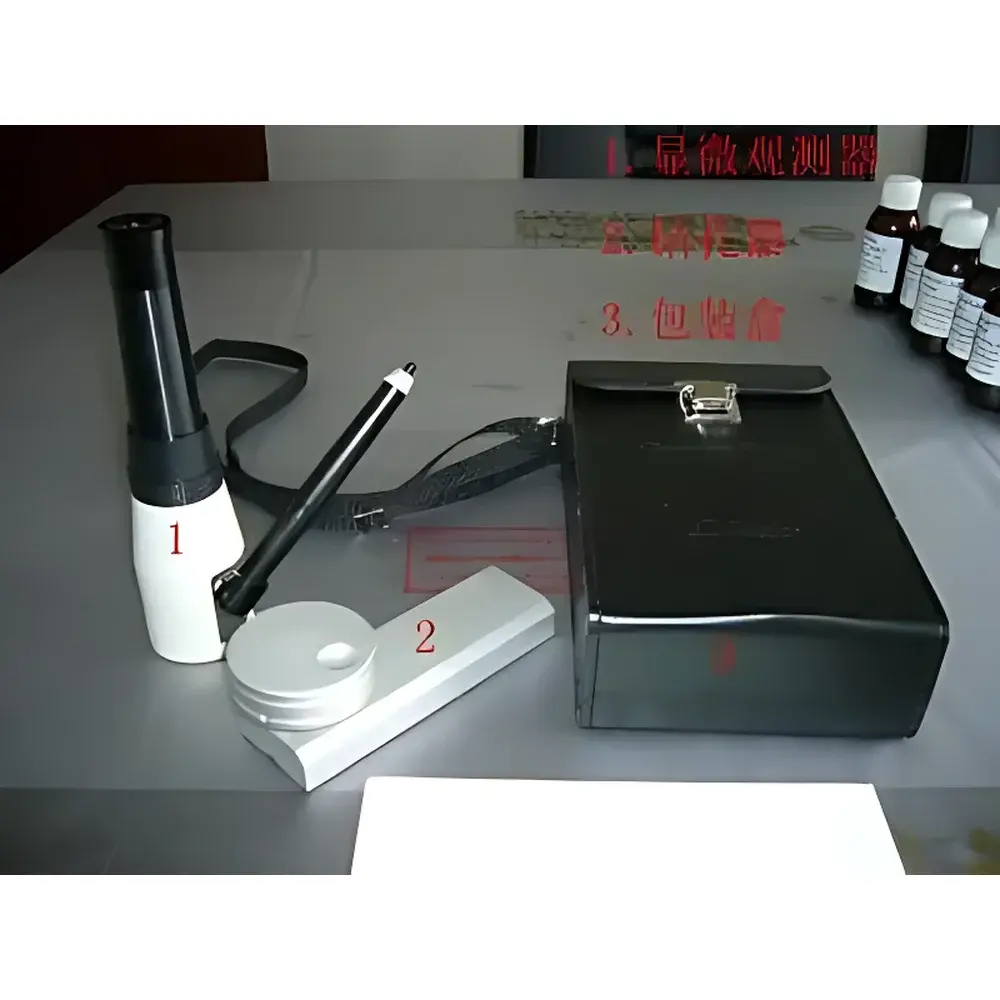
AB302 Micro-Indentation Coating Thickness Tester (Swiss-Made)
| Origin | Switzerland |
|---|---|
| Manufacturer Type | Authorized Distributor |
| Origin Category | Imported Instrument |
| Model | AB302 |
| Pricing | Available Upon Request |
Overview
The AB302 Micro-Indentation Coating Thickness Tester is a precision mechanical metrology instrument engineered for the quantitative, layer-resolved measurement of multi-layer coating systems on conductive and non-conductive substrates. Unlike optical or electromagnetic methods, the AB302 operates on the micro-drilling (scratch-indentation) principle—employing a calibrated conical drill bit with a fixed apex angle to create a controlled, tapered micro-cavity (often referred to as a “micro-crater”) through successive layers until the substrate is exposed. This physical cross-sectioning technique enables direct visual assessment under high-magnification optical observation, eliminating assumptions about material optical properties, conductivity, or density gradients. Designed and assembled in Switzerland, the AB302 conforms to the fundamental principles outlined in ISO 2808 (Paints and varnishes — Determination of film thickness), ASTM D7091 (Standard Practice for Nondestructive Measurement of Dry Film Thickness of Nonmagnetic Coatings Applied to Ferrous Metals and Nonconductive Coatings Applied to Non-Ferrous Metals), and ISO 4624 (Paints and varnishes — Pull-off test for adhesion). It serves as a primary reference method in laboratories requiring traceable, operator-independent verification of coating architecture—particularly where layered systems (e.g., zinc phosphate + epoxy primer + polyurethane topcoat) demand individual layer quantification.
Key Features
- Swiss-manufactured mechanical platform with hardened steel drill spindle and micrometer-adjusted vertical feed mechanism ensuring sub-micron repeatability in crater depth control.
- Interchangeable tungsten-carbide drill bits with standardized 30° or 45° apex angles, certified for consistent geometry and wear resistance across >10,000 measurement cycles.
- Integrated high-resolution stereo microscope (10×–40× zoom) equipped with calibrated reticle eyepiece featuring 1 µm graduation intervals along orthogonal axes—enabling direct manual readout of layer boundaries without digital interpolation.
- Adjustable sample stage with fine X-Y translation (±5 mm, 10 µm resolution) and tilt compensation for optimal crater alignment under optical axis.
- No electrical or magnetic field requirements—suitable for measuring coatings on composite substrates, ceramics, plastics, and anodized aluminum where eddy-current or magnetic induction methods fail.
- Compliant with GLP documentation standards: all measurement parameters—including bit ID, drilling force (manually set via calibrated spring load), magnification, and observer ID—are recorded manually in laboratory notebooks per audit trail requirements.
Sample Compatibility & Compliance
The AB302 accommodates flat or gently curved specimens up to 200 mm × 200 mm × 50 mm (L × W × H), with minimum substrate hardness ≥ 80 HV to prevent plastic deformation during drilling. It reliably measures organic and inorganic coatings—including conversion coatings (e.g., chromate, phosphating), electrodeposited layers (e.g., e-coat), thermoset primers, UV-cured topcoats, and PVD/CVD thin films—provided interlayer adhesion is sufficient to maintain distinct boundaries post-drilling. The method is explicitly referenced in ISO 2360 (non-conductive coatings on non-magnetic substrates) and ASTM B499 (for calibration verification of magnetic induction gauges). As a destructive reference technique, it satisfies regulatory validation protocols under FDA 21 CFR Part 11 when paired with controlled documentation procedures and trained personnel certification records.
Software & Data Management
The AB302 is a hardware-only, analog-optical instrument with no embedded firmware or proprietary software. All measurements are performed visually and documented manually—ensuring full transparency, zero algorithmic bias, and compatibility with any laboratory information management system (LIMS) or electronic lab notebook (ELN). Users may digitize reticle readings using standard image-capture systems (e.g., USB microscope cameras) and annotate boundary positions in open-format tools (TIFF/PDF with scale bar metadata). Calibration certificates for drill bits and eyepiece reticles are supplied with NIST-traceable uncertainty statements (< ±0.5 µm at 95% confidence), supporting ISO/IEC 17025-compliant internal calibration programs.
Applications
- Validation and recalibration of electromagnetic (DFT) gauges used in automotive OEM paint shops and aerospace MRO facilities.
- Failure analysis of delamination or interlayer contamination in corrosion protection systems (e.g., galvanized steel + passivation + paint).
- Quality assurance of multi-stage coil coating lines producing architectural metal panels.
- Research-grade characterization of functional thin-film stacks in photovoltaic and semiconductor packaging R&D.
- Third-party testing for ISO 12944 C5-I and C5-M corrosion category compliance reporting.
FAQ
Is the AB302 compliant with ISO/IEC 17025 for accredited testing laboratories?
Yes—when operated by certified personnel following documented SOPs and traceable calibration records, the AB302 meets the metrological requirements for reference method use under Clause 6.4 (Equipment) and Clause 7.7 (Ensuring validity of results).
Can it measure coatings on flexible or irregular substrates?
No—the method requires rigid, planar support during drilling; samples must be fixtured on a stable, vibration-damped surface. Curved surfaces exceeding 5° local deviation are not suitable.
What is the typical measurement uncertainty for a single-layer reading?
Under optimal conditions (trained operator, clean crater, 40× magnification), expanded uncertainty (k=2) is ±0.8 µm for layers ≥5 µm thick, as verified per ISO/IEC Guide 98-3 (GUM).
Does the instrument require annual factory recalibration?
Drill bits and reticles are supplied with initial calibration certificates valid for 12 months; users may perform in-house verification using certified step-height standards (e.g., NIST SRM 2156).
Is operator training required for ISO-compliant reporting?
Yes—ISO 2808 Annex B mandates documented competency assessment for micro-indentation operators, including crater morphology recognition and boundary discrimination proficiency.



