
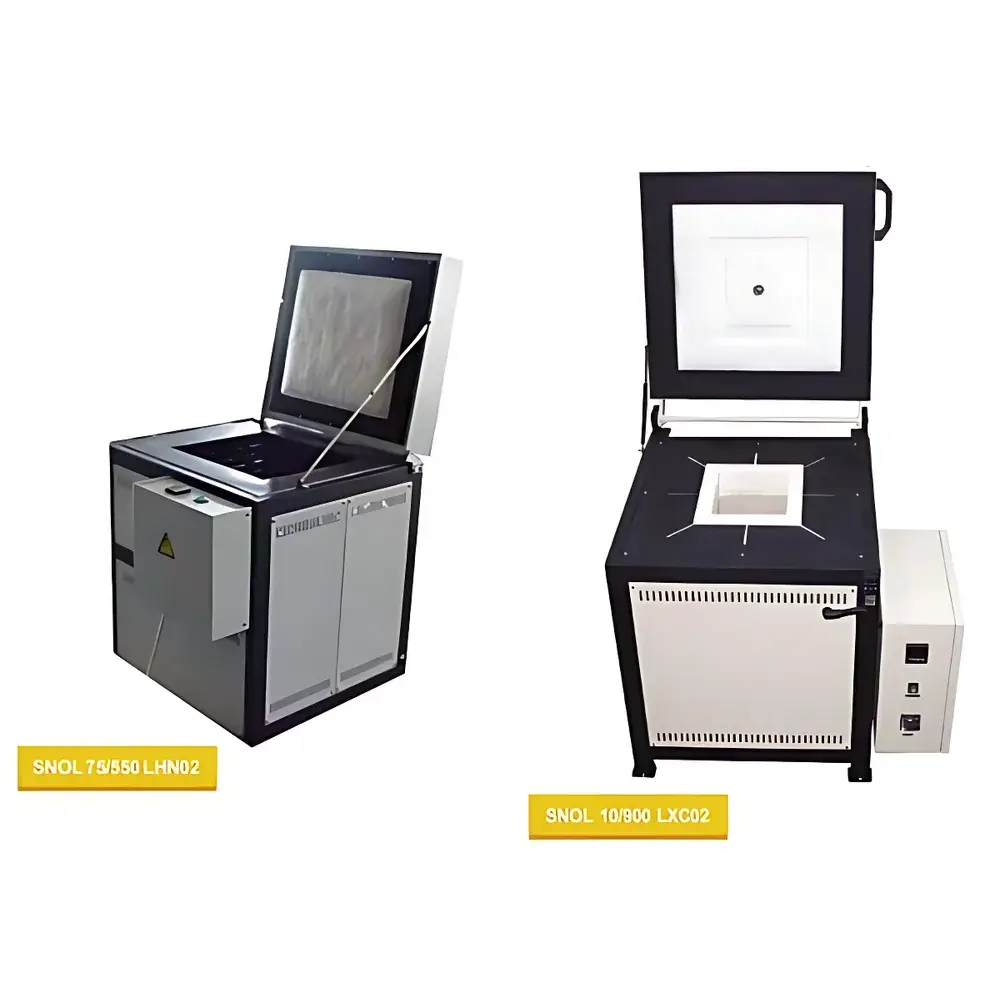
SNOL SNOL 10/900 LC02 & SNOL 75/550 LHN02 Vertical Tube Furnaces
| Origin | Imported |
|---|---|
| Manufacturer Type | Authorized Distributor |
| Temperature Range | 20–900 °C |
| Temperature Uniformity | ±0.5 °C |
| Internal Chamber Dimensions (W×L×H) | 340 × 390 × 550 mm (SNOL 75/550 LHN02) / 150 × 150 × 450 mm (SNOL 10/900 LC02) |
| External Dimensions (W×L×H) | 870 × 660 × 850 mm (SNOL 75/550 LHN02) / 860 × 750 × 800 mm (SNOL 10/900 LC02) |
| Max Power Consumption | 6 kW (SNOL 75/550 LHN02) / 4.5 kW (SNOL 10/900 LC02) |
| Net Weight | 100 kg (SNOL 75/550 LHN02) / 120 kg (SNOL 10/900 LC02) |
| Chamber Volume | 75 L (SNOL 75/550 LHN02) / 10 L (SNOL 10/900 LC02) |
| Control System | Microprocessor-based PID controller with programmable ramp-soak profiles |
| Safety Compliance | Over-temperature cut-off, thermal insulation per EN 60519-1, CE-marked |
Overview
The SNOL SNOL 10/900 LC02 and SNOL 75/550 LHN02 vertical tube furnaces are precision-engineered laboratory-grade electric furnaces designed for controlled high-temperature thermal processing up to 900 °C. Based on the classic well-type (vertical loading) configuration, these furnaces employ resistive heating elements embedded within high-density ceramic fiber insulation or solid refractory brick linings—depending on model—to achieve rapid heat-up, stable isothermal zones, and minimal thermal inertia. The vertical orientation enables gravity-assisted sample insertion and uniform radial heat distribution around cylindrical or crucible-mounted specimens. These units are not general-purpose drying ovens; rather, they serve as calibrated thermal platforms for metallurgical heat treatment (annealing, normalizing, quenching), ceramic sintering, catalyst activation, ashing protocols, and pre-conditioning of reference materials in compliance with ASTM E1112, ISO 9001-controlled environments, and GLP-aligned laboratory workflows.
Key Features
- Two distinct chamber architectures: SNOL 10/900 LC02 features a compact 10 L all-ceramic chamber with solid alumina-silica refractory lining and ceramic hearth plate—optimized for ultra-stable 900 °C operation and low thermal mass; SNOL 75/550 LHN02 utilizes a larger 75 L stainless-steel outer jacket with reinforced ceramic fiber insulation and optional reinforced base plate for heavy-duty crucible handling.
- Precision microprocessor PID controller with 16-segment programmable ramp-soak capability, real-time temperature logging, and user-defined setpoint hysteresis—calibratable via external reference thermocouple input (Type K or S).
- Thermal uniformity maintained at ±0.5 °C across the working zone under steady-state conditions (verified per ASTM E220 calibration methodology using multi-point sensor mapping).
- Robust safety architecture including independent over-temperature protection (mechanical limit switch + digital cut-off), double-wall construction with low-surface-temperature external casing (RAL 7035 powder-coated steel), and automatic power disengagement upon lid opening.
- Low-energy design: optimized element geometry and high-efficiency insulation reduce standby losses by >35% compared to conventional muffle furnaces of equivalent volume.
Sample Compatibility & Compliance
Both models accommodate standard laboratory crucibles (alumina, quartz, silicon carbide), metal ingots, ceramic green bodies, and powdered samples in inert or air atmospheres. The SNOL 10/900 LC02 is rated for continuous operation at 900 °C; the SNOL 75/550 LHN02 is rated for 550 °C continuous use with short-term excursions to 600 °C. Chamber materials meet EU RoHS Directive 2011/65/EU and are free from asbestos or halogenated binders. All electrical components comply with IEC 61000-6-3 (EMC) and IEC 61000-6-4 (immunity). Optional factory-installed data loggers support 21 CFR Part 11-compliant audit trails when paired with validated software packages.
Software & Data Management
- Standard RS232/RS-485 serial interface enables integration with LabVIEW, MATLAB, or custom SCADA systems for remote monitoring and automated thermal profiling.
- Optional USB interface supports direct connection to Windows-based PCs running SNOL’s proprietary FurnaceControl Suite—providing real-time graphing, CSV export, alarm history, and electronic signature-enabled calibration records.
- Data recording intervals configurable from 1 second to 60 minutes; onboard memory retains ≥10,000 timestamped readings during power interruption.
- Firmware updates delivered via secure HTTPS portal; version control and change logs maintained per ISO/IEC 17025 clause 5.9.2 requirements.
Applications
These furnaces are routinely deployed in university materials science labs for phase transformation studies; in pharmaceutical QC laboratories for loss-on-drying (LOD) validation per USP ; in metallurgical R&D for TTT diagram development; and in environmental testing labs for EPA Method 3050B acid digestion residue calcination. Their reproducible thermal gradients support inter-laboratory comparison studies under ISO/IEC 17043 proficiency testing schemes. The vertical loading geometry minimizes contamination risk during ashing of biological tissue or polymer residues—critical for trace-metal analysis workflows requiring sub-ppb detection limits.
FAQ
What is the difference between SNOL 10/900 LC02 and SNOL 75/550 LHN02?
The LC02 is a small-volume, high-temperature furnace (10 L, 900 °C max) with all-ceramic construction for applications demanding thermal stability and rapid cycling. The LHN02 is a larger-volume unit (75 L, 550 °C max) with stainless-steel housing and ceramic fiber insulation, suited for batch processing of multiple samples or heavier crucibles.
Is temperature calibration traceable to NIST standards?
Yes—optional factory calibration includes a certificate of conformity with uncertainty budget, referencing NIST-traceable thermocouples (±0.3 °C at 900 °C) and documented per ISO/IEC 17025 requirements.
Can these furnaces operate under inert gas purge?
Yes—both models feature dedicated gas inlet/outlet ports compatible with argon or nitrogen purge lines (recommended flow rate: 0.5–2 L/min); optional gas-tight door gaskets available upon request.
What maintenance is required for long-term accuracy?
Annual verification of thermocouple drift and insulation integrity is recommended; heating elements have a typical service life of >5,000 hours at rated temperature. No routine lubrication or consumable replacement is required.



