
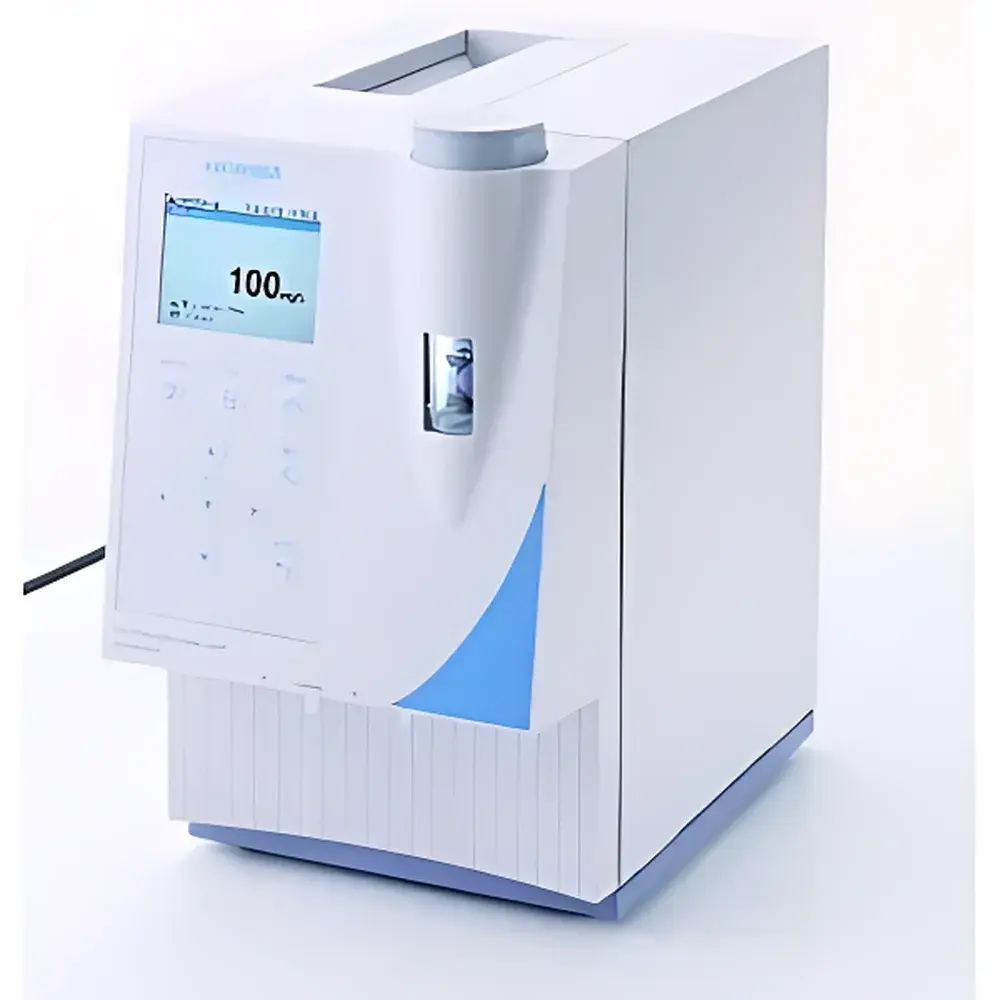
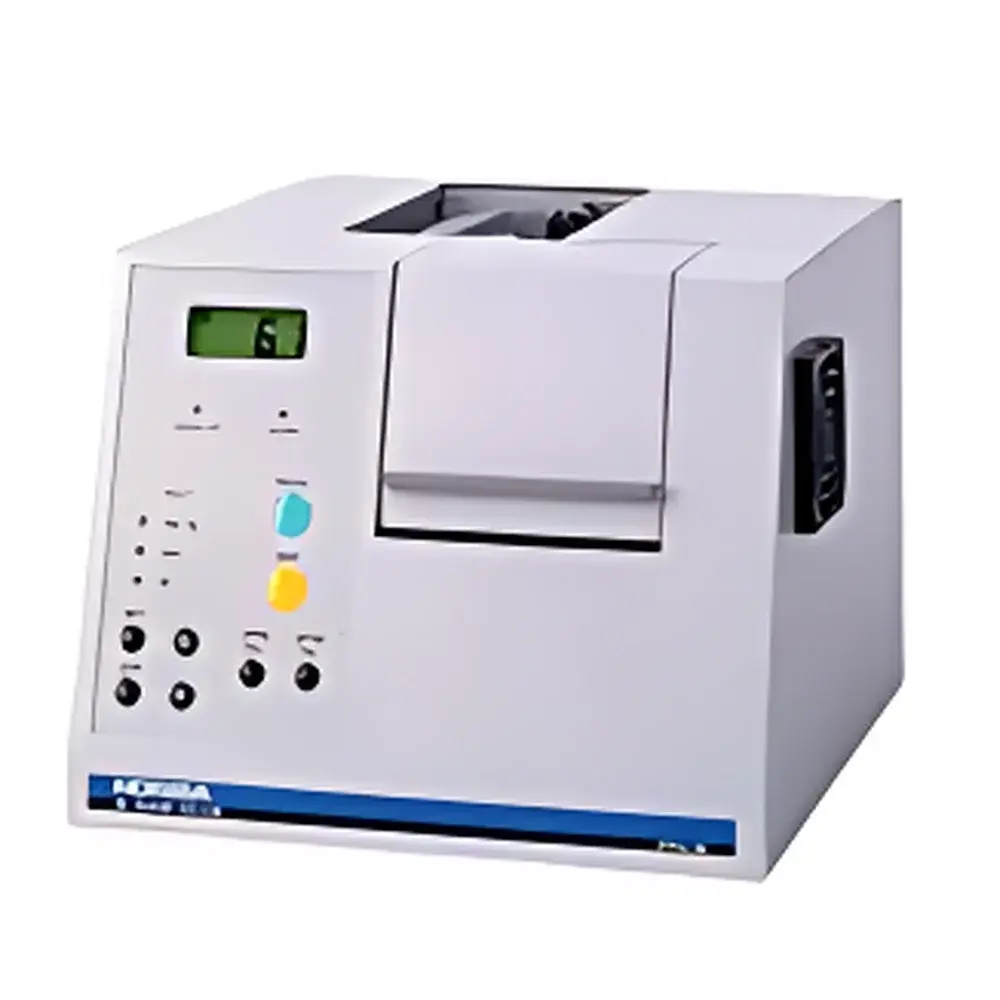
HORIBA OCMA-550 Oil Content Analyzer
| Brand | HORIBA |
|---|---|
| Origin | Japan |
| Model | OCMA-550 |
| Instrument Type | Laboratory Benchtop Analyzer |
| Measurement Principle | Fluorescence Spectrophotometry |
| Measurement Range | 0–200 mg/L |
| Detection Limit | <0.2 mg/L |
| Accuracy | ±0.4 mg/L ±1 digit (0–9.9 mg/L) |
| Resolution | 0.1 mg/L (0–99.9 mg/L) |
| Measurement Frequency | 1 measurement per minute |
| Cell Material | Quartz |
| Cell Path Length | 20 mm |
| Extraction Solvent | S-316 (reusable) |
| Solvent Volume per Test | 6.5 mL |
| Display | 3.5-inch color LCD (320 × 240 pixels, backlight) |
| Data Storage | Up to 300 measurement records |
| Output Interface | USB flash drive export |
| Power Supply | 100–240 V AC ±10%, 50/60 Hz |
| Dimensions (W×D×H) | 253 × 253 × 195 mm |
| Weight | 5 kg |
Overview
The HORIBA OCMA-550 Oil Content Analyzer is a laboratory-grade benchtop instrument engineered for precise, rapid quantification of total petroleum hydrocarbons (TPH) and mineral oil residues in solid and liquid matrices. It operates on the principle of fluorescence spectrophotometry — a highly selective and sensitive optical detection method that exploits the native fluorescent properties of aromatic hydrocarbons under ultraviolet excitation. Unlike non-dispersive infrared (NDIR) or gravimetric methods, fluorescence detection delivers superior specificity for oil compounds while minimizing interferences from background organic matter, water, or polar solvents. The OCMA-550 is designed for routine environmental monitoring applications, including residual oil analysis on metal parts, soil contamination assessment, food safety screening, and wastewater effluent compliance testing. Its compact footprint, solvent reuse capability, and ergonomic one-hand operation make it particularly suited for high-throughput laboratories requiring GLP-compliant trace oil quantification without solvent evaporation steps.
Key Features
- Ergonomic single-hand operation: Integrated hinged measurement cell cover and quartz cuvette placement mechanism enable rapid sample loading — critical for volatile oil analysis where exposure time must be minimized.
- Reusable S-316 extraction solvent system: Non-toxic, low-volatility chlorinated solvent with high extraction efficiency for aliphatic and aromatic hydrocarbons; compatible with optional SR-305 solvent recovery unit (activated carbon + alumina filtration, passive operation).
- High-resolution 3.5-inch color LCD display (320 × 240 pixels, backlight): Real-time visualization of measured values, clock-stamped results, and system status indicators — supports intuitive navigation without external PC dependency.
- Multi-unit reporting: Direct on-device conversion between mg/L (aqueous phase), mg/kg (soil/solid), mg/g (concentrated extracts), and particle count (PC) — configurable via front-panel input of sample mass/volume ratios.
- Onboard data management: Stores up to 300 measurement records with timestamps; exports raw and processed data (CSV format) via USB flash drive for traceable audit trails and LIMS integration.
- Integrated self-diagnostic routines: Automatic lamp intensity monitoring, solvent blank validation, and photometric stability verification ensure measurement integrity prior to each analysis.
- Stable quartz flow cell (20 mm path length): Minimizes scattering artifacts and enables reproducible absorbance/fluorescence baseline referencing across diverse sample viscosities and particulate loads.
Sample Compatibility & Compliance
The OCMA-550 accommodates heterogeneous samples following standardized extraction protocols (e.g., EPA Method 1664A, ISO 9377-2, JIS K 0102). It accepts extracts from soils, swabs, machining parts, food matrices (e.g., edible oils, roasted nuts), and aqueous effluents — provided the extract is clarified and free of suspended solids >5 µm. The instrument meets key regulatory design criteria for environmental testing laboratories: its calibration protocol supports dual-point (zero and span) verification per ISO/IEC 17025 requirements; measurement uncertainty budgets are documented in HORIBA’s technical validation report; and timestamped data export satisfies FDA 21 CFR Part 11 electronic record retention expectations when paired with controlled USB media handling procedures. No internal heating or pressurization components are used — eliminating risks associated with volatile solvent handling in enclosed systems.
Software & Data Management
While the OCMA-550 operates as a standalone analyzer, its USB export functionality enables seamless post-acquisition processing in standard spreadsheet or statistical software environments. Each exported file contains: measurement ID, date/time stamp, raw fluorescence intensity (arbitrary units), concentration value (with selected unit), operator ID field (manually entered), and QC flags (e.g., “blank out-of-spec”, “signal saturation”). For laboratories implementing digital quality management systems, the device supports manual entry of batch IDs and sampling location codes directly on the LCD interface — ensuring metadata linkage without secondary transcription. All stored records retain their original acquisition timestamp; no automatic overwriting or auto-deletion occurs, preserving full data lineage for internal audits or third-party accreditation reviews.
Applications
- Residual oil quantification on precision machined components (e.g., automotive parts, aerospace alloys) per ASTM D7687 and ISO 14635-1 standards.
- Soil remediation site assessment: TPH screening in contaminated soils using hexane or S-316 extraction followed by OCMA-550 readout.
- Food industry quality control: Detection of lubricant carryover in production lines or adulteration in vegetable oil blends.
- Wastewater treatment plant monitoring: Effluent oil-in-water compliance checks against local discharge limits (e.g., <10 mg/L).
- Research applications: Kinetic studies of oil biodegradation in microcosms, where repeated low-concentration measurements (<1 mg/L) demand sub-mg/L detection capability and high repeatability.
FAQ
What extraction solvents are compatible with the OCMA-550?
S-316 is the validated, factory-recommended solvent due to its optimal fluorescence quantum yield, low volatility, and compatibility with quartz optics. Alternative solvents (e.g., n-hexane, isooctane) may be used but require revalidation of calibration curves and limit of detection — HORIBA does not guarantee performance with non-S-316 solvents.
Can the OCMA-550 measure emulsified oil in water?
No — the instrument requires a clear, particle-free extract. Emulsions must first be broken (e.g., via centrifugation, acidification, or surfactant addition) and the oil phase separated prior to S-316 extraction and measurement.
Is the OCMA-550 compliant with ISO/IEC 17025 requirements?
Yes — its documented calibration procedure, traceable reference standards (available from HORIBA), and built-in QC functions (blank verification, signal stability check) support implementation within an ISO/IEC 17025-accredited testing laboratory’s technical scope.
How often must the quartz measurement cell be cleaned?
After every 10–15 analyses, or immediately after measuring highly viscous or particulate-laden extracts — cleaning with isopropanol followed by nitrogen drying is recommended to prevent residue buildup affecting path length accuracy.
Does the instrument support remote calibration or network connectivity?
No — the OCMA-550 is a stand-alone, non-networked instrument. Calibration is performed manually using certified reference standards; all data transfer occurs exclusively via physical USB media to maintain data integrity and cybersecurity boundaries in regulated environments.
Related Products







