
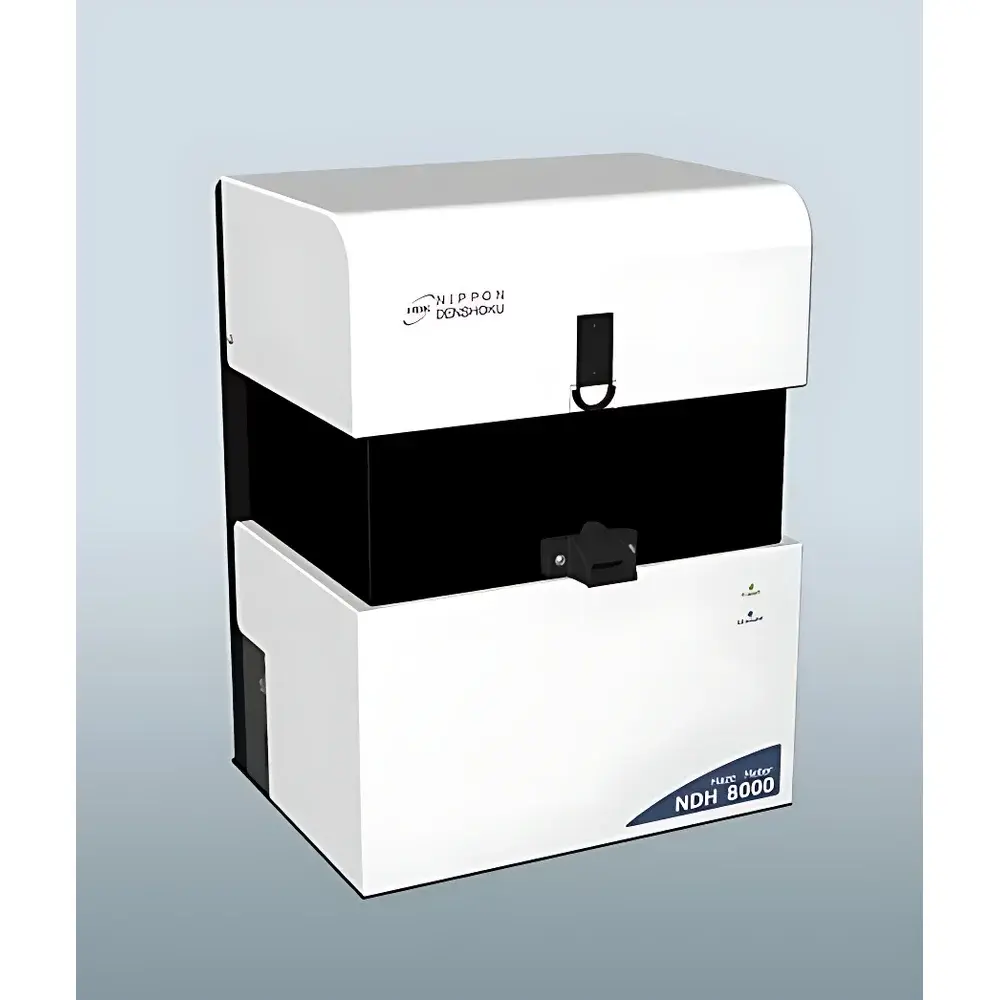
NIPPON DENSHOKU NDH8000 Haze and Transmittance Meter
| Brand | NIPPON DENSHOKU |
|---|---|
| Origin | Japan |
| Model | NDH8000 |
| Type | Automatic |
| Measurement Principle | Dual-beam compensated integrating sphere |
| Light Source | White LED |
| Sample Size Range | 30 mm × 30 mm to 210 mm × 297 mm (A4) |
| Haze Range | 0–100% |
| Total Luminous Transmittance Range | 0–100% |
| Haze Repeatability | ≤0.03% std. dev. (20 consecutive measurements) |
| Transmittance Repeatability | ≤0.03% std. dev. |
| Compliance Standards | JIS K7361, JIS K7136, JIS K7105, ASTM D1003, ISO 13468, ISO 14782 |
| Power Supply | 100–240 V AC, 50/60 Hz, 20 VA |
| Dimensions (Main Unit) | 340 mm (W) × 294 mm (D) × 473 mm (H) |
| Weight (Main Unit) | 14 kg |
| Display | 5.7-inch color LCD |
| Data Storage | 1,000 test records internal memory |
| USB Port | Host & device mode (CSV export via FAT32 USB flash drive) |
| Interface Options | RS-232C, parallel printer port |
| Operating Languages | English, Japanese |
| Calibration Reminder | Configurable due-date alert |
| Real-time Clock | Year/Month/Day/Hour/Minute/Second |
| Averaging | 2–99 cycles programmable |
| Optional Accessories | CU-11 film holder, CU-II test unit, 7-mm abrasion test attachment, thermal line dot printer, impact dot printer, PC control software |
Overview
The NIPPON DENSHOKU NDH8000 Haze and Transmittance Meter is a precision optical measurement instrument engineered for high-accuracy, non-destructive evaluation of light-scattering and transmission characteristics in transparent and semi-transparent materials. Based on dual-beam compensated integrating sphere photometry, the NDH8000 eliminates drift-induced errors by continuously balancing reference and sample beam intensities using a stable white LED source. This architecture ensures long-term stability and traceable repeatability—critical for quality control in regulated manufacturing environments. The instrument simultaneously quantifies haze (%), total luminous transmittance (%), diffuse transmittance (%), direct (parallel) transmittance (%), and turbidity (NTU-equivalent)—all in accordance with internationally harmonized test standards including JIS K7361, JIS K7136, JIS K7105, ASTM D1003, ISO 13468, and ISO 14782. Its modular design supports both horizontal and vertical sample positioning, enabling flexible integration into production lines or laboratory workbenches.
Key Features
- Dual-beam compensated integrating sphere optics for real-time drift correction and enhanced signal stability
- White LED light source with spectral output optimized for CIE photopic luminosity function (V(λ)) compliance
- Adjustable sample stage accommodating specimens from 30 mm × 30 mm up to A4 size (210 mm × 297 mm), including protruding or uneven surfaces
- Measured repeatability ≤0.03% standard deviation across 20 consecutive readings under identical conditions—validated per ISO/IEC 17025-aligned protocols
- 5.7-inch full-color TFT-LCD touchscreen interface with membrane key backup for glove-compatible operation
- Programmable averaging (2–99 cycles) to suppress stochastic noise in low-signal or heterogeneous samples
- Configurable calibration reminder system with user-defined due dates and timestamped audit trail
- Onboard real-time clock supporting full ISO 8601-compliant time stamping of all stored records
Sample Compatibility & Compliance
The NDH8000 is validated for use across polymer science, optical component manufacturing, pharmaceutical packaging, and display material R&D. It accommodates rigid plates, flexible films, laminated composites, and molded thermoplastics—including polycarbonate, PMMA, PET, COP, and AR-coated glass substrates. Sample thickness is unrestricted; surface topography is handled via optional CU-11 film holders or CU-II test units with adjustable aperture alignment. All measurement modes adhere to statutory requirements for regulatory submissions: ASTM D1003 defines haze as the ratio of diffusely transmitted light to total transmitted light, while ISO 13468 specifies geometric conditions for integrating sphere-based transmittance. The system’s firmware implements data integrity safeguards consistent with FDA 21 CFR Part 11 expectations—including electronic signatures, immutable audit logs, and role-based access control when paired with optional PC control software.
Software & Data Management
Internal memory retains up to 1,000 complete test records—including raw photodetector values, calculation parameters, operator ID, date/time stamps, and measurement method identifiers. Data export is supported via USB host port to FAT32-formatted flash drives in CSV format for downstream statistical analysis (e.g., SPC charting in Minitab or JMP). The instrument also provides native RS-232C and parallel printer interfaces for direct hardcopy output. Optional PC control software enables remote instrument configuration, batch test sequencing, GLP-compliant report generation (PDF/XLS), and integration with LIMS via ODBC drivers. All exported files include embedded metadata compliant with ISO/IEC 17025 clause 7.5.2 on result reporting.
Applications
- Quality assurance of anti-fog and anti-reflective coatings on automotive glazing and medical device housings
- Process validation of extruded optical films used in OLED backlight units and touch sensor overlays
- Stability monitoring of UV-curable resins during accelerated aging per ASTM G154
- Regulatory testing of child-resistant blister packaging per USP and EU Pharmacopoeia 2.1.2
- R&D evaluation of nanoparticle-dispersed composites for tunable scattering profiles
- Supplier qualification audits requiring third-party traceable haze/transmittance certification
FAQ
Does the NDH8000 support GLP/GMP-compliant data handling?
Yes—the instrument logs operator ID, calibration status, environmental timestamps, and measurement parameters with immutability. When used with optional PC software, it satisfies FDA 21 CFR Part 11 requirements for electronic records and signatures.
Can the NDH8000 measure curved or textured surfaces?
It accommodates protruding features via optional fixtures (e.g., CU-II test unit); however, curvature exceeding ±2° over the measurement aperture requires custom collimation verification per ISO 13468 Annex B.
Is ASTM D1003 Method A or Method B implemented?
The NDH8000 conforms to ASTM D1003 Method A (integrating sphere geometry), with automatic compensation for sphere wall degradation and detector aging.
What is the recommended calibration frequency?
NIPPON DENSHOKU recommends annual factory recalibration; however, the built-in calibration reminder allows users to schedule interim verification using certified reference standards (e.g., NIST-traceable haze plates).
Are firmware updates available remotely?
Firmware upgrades are distributed via encrypted USB media and require physical installation—no network connectivity is embedded to maintain electromagnetic compatibility (EMC) and cybersecurity integrity per IEC 61326-1.





