
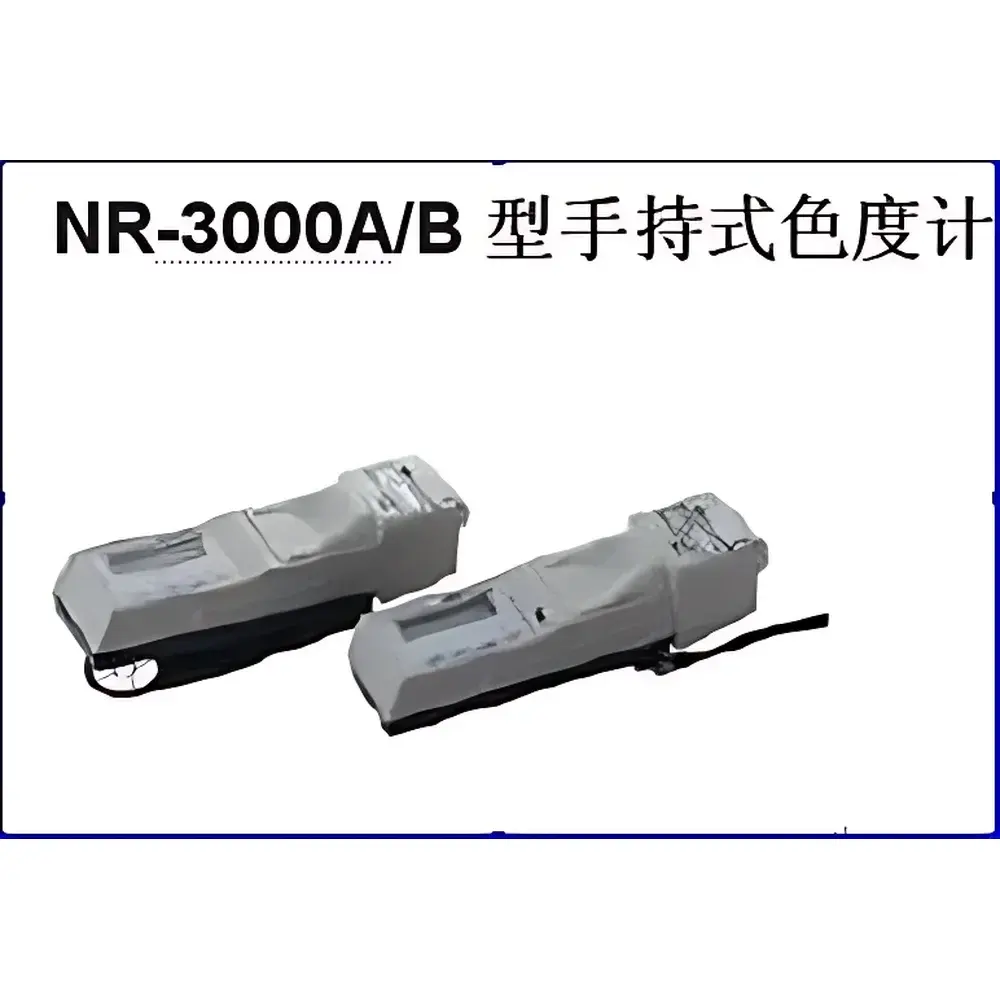
NR-3000A/B Handheld Colorimeter with Integrated Thermal Printer
| Origin | Japan |
|---|---|
| Manufacturer Type | Authorized Distributor |
| Origin Category | Imported |
| Model | NR-3000A/B |
| Pricing | Available Upon Request |
| Measurement Geometry | 0°/45° (JIS Z 8722) |
| Illuminant/Observer | C/2°, D65/10° |
| Measured Color Spaces | CIE XYZ, Yxy, CIELAB (L*a*b*), CIELCH (L*C*H*), Hunter Lab, Whiteness (W, WB), Yellowness Index (YI), Munsell Hue/Value/Chroma (HV/C) |
| Delta Metrics | ΔXYZ, ΔYxy, ΔL*a*b*, ΔE*ab, ΔL*C*H*, ΔHunter Lab, ΔE, ΔW, ΔWB, ΔYI |
| Aperture Sizes | Φ10 mm (standard), Φ3 mm (optional) |
| Repeatability (ΔE*ab, Φ10 mm) | ≤0.07 (20 measurements on white reference tile, SD of mean) |
| Dimensions (W×D×H) | 200 × 70 × 68 mm |
| Weight | 0.6 kg (battery excluded) |
| Power | 4 × AA alkaline (1.5 V) or Ni–Cd (1.2 V) |
| Lamp | 3 V / 500 mA halogen |
| Max Power Consumption | 400 mW |
| Compliance Standards | JIS Z 8722, ASTM E 308, ASTM E 313, ASTM D 1925 |
| Optional Accessories | Windows-compatible data acquisition & editing software, liquid/powder sample holders |
Overview
The NR-3000A/B Handheld Colorimeter with Integrated Thermal Printer is an industrial-grade portable color measurement instrument engineered for precision, field mobility, and traceable compliance in quality control environments. Based on the 0°/45° illumination/reception geometry defined in JIS Z 8722—equivalent to ASTM E 308’s recommended geometry for non-scattering, opaque, and textured surfaces—the device employs a stabilized halogen lamp (3 V / 500 mA) as its spectral source, ensuring consistent spectral power distribution across repeated measurements. Unlike diffuse d/8° spectrophotometers, the NR-3000A/B’s directional geometry minimizes interferences from surface texture and gloss, making it particularly suitable for evaluating painted panels, plastic injection-molded parts, coated textiles, and printed packaging where geometric consistency is critical for process validation. Its CIE-compliant photometric detection system computes tristimulus values (XYZ) under multiple standard illuminants (C/2°, D65/10°) and observer functions, enabling full derivation of L*a*b*, L*C*H*, Hunter Lab, whiteness (W, WB), yellowness index (YI), and Munsell notation (HV/C). Calibration traceability is anchored to primary standards maintained by the Japan Color Research Institute (JCRI), providing metrological confidence aligned with ISO/IEC 17025–accredited reference practices.
Key Features
- Integrated thermal printer enabling immediate hard-copy output of measurement records—including sample ID, date/time stamp, color coordinates, delta values (e.g., ΔE*ab), pass/fail status, and user-defined notes—without external peripherals.
- Ergonomic single-hand operation supported by a built-in optical viewfinder and precisely aligned Φ10 mm measurement aperture (Φ3 mm optional), facilitating accurate targeting of localized areas such as printed logos, weld seams, or defect patches.
- Onboard reference compensation: Users may store custom reference values and apply real-time sensor-based corrections to offset instrumental drift or minor environmental shifts.
- Embedded temperature sensor continuously monitors ambient conditions; if operational temperature exceeds the validated range (typically 10–35 °C), the instrument displays a warning and suspends measurement until stabilization.
- Low-power architecture: Operates on four standard AA alkaline or rechargeable Ni–Cd cells, delivering >5,000 measurements per full charge set under typical usage—ideal for extended factory floor or warehouse audits.
Sample Compatibility & Compliance
The NR-3000A/B supports solid, flat, or gently curved surfaces with minimal specular reflection. Its 0°/45° geometry complies with JIS Z 8722 Class II requirements for routine industrial color matching and is explicitly referenced in ASTM E 308 Annex A2 for chromaticity computation. It meets the essential performance criteria outlined in ASTM E 313 (for yellowness index) and ASTM D 1925 (for plastic whiteness evaluation). While not a full-spectrum spectrophotometer, its photometric filter array and halogen source provide sufficient spectral fidelity for QC-level conformance testing in automotive trim, consumer electronics housings, food packaging films, and architectural coatings. The instrument does not require PC connectivity for basic operation but supports GLP/GMP-aligned audit trails when used with optional Windows-compatible software that logs operator ID, calibration history, and timestamped raw data.
Software & Data Management
Optional Windows-compatible data acquisition and editing software enables bidirectional communication via USB or RS-232 interface. The application supports batch import/export in CSV and XLSX formats, customizable report templates (including company logo insertion), statistical analysis (mean, SD, CPK), and automated pass/fail flagging against user-defined tolerance limits (e.g., ΔE*ab ≤ 1.0). All measurement sessions are time-stamped and optionally tagged with operator ID—supporting FDA 21 CFR Part 11 readiness when configured with electronic signature and audit trail modules. Raw data files include embedded metadata: instrument serial number, firmware version, aperture size, illuminant/observer setting, and ambient temperature at time of capture.
Applications
- Automotive: In-line verification of paint finish uniformity across body panels and interior trims.
- Plastics manufacturing: Monitoring color consistency of injection-molded components before shipment.
- Printing & Packaging: Spot-checking ink density, substrate metamerism, and label color registration accuracy.
- Textiles & Apparel: Evaluating dye lot consistency across fabric batches and finished garments.
- Food & Beverage: Assessing color stability of packaging laminates and printed cartons under accelerated aging conditions.
FAQ
What calibration standards does the NR-3000A/B support?
It accepts JCRI-traceable ceramic white and black calibration tiles; factory calibration is performed using JCRI’s primary standard reference materials.
Can the instrument measure translucent or liquid samples?
Not natively—the 0°/45° geometry is optimized for opaque solids. Optional liquid cuvette holders and powder cells are available as accessories to enable semi-quantitative assessment under controlled path-length conditions.
Is the thermal printer replaceable or serviceable in-field?
Yes—the print head and paper roll are user-replaceable; consumables (thermal paper rolls, spare print heads) are stocked globally through authorized distributors.
Does the device meet ISO 13655 requirements for M1/M2 measurement modes?
No—it operates exclusively in M0 mode (halogen illumination); for M1 (D50 LED) or M2 (UV-cut) compliance, a dedicated spectrophotometer is required.
How is measurement repeatability verified during routine use?
Users perform daily verification using the supplied white reference tile; the instrument calculates and displays the standard deviation of ΔE*ab across ten consecutive readings—values ≤0.07 confirm system stability per JCRI protocol.




