
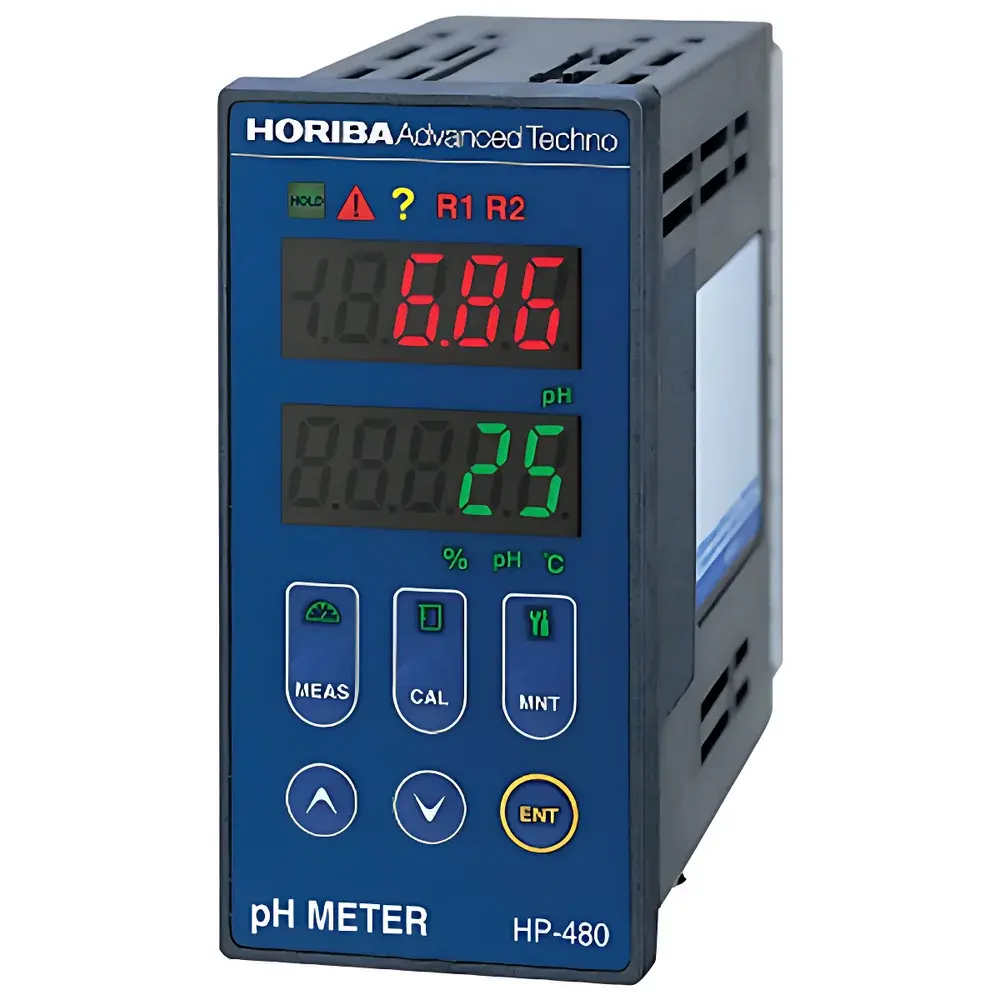
HORIBA HP-480 Panel-Mount pH and Temperature Transmitter
| Brand | HORIBA |
|---|---|
| Origin | Japan |
| Model | HP-480 |
| Measurement Principle | Glass Electrode Method |
| pH Range | 0–14 |
| pH Resolution | 0.01 pH |
| Temperature Range | 0–100 °C |
| Temperature Resolution | 1 °C (selectable display) |
| Accuracy (pH) | ±0.05 pH (equivalent input) |
| Linearity (pH) | ±0.05 pH (equivalent input) |
| Output Signal | 4–20 mA DC, isolated, max load ≤ 600 Ω |
| Relay Outputs | 2 × SPDT (240 V AC / 30 V DC, 3 A resistive) |
| Calibration | 2-point auto/manual (pH 2/4/7/9/10 JIS standards) |
| Temperature Compensation | Selectable RTD types (350 Ω, 500 Ω, 1 kΩ, 6.8 kΩ, 10 kΩ) or none |
| Self-Diagnosis | Asymmetry potential, slope deviation, response time anomaly, reference junction fault, sensor open/short, out-of-range detection |
| Enclosure Rating | IP65 (panel-mounted, indoor use) |
| Operating Ambient | −5 to +45 °C |
| Power Supply | 100–240 V AC, 50/60 Hz, ≤10 W |
| Certifications | CE, FCC |
Overview
The HORIBA HP-480 is a panel-mounted, industrial-grade pH and temperature transmitter engineered for continuous, high-reliability monitoring in water quality management, wastewater treatment, chemical process control, and municipal utility applications. It operates on the potentiometric glass electrode principle—measuring the voltage difference between a pH-sensitive glass membrane and a stable reference electrode—to deliver precise, traceable pH quantification across the full aqueous range (0–14 pH). Integrated Pt100-compatible temperature sensing enables automatic temperature compensation (ATC), ensuring measurement integrity across dynamic thermal conditions (0–100 °C). Designed for seamless integration into SCADA, DCS, and PLC-based infrastructure, the HP-480 features galvanically isolated 4–20 mA analog output with user-configurable span and zero points, supporting both process feedback control and centralized data acquisition. Its robust architecture prioritizes long-term stability, low drift, and operational transparency—critical for compliance-driven environments governed by ISO 5667, ASTM D1293, and EPA Method 150.1.
Key Features
- Panel-mount form factor with IP65-rated front bezel—suitable for indoor industrial enclosures, control rooms, and wet-process skids.
- Dual relay outputs (R1/R2) configured as independent high/low alarms or maintenance status indicators—fully programmable for ON/OFF process interlocks per IEC 61511 functional safety guidelines.
- Comprehensive electrode health diagnostics: real-time assessment of asymmetry potential, slope deviation (% recovery vs. theoretical Nernst response), and response time (t90)—reducing unplanned downtime and enabling predictive maintenance scheduling.
- Multi-standard calibration support: JIS-compliant two-point calibration using certified buffers (pH 2, 4, 7, 9, 10); optional single-point temperature calibration at user-defined setpoint.
- Lead-free construction throughout: borosilicate glass membrane, Pb-free soldered PCB assembly, and RoHS-compliant electrode lead terminations—aligned with EU Directive 2011/65/EU and global sustainability mandates.
- Flexible temperature compensation: five selectable RTD resistance curves (350 Ω, 500 Ω, 1 kΩ, 6.8 kΩ, 10 kΩ) plus non-compensated mode—compatible with legacy and modern temperature sensors without hardware modification.
Sample Compatibility & Compliance
The HP-480 interfaces with a broad spectrum of glass pH electrodes—including general-purpose, low-conductivity, high-temperature, and antifouling configurations—enabling adaptation to diverse sample matrices: municipal influent/effluent, boiler feedwater, pharmaceutical rinse solutions, food processing brines, and electroplating baths. Its input circuitry accommodates high-impedance sensor signals (>1012 Ω) while rejecting common-mode noise typical in electrically noisy plant environments. Regulatory conformance includes CE marking per EMC Directive 2014/30/EU and Low Voltage Directive 2014/35/EU, as well as FCC Part 15 Class B emissions compliance. While not inherently 21 CFR Part 11 compliant (as it lacks audit-trail-capable software), its analog output and relay logic support integration into validated systems under GMP/GLP frameworks when paired with compliant data loggers or DCS historian modules.
Software & Data Management
The HP-480 operates as a standalone transmitter with no embedded firmware update capability or PC connectivity—emphasizing deterministic, maintenance-free operation over digital feature creep. All configuration (output scaling, alarm thresholds, relay logic, temperature compensation type) is performed locally via front-panel keypad and LCD interface. No proprietary software, drivers, or cloud dependencies are required. This design minimizes cybersecurity attack surface and eliminates version-control risks associated with firmware updates—making it suitable for air-gapped or legacy control networks where IT/OT convergence is restricted. Output signals remain continuously traceable via calibrated 4–20 mA loop testers; relay state changes are visually indicated on the display and mechanically latched per IEC 60947-5-1.
Applications
- Real-time pH monitoring in activated sludge basins and anaerobic digesters to optimize biological nutrient removal efficiency.
- Neutralization control in industrial wastewater equalization tanks—preventing discharge violations under local environmental permits.
- Boiler water alkalinity management to mitigate caustic embrittlement and scale formation per ASME B31.1 guidelines.
- In-line pH verification during Clean-in-Place (CIP) cycles in beverage and dairy processing lines.
- Groundwater remediation site monitoring—paired with submersible electrodes for long-term unattended deployment in kiosk-style shelters.
FAQ
Does the HP-480 support digital communication protocols such as Modbus or HART?
No. The HP-480 is an analog-only transmitter with 4–20 mA output and dry-contact relays. It does not incorporate serial communication interfaces.
Can the unit perform automatic temperature compensation without an external RTD sensor?
No. ATC requires connection of a compatible RTD (e.g., Pt100) to the dedicated temperature input terminals. The “no compensation” mode disables correction but retains temperature readout.
Is the HP-480 suitable for outdoor installation?
It is rated IP65 only on the front panel face; the rear chassis and terminal block are not weatherproof. Outdoor use requires integration into a NEMA 4X or IP66-rated enclosure.
What buffer solutions are required for two-point calibration?
JIS-certified standard buffers: one acidic (pH 2 or 4), one basic (pH 9 or 10), and pH 7 as the midpoint reference—calibration sequence follows NIST-traceable practice.
How is electrode failure diagnosed beyond calibration errors?
The self-diagnostic engine continuously monitors reference junction potential, glass membrane impedance, and thermal time constant—flagging deviations before measurement error exceeds ±0.1 pH.
Related Products







