
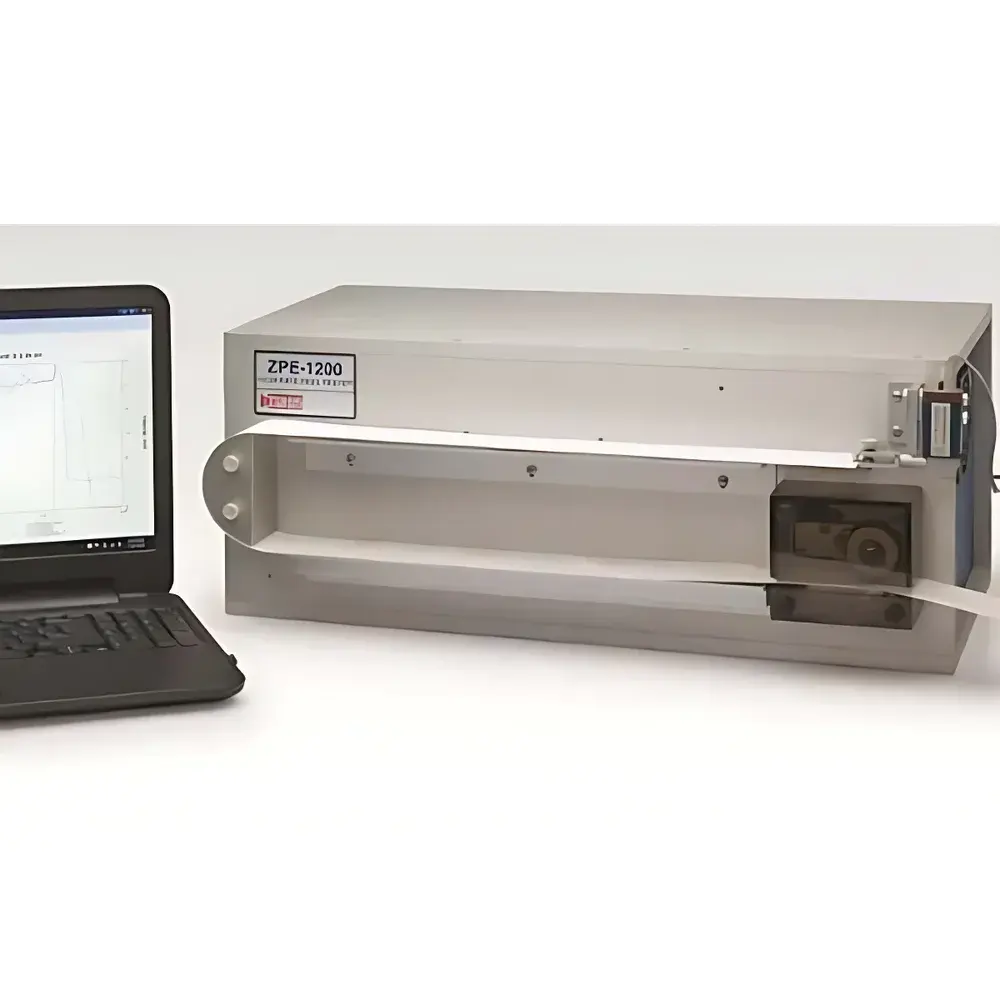
IMASS ZPE-1100W High-Speed Peel Testing System
| Brand | IMASS |
|---|---|
| Origin | USA |
| Model | ZPE-1100W |
| Category | Packaging Industry Specialized Instrument |
| Type | Coefficient of Friction & High-Speed Peel Tester |
| Sample Support | Air-bearing Stage |
| Data Fitting | Polynomial up to 20th Order |
| Output Formats | CSV, TXT, XLSX (native Excel export) |
| RMS Force Calculation | Enabled for flutter/zipping quantification |
| Compliance Context | Designed for ASTM D903, ASTM F88, ISO 8510-2, and TAPPI T813 test protocols |
Overview
The IMASS ZPE-1100W High-Speed Peel Testing System is an engineered solution for dynamic peel force characterization in high-speed packaging operations. Unlike conventional static or low-velocity peel testers, the ZPE-1100W operates under controlled inertial and kinematic conditions to replicate real-world unwinding, label application, and liner release scenarios at velocities up to 1,000 mm/s. Its core measurement principle relies on high-frequency load cell acquisition synchronized with precision motion control, enabling resolution of transient force events—including edge lift initiation, interfacial stick-slip, and zipping propagation—that are undetectable using quasi-static methods. The system is purpose-built for R&D laboratories, packaging engineering centers, and quality assurance departments requiring quantitative correlation between peel dynamics and end-use performance, particularly in pressure-sensitive adhesive (PSA) systems, medical device labels, flexible electronics substrates, and tamper-evident seals.
Key Features
- Air-bearing sample carriage eliminates mechanical friction between test substrate and support surface—ensuring measured forces reflect only adhesive interfacial behavior, not parasitic rolling or sliding resistance.
- Adjustable graphical data boundary window allows users to exclude non-steady-state regions (e.g., acceleration/deceleration transients) from final analysis, improving repeatability and statistical confidence in reported peel values.
- Real-time polynomial curve fitting (up to 20th order) enables precise modeling of complex force–displacement profiles, supporting advanced failure mode decomposition such as elastic recovery contribution, viscoelastic lag, and cohesive vs. adhesive fracture thresholds.
- Direct RMS (root-mean-square) force computation provides an objective metric for quantifying high-frequency oscillatory phenomena—commonly observed as “flutter” during high-speed liner release or “zipping” in multi-layer laminates—without subjective visual interpretation.
- Native Excel-compatible output ensures seamless integration into existing QA workflows; all raw time-series data, metadata (test speed, temperature, humidity), and processed parameters (average peel force, standard deviation, RMS value, peak load) export directly to .xlsx files with column headers compliant with LIMS ingestion standards.
Sample Compatibility & Compliance
The ZPE-1100W accommodates a broad range of substrate geometries and material classes, including but not limited to: pressure-sensitive adhesives on paper, PET, PP, and silicone-coated liners; medical-grade acrylic and rubber-based PSAs; thin-film barrier laminates; and die-cut functional labels. Specimen widths range from 10 mm to 110 mm, with thickness tolerance up to 2.5 mm. The system supports both 90° and 180° peel configurations per ASTM D903 and ISO 8510-2, and is routinely deployed in validation studies aligned with FDA 21 CFR Part 11 requirements when paired with audit-trail-enabled software extensions. It meets mechanical and electrical safety criteria per UL 61010-1 and IEC 61326-1 for laboratory instrumentation.
Software & Data Management
The ZPE-1100W operates under IMASS’ proprietary PeelControl™ v4.x firmware and desktop application suite. All test sequences—including velocity ramping profiles, dwell times, and trigger thresholds—are programmable via intuitive graphical interface. Software enforces user-level access controls (administrator/operator modes), maintains immutable test logs with timestamps and operator IDs, and generates PDF reports compliant with GLP/GMP documentation expectations. Data integrity is preserved through SHA-256 hash verification of exported files, and optional database synchronization supports centralized archival in SQL Server or Oracle environments. Raw sensor data is recorded at ≥10 kHz sampling rate, ensuring Nyquist compliance for signals up to 5 kHz bandwidth.
Applications
- Quantitative benchmarking of liner release force consistency across production lots of silicone-coated backing materials.
- Development of low-tack, repositionable adhesives where transient peel stability—not just average force—is critical to user experience.
- FDA-submission-ready peel kinetics data for Class II/III medical device labeling systems subject to ISO 15378 and ISO 13485 requirements.
- Root-cause analysis of delamination failures in roll-to-roll printed electronics, where zipping propagation velocity correlates with interlayer adhesion energy.
- Validation of hot-melt adhesive performance under high-line-speed converting conditions (e.g., packaging carton erecting, pouch sealing).
FAQ
What is the maximum test speed supported by the ZPE-1100W?
The system is calibrated and validated for continuous operation at speeds up to 1,000 mm/s, with traceable calibration certificates available upon request.
Does the ZPE-1100W comply with ASTM F88 for seal strength testing?
While primarily configured for peel testing, the ZPE-1100W can be adapted for ASTM F88-compliant seal strength evaluation using optional fixture kits and modified grip geometry—subject to method qualification per ISO/IEC 17025.
Can test data be imported into statistical process control (SPC) platforms?
Yes—CSV and XLSX exports include all required fields for direct ingestion into Minitab, JMP, or custom SPC dashboards; metadata tags support automated batch-level trending.
Is air supply required for the air-bearing stage?
Yes—a clean, dry, oil-free compressed air source delivering 6 bar (90 psi) at ≥10 L/min is mandatory for stable levitation and consistent test repeatability.
How does the ZPE-1100W differ from the newer ZPE-1200 model?
The ZPE-1100W lacks the ZPE-1200’s integrated environmental chamber, dual-load-cell redundancy, and real-time FFT spectral analysis module—but retains identical core mechanics, air-bearing architecture, and peel algorithm fidelity.




