
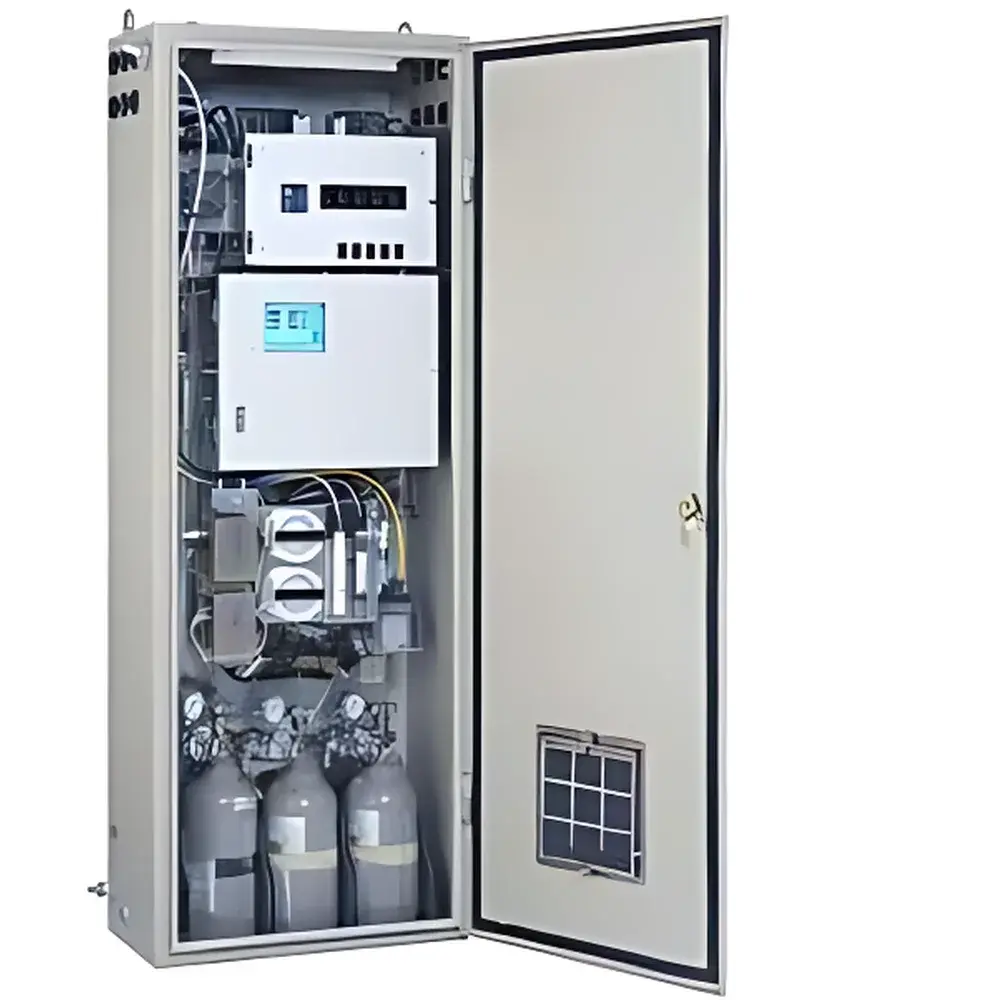
TR-II Series Continuous Emission Monitoring System (CEMS)
| Origin | France |
|---|---|
| Manufacturer Type | Authorized Distributor |
| Origin Category | Imported |
| Model | TR-II |
| Pricing | Available Upon Request |
Overview
The TR-II Series Continuous Emission Monitoring System (CEMS) is a fully extractive, industrial-grade flue gas monitoring platform engineered for regulatory compliance and long-term operational reliability in fixed-source emission monitoring applications. Designed in accordance with international CEMS performance standards—including EN 15267-3, EN 14181, and EPA Performance Specification 2 (PS-2)—the system continuously measures key gaseous pollutants and physical parameters from combustion exhaust streams. Its core measurement architecture integrates non-dispersive infrared (NDIR) spectroscopy for SO₂, NOₓ, CO, CO₂, and O₂; laser transmission-based particulate matter (PM) detection; and certified thermal/pressure/humidity sensors for flue gas flow, temperature, and moisture content. Unlike in-situ or dilution-probe systems, the TR-II’s complete extraction methodology ensures representative sampling across variable stack conditions—particularly critical for high-dust, high-moisture, or low-velocity flue gas environments typical of coal-fired boilers, cement kilns, waste incinerators, and industrial furnaces.
Key Features
- Fully extractive sampling train with heated sample line (maintained at >180 °C) to prevent condensation and analyte loss
- NDIR gas analyzers featuring alternating sample/reference cell configuration to minimize optical drift and cross-interference
- Automated zero/span calibration capability with integrated standard gas manifold and solenoid-controlled valve sequencing
- Particulate monitor utilizing dual-beam laser transmissometry with real-time auto-blowback (pulse-controlled compressed air) to maintain optical path integrity
- Stainless steel 316L filter element (2 µm pore size) at probe inlet—resistant to thermal shock, corrosion, and mechanical clogging
- Modular subsystem architecture: Gas Analysis Subsystem, Particulate Matter Subsystem, Flue Gas Parameter Subsystem, and Data Acquisition & Handling (DAH) Unit
- Unattended operation certified for ≥720 hours mean time between maintenance (MTBM), compliant with EU Directive 2010/75/EU (IED) requirements for automated monitoring
Sample Compatibility & Compliance
The TR-II system is validated for continuous operation in flue gases with dust loadings up to 10 g/Nm³, moisture content ≤30 vol%, and operating temperatures ranging from 60 °C to 250 °C. It meets mandatory technical specifications under China’s HJ 75-2017 and HJ 76-2017 standards for CEMS installation, calibration, and data validity assessment. All gas analyzers carry TÜV Rheinland QAL1 certification for accuracy class ±2% FS (full scale) per EN 15267-3. The DAH unit supports audit-trail logging, electronic signature, and secure data export aligned with ISO/IEC 17025:2017 laboratory management principles. System outputs are compatible with national environmental monitoring platforms including China’s National Pollutant Discharge Permit Management Information System and provincial EPAs’ real-time data reporting portals.
Software & Data Management
The embedded DAH unit runs on a Linux-based industrial controller with redundant storage and dual Ethernet interfaces. Its proprietary CEMS software provides real-time visualization of all measured parameters, automatic calculation of mass emission rates (kg/h), rolling 24-hour/30-day cumulative totals, and dynamic alarm thresholds based on regulatory limits (e.g., GB 13223-2011, GB 18485-2014). All raw sensor data, calibration logs, maintenance records, and system diagnostics are timestamped, digitally signed, and stored locally for ≥18 months. Export formats include CSV, XML, and MODBUS TCP for integration with SCADA, DCS, or enterprise-level environmental management information systems (EMIS). Software design conforms to IEC 62443-3-3 cybersecurity requirements and supports optional FDA 21 CFR Part 11-compliant user access control and electronic record retention.
Applications
- Regulatory compliance monitoring for thermal power plants, steel mills, glass manufacturing, and chemical production facilities
- Real-time emission accounting under China’s “Total Emission Control” policy and carbon emission trading schemes
- Performance verification of flue gas desulfurization (FGD), selective catalytic reduction (SCR), and electrostatic precipitator (ESP) systems
- Stack testing support and QA/QC validation for third-party environmental inspection agencies
- Long-term trend analysis of process efficiency and combustion optimization via correlated O₂–CO–NOₓ–SO₂ profiles
FAQ
What gas species does the TR-II system measure simultaneously?
SO₂, NOₓ (as NO and NO₂), CO, CO₂, O₂, particulate matter (PM₁₀/PM₂.₅ equivalent), flue gas flow rate, temperature, and relative humidity.
Is the system certified for use in hazardous area installations?
Yes—the sampling probe and pre-treatment unit are available with ATEX Zone 2 / IECEx certification (II 2G Ex db IIB T4 Gb) upon configuration request.
How frequently does the system require calibration verification?
Per HJ 75-2017, zero/span checks must be performed at least every 24 hours; full multi-point calibration is recommended quarterly or after major maintenance.
Can historical data be retrieved remotely?
Yes—via secure HTTPS web interface or OPC UA server; remote access requires role-based authentication and TLS 1.2+ encryption.
Does the TR-II support integration with existing plant DCS networks?
Yes—it provides native Modbus RTU/TCP, Profibus DP, and optional OPC UA connectivity with configurable polling intervals and data mapping tables.
Related Products







