
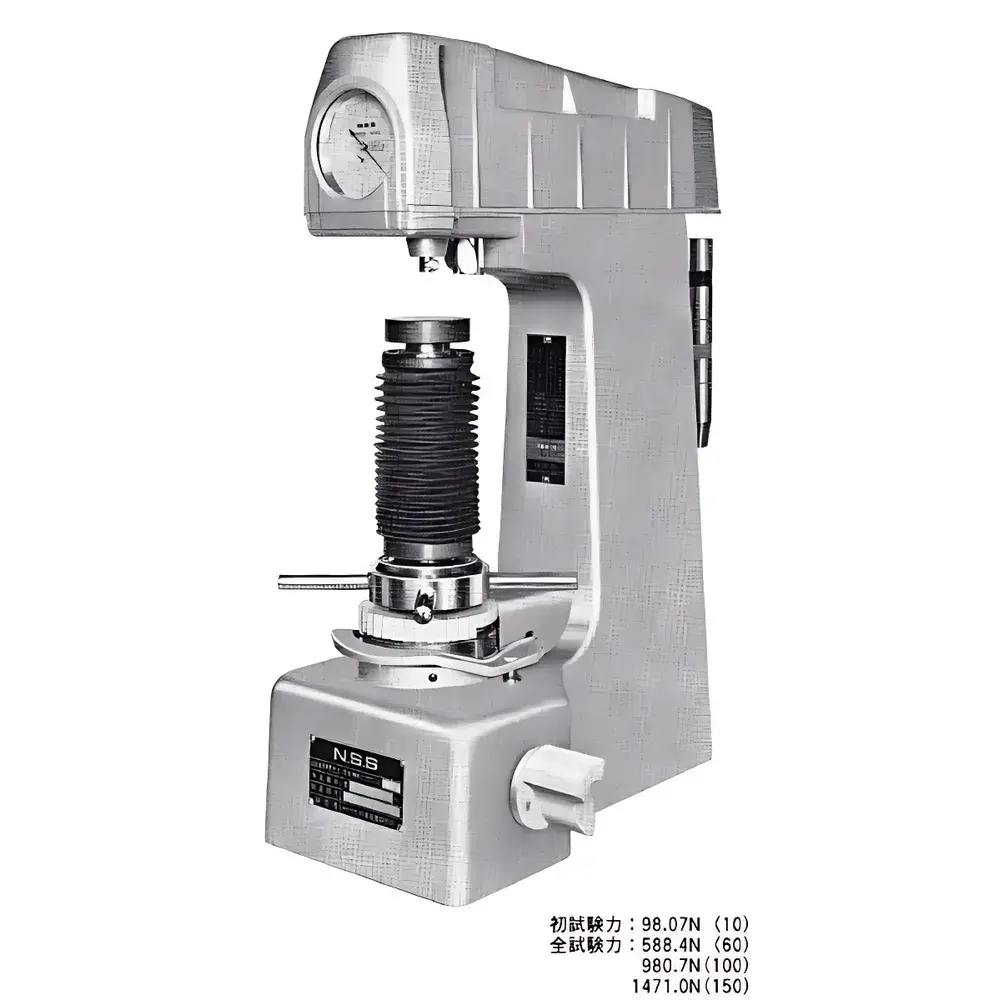
SOLY 3NR Rockwell Hardness Tester
| Brand | SOLY |
|---|---|
| Origin | Italy |
| Manufacturer Type | Authorized Distributor |
| Origin Category | Imported |
| Model | 3NR |
| Instrument Type | Rockwell Hardness Tester |
| Vertical Travel | 200 mm |
| Flat Anvil Diameter | 65 mm |
| V-Anvil Dimensions | Ø47 mm × 127 mm |
| Maximum Specimen Height | 640 mm |
| Base Footprint | 490 × 280 mm |
| Net Weight | 74 kg |
| Indenters Supplied | Diamond Cone (HRC scale), 1/16″ Steel Ball (HRB scale) |
| Hardness Adjustment Discs | Two for HRC, One for HRB |
| Accessories | Adjustable Dial Ring, Crank Handle with Optimized Lever Ratio, Dust-Proof Enclosure, Calibration Certificate, Hardness Conversion Chart, Power Cord, Accessory Storage Case |
Overview
The SOLY 3NR Rockwell Hardness Tester is a precision-engineered mechanical analog hardness testing instrument designed for routine and quality assurance applications in metallurgical laboratories, heat treatment facilities, and manufacturing QC environments. It operates on the fundamental Rockwell principle—measuring the permanent depth of indentation produced by a major load following an initial minor load—enabling rapid, non-destructive assessment of material resistance to plastic deformation. As a sealed, dust-resistant evolution of the proven 3R platform, the 3NR integrates ergonomic refinements—including a reconfigured dial adjustment ring and a low-effort crank handle with optimized kinematic leverage—while preserving metrological integrity and long-term repeatability. Its robust cast-iron frame, precision-ground anvils, and calibrated load train comply with the essential mechanical requirements of ASTM E18 and ISO 6508-1 for manual Rockwell hardness testing.
Key Features
- Dust-sealed mechanical architecture minimizes particulate ingress into critical load train and indicator mechanisms, extending service intervals and maintaining calibration stability in industrial workshop environments.
- Optimized hand-crank mechanism with revised crankshaft geometry reduces operator effort by approximately 30% during load application, improving consistency across sequential tests and reducing fatigue during high-volume inspection.
- Adjustable dial ring enables fine-tuning of zero reference without tooling—critical for verifying preload engagement and compensating for minor anvil wear or surface contamination.
- Standard indenter set includes a 120° diamond cone (for HRC, HRA, HRD scales) and a 1/16″ diameter hardened steel ball (for HRB, HRF, HRG scales), both traceably certified to NIST-traceable reference standards.
- Two-stage loading system applies a 10 kgf minor load followed by selectable major loads (60, 100, or 150 kgf) via calibrated deadweight levers—ensuring compliance with Rockwell scale definitions per ASTM E18 Table 1.
- Vertical travel of 200 mm accommodates specimens up to 640 mm in height; base footprint (490 × 280 mm) ensures stability on standard lab benches or vibration-isolated tables.
Sample Compatibility & Compliance
The 3NR accepts flat, cylindrical, and irregularly shaped metallic specimens within defined dimensional limits: maximum thickness 200 mm (under anvil), minimum surface flatness ±0.01 mm over 10 mm, and minimum radius of curvature ≥10 mm for curved surfaces. Standard anvils include a 65 mm diameter flat anvil and a V-anvil (Ø47 mm × 127 mm) for rods and tubes. All hardness values are reported as unitless Rockwell numbers (e.g., 62 HRC), directly traceable to national metrology institutes via supplied calibration certificates. The instrument meets mechanical and procedural requirements of ASTM E18–23, ISO 6508-1:2016, and JIS Z 2245, and supports GLP-compliant recordkeeping when paired with external documentation protocols.
Software & Data Management
As a fully mechanical analog instrument, the 3NR does not incorporate onboard electronics or digital data output. However, it is compatible with third-party digital imaging systems (e.g., USB microscope + measurement software) for automated indentation capture and archival. Hardness readings may be manually logged into LIMS or Excel-based QA databases using standardized templates aligned with ISO/IEC 17025 documentation practices. Optional accessories include a calibrated test block set (certified per ASTM E18 Annex A2) and a portable surface roughness gauge (Ra ≤ 0.8 µm) to verify specimen preparation compliance prior to testing.
Applications
- Verification of case depth and core hardness in carburized, nitrided, or induction-hardened steels.
- In-process quality control of forged, rolled, and extruded aluminum, copper, and titanium alloys.
- Acceptance testing of purchased raw materials against supplier specifications (e.g., AMS 2249, EN 10083).
- Periodic verification of heat treatment furnace uniformity using standardized test coupons.
- Educational demonstration of hardness–microstructure relationships in metallurgy and materials science curricula.
FAQ
Does the 3NR support all standard Rockwell scales?
Yes—it is configured for common scales including HRA, HRB, HRC, HRD, HRF, and HRG via interchangeable indenters and major load selection.
Is calibration certification included with shipment?
Each unit ships with a factory-issued calibration certificate traceable to Italian National Metrology Institute (INRIM) standards, valid for 12 months from date of issue.
Can the 3NR be used for thin sheet metal testing?
Specimens must be ≥1.5 mm thick for reliable HRB/HRC results; thinner samples require alternative methods such as superficial Rockwell (HR15N/30N/45N) or microhardness testing.
What maintenance is required for long-term accuracy?
Biannual verification of load train alignment and indenter geometry is recommended; annual recalibration by an accredited laboratory is advised for ISO/IEC 17025 compliance.
Is the dust-proof enclosure field-serviceable?
Yes—the sealed housing uses replaceable gaskets and modular access panels, allowing full internal inspection without disassembly of the load frame.



