
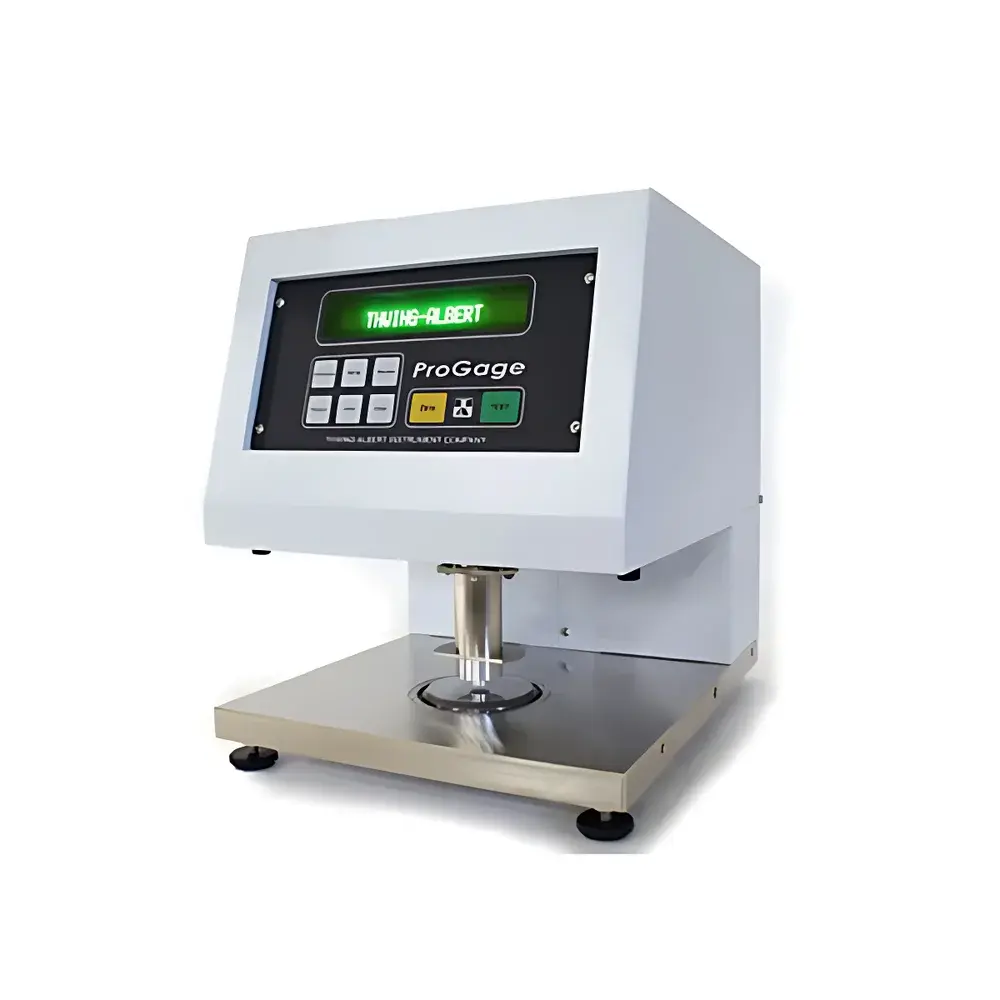
Thwing-Albert Progage Precision Thickness Gauge
| Origin | USA |
|---|---|
| Manufacturer Type | Authorized Distributor |
| Origin Category | Imported |
| Model | Progage |
| Pricing | Upon Request |
Overview
The Thwing-Albert Progage Precision Thickness Gauge is an electromechanical, high-resolution thickness measurement instrument engineered for rigorous laboratory and quality control environments. It operates on the principle of controlled-force mechanical displacement measurement—utilizing a precision-ground anvil and a motorized or manually actuated pressure foot to compress a specimen under standardized load and dwell time, then measuring the resulting gap with a calibrated linear variable differential transformer (LVDT) or high-stability capacitive transducer. Designed in strict accordance with international material testing standards—including ASTM D374 (electrical insulation), D1777 (textiles), D645 (paper), D6988 (plastic film), TAPPI T411 (paperboard), ISO 3034 (paper and board), ISO 4593 (plastic film), EN 20534 (packaging), and EDANA 30.4-89 (nonwovens)—the Progage delivers traceable, repeatable thickness data critical for product specification compliance, process validation, and incoming/outgoing inspection.
Key Features
- Dual-speed pressure foot actuation enabling up to 20 test cycles per minute without compromising measurement integrity
- Adjustable pressure foot travel height, contact diameter, and mass to meet application-specific standard requirements (e.g., 2.0 mm, 5.0 mm, or 10.0 mm foot diameters; 0.5–10 N selectable loading)
- Configurable dwell time (0.1–9.9 seconds) and pre-load delay for dynamic compression profiling
- Zero-stable anvil geometry ensuring parallelism within ±0.00004 in (±0.001 mm) across full measurement range
- Multi-range capability: four selectable spans (1 mm, 2.5 mm, 5 mm, 12.7 mm) with corresponding resolution and accuracy specifications
- High-resolution digital display supporting units in inches, mils, millimeters, and micrometers (0.00001 in / 0.1 µm minimum resolution on base range)
- Integrated statistical engine performing real-time calculation and display of mean, maximum, minimum, and standard deviation across up to 99 stored measurements
- RS-232 serial interface for bidirectional communication with LIMS or custom QC software; fully compatible with Windows-based data acquisition systems
- Rugged cast-aluminum frame and hardened stainless-steel contact surfaces for long-term dimensional stability and wear resistance
Sample Compatibility & Compliance
The Progage accommodates a broad spectrum of flexible and semi-rigid sheet materials, including but not limited to: paper, corrugated board, cardboard, aluminum foil, medical-grade films (e.g., blister packaging, IV bag substrates), polymer films (PET, PP, PE, BOPP), nonwovens (spunbond, meltblown), textiles (woven and knit), tissue paper, towel stock, rubber sheets, foam laminates, and molded thermoplastics. Its modular pressure foot configuration allows direct alignment with method-defined parameters from ASTM, ISO, TAPPI, SCAN, DIN, BS, and CPPA standards. All configurations support GLP-compliant operation when paired with audit-trail-enabled software, and the instrument’s mechanical design inherently satisfies the repeatability and reproducibility criteria outlined in ISO/IEC 17025 for accredited testing laboratories.
Software & Data Management
While the Progage operates as a standalone gauge with embedded firmware, its RS-232 port enables seamless integration into regulated environments requiring electronic record retention. When connected to compliant PC-based software (e.g., Thwing-Albert’s optional GAGElink™ or third-party validated applications), the device supports FDA 21 CFR Part 11–compliant workflows—including user authentication, electronic signatures, audit trail generation, and secure data export in CSV or XML format. Raw measurement timestamps, operator IDs, test parameters (dwell time, pressure, foot size), and statistical outputs are all captured and timestamped at acquisition. No internal memory or cloud dependency is required—the system functions reliably in air-gapped lab networks.
Applications
- Quality assurance of roll-to-roll converted materials in packaging, hygiene, and medical device manufacturing
- Thickness uniformity mapping for R&D of barrier films and multilayer coextrusions
- Calibration verification of online gauging systems using certified reference standards
- Comparative analysis of compressibility behavior across substrate families (e.g., low-density foam vs. high-basis-weight nonwoven)
- Supporting ISO 9001 and IATF 16949 process control documentation through automated SPC charting
- Validation of thickness-related physical properties such as tensile strength, burst resistance, and permeability correlations
FAQ
What standards does the Progage directly support out-of-the-box?
The Progage is pre-configured to execute ASTM D374, D1777, D645, D6988; TAPPI T411; ISO 3034, 4593; EN 20534; SCAN P7, P31, P47; DIN 53105, 53353; and EDANA 30.4-89—requiring only selection of the appropriate pressure foot and dwell time.
Can the Progage be used for compressed thickness testing of foams or elastomers?
Yes—by selecting larger-diameter pressure feet (e.g., 10 mm) and extended dwell times (up to 9.9 s), the instrument meets ASTM D3574 and ISO 1856 requirements for resilient materials when used with optional compression fixtures.
Is calibration traceable to NIST or equivalent national metrology institutes?
All factory calibrations are performed using master gage blocks and step standards certified to ISO/IEC 17025-accredited laboratories; certificate of calibration includes uncertainty budgets and traceability statements.
Does the Progage require annual recalibration?
Per ISO/IEC 17025 and internal QA protocols, recalibration is recommended every 12 months—or after any impact event, mechanical adjustment, or performance deviation exceeding ±0.0001 in (±2.5 µm) during routine verification checks.
How is zero stability maintained over time and temperature fluctuations?
The anvil assembly uses matched coefficient-of-expansion Invar-steel components and passive thermal compensation; zero drift remains within ±0.00002 in (±0.5 µm) over 23 ±2°C ambient operating range.



