
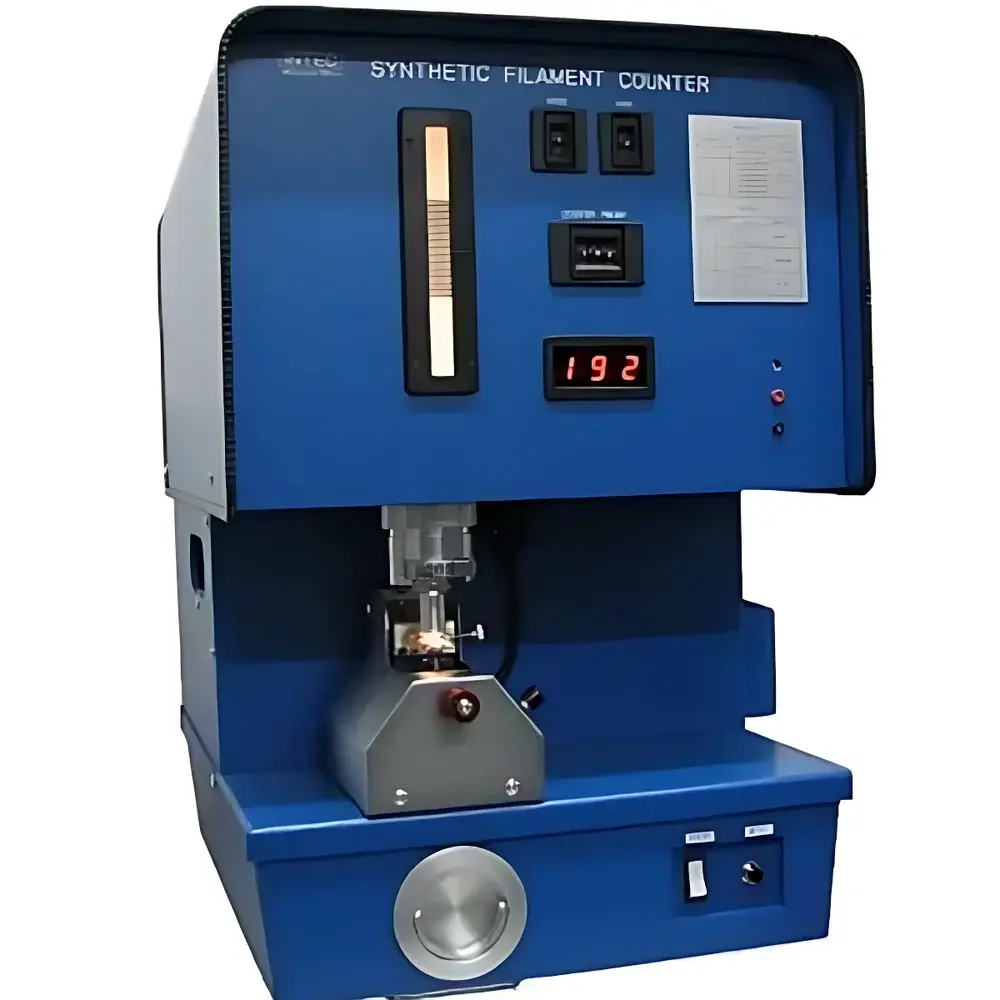
INTEC Kanebo KE-6 / KE-6S / KE-6SS Synthetic Filament Counting System
| Brand | INTEC |
|---|---|
| Origin | Japan |
| Model | KE-6 / KE-6S / KE-6SS |
| Detection Method | Transmission optical imaging of aligned filaments |
| Max Single-Measurement Capacity | 100 (KE-6), 200 (KE-6S & KE-6SS) filaments |
| Segment Measurement Range | 1–6 segments |
| Total Measurable Filaments per Sample | up to 599 (KE-6), 999 (KE-6S & KE-6SS) |
| Filament Linear Density Range | 0.6–33 dtex (KE-6/KE-6S), 2–33 dtex (KE-6SS, TiO₂ ≤2.0% w/w) |
| Filament Count Adjustment Limit | Total dtex × filament count ≤ 50,000 (KE-6), ≤ 250,000 (KE-6S/KE-6SS) |
| Alignment Aid | Vibration bar for uniform filament arrangement |
| Image Acquisition | Real-time CCD-based transmission imaging with auto-focus assist |
| Illumination Monitoring | Integrated lux meter for ambient and backlight intensity control |
| Operation Mode | Manual (button) or foot-switch triggered scanning |
| Power Supply | 100 V / 220 V, 50/60 Hz, single-phase |
Overview
The INTEC Kanebo KE-6, KE-6S, and KE-6SS Synthetic Filament Counting Systems are precision optical instruments engineered for rapid, non-contact quantification of filament count (F-number) in synthetic multifilament yarns—primarily polyester, nylon, and acrylic fibers used in apparel, industrial textiles, tire cord, and airbag fabrics. These systems operate on the principle of high-contrast transmission imaging: filaments are mechanically aligned via a vibration-assisted bar, illuminated by a stabilized backlight source, and imaged using a calibrated CCD sensor. The embedded microprocessor applies edge-detection algorithms and adaptive thresholding to distinguish individual filaments—even under minor misalignment or slight inter-filament overlap—delivering objective, operator-independent counts with repeatability compliant with ISO 2060 and JIS L 1013 standards for filament yarn characterization.
Key Features
- Vibration-assisted filament alignment mechanism ensures consistent lateral spacing and minimizes bundle stacking, enabling reliable detection across heterogeneous yarn structures.
- Real-time transmission optical imaging with integrated lux monitoring allows dynamic compensation for ambient light fluctuations and backlight degradation—critical for long-term measurement stability.
- Self-diagnostic firmware performs periodic calibration verification and automatically adjusts image contrast, exposure time, and segmentation parameters to maintain optimal counting accuracy.
- Segmented measurement mode supports up to six sub-scans per sample, permitting accurate enumeration of high-F-number yarns (up to 999 filaments) without manual reconfiguration.
- Dual-mode operation (push-button or foot-switch activation) facilitates integration into QC workstations where hands-free control improves workflow continuity and reduces operator fatigue.
- Acoustic (buzzer) and visual (LED flash) alerts trigger immediately upon detection of filament count deviation exceeding user-defined tolerance thresholds—enabling real-time process intervention.
- Robust mechanical design accommodates both drawn and undrawn synthetic filaments, including those with low refractive index contrast (e.g., TiO₂-loaded polyester at ≤2.0% w/w).
Sample Compatibility & Compliance
The KE-6 series is validated for use with continuous-filament synthetic yarns ranging from 0.6 dtex (KE-6/KE-6S) to 2 dtex (KE-6SS) minimum linear density, supporting total fineness × filament count products up to 50,000 dtex·F (KE-6) or 250,000 dtex·F (KE-6S/KE-6SS). It complies with textile testing requirements outlined in ISO 2060:2017 (yarn numbering systems), ASTM D2256 (tensile properties of yarns), and JIS L 1013 (methods for testing synthetic filament yarns). Its optical architecture meets GLP-aligned documentation criteria when paired with optional audit-trail-enabled software modules, supporting traceability in regulated manufacturing environments subject to IATF 16949 or ISO 9001 quality system audits.
Software & Data Management
Each unit includes embedded firmware with local data storage (non-volatile memory for ≥10,000 measurement records), timestamped results exportable via RS-232 or USB interface in CSV format. Optional PC-based software provides batch reporting, statistical process control (SPC) charting (X̄-R, Cpk), and configurable pass/fail logic based on preset filament count windows. All software modules support FDA 21 CFR Part 11-compliant electronic signatures and audit trail logging when deployed in pharmaceutical-grade cleanroom textile applications (e.g., medical gowns, filtration media).
Applications
- Final inspection of textured polyester yarns for automotive airbag fabric suppliers.
- In-process verification of filament count consistency during draw-texturing and false-twist texturing lines.
- QC screening of tire cord yarns prior to rubber adhesion treatment.
- Validation of filament splitting integrity in ultra-fine denier microfiber production.
- Technical textile R&D labs evaluating filament distribution uniformity across hybrid yarn architectures.
FAQ
What filament types and finishes are supported?
The system is optimized for undyed or lightly dyed synthetic filaments (polyester, nylon 6/6.6, polypropylene) with surface TiO₂ content ≤2.0%. Metallic or heavily carbon-black–loaded filaments require empirical validation due to reduced optical transmission.
Can the KE-6S measure partially fused filaments?
Yes—the adaptive edge-detection algorithm distinguishes subtle intensity gradients between adjacent filaments, provided physical separation exceeds ~5 µm and no permanent fusion occurs at the fiber surface.
Is external calibration required?
No routine external calibration is needed; the system performs internal reference checks before each measurement cycle using built-in photometric and geometric references.
How is data integrity ensured during power interruption?
All active measurements are buffered in non-volatile RAM; unsaved results persist through brief outages (<5 s) and resume upon power restoration without data loss.
Does the system support multi-language UI?
The base firmware operates in English and Japanese; custom language packs (German, French, Chinese) are available under OEM licensing agreements.



