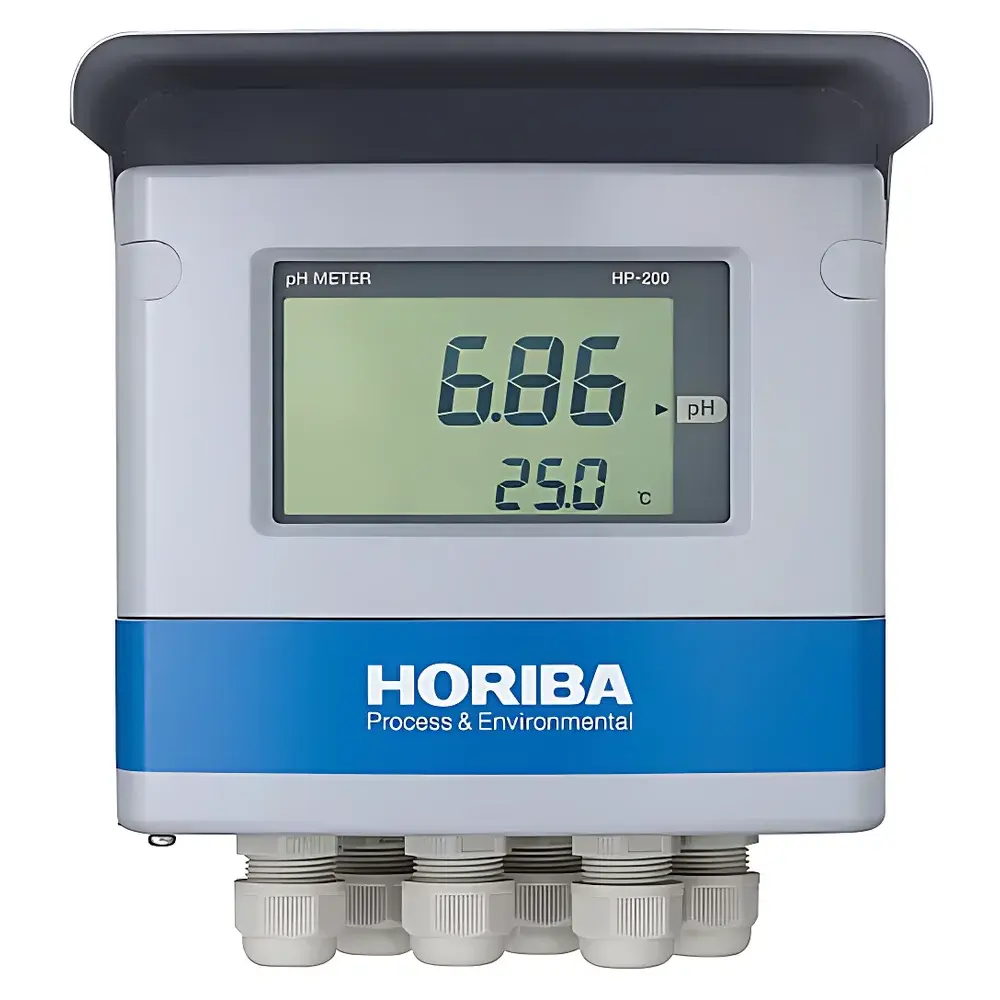
HORIBA PH-200 Online pH Transmitter and Analyzer
| Brand | HORIBA |
|---|---|
| Origin | Japan |
| Model | PH-200 |
| pH Range | 0–14 |
| Temperature Range (Sample) | 0–100 °C |
| Operating Ambient Temperature (Transmitter) | −20 to +55 °C |
| Power Supply | AC 100–240 V ±10%, 50/60 Hz |
| Enclosure Material | Aluminum Alloy |
| Ingress Protection | IP65 |
| Compliance | CE Marking, FCC Rules, RoHS, WEEE |
| Output | 4–20 mA (4-wire), Optional Temperature Compensation |
| Display | Backlit LCD with Simultaneous pH & Temperature Readout |
| Self-Diagnostic Function | Yes |
| Electrode Interface | Standard BNC or DIN connector (electrode not included) |
| Calibration Memory | Yes |
| Terminal Type | Screw-type Terminal Blocks (Non-loosening) |
Overview
The HORIBA PH-200 is a robust, industrial-grade online pH transmitter and analyzer engineered for continuous, high-reliability monitoring and control of aqueous process streams in demanding environments. Designed around the fundamental electrochemical principle of potentiometric pH measurement—where the potential difference between a pH-sensitive glass electrode and a stable reference electrode is converted into a calibrated pH value—the PH-200 delivers stable, traceable readings across the full physicochemical range of 0–14 pH units. Its integrated temperature measurement (0–100 °C) enables automatic temperature compensation (ATC) using NIST-traceable algorithms, ensuring accuracy under dynamic thermal conditions typical in chemical processing, municipal wastewater treatment, food & beverage production, and pharmaceutical water systems. The unit operates as a 4-wire transmitter, supporting isolated analog output (4–20 mA) compatible with DCS, PLC, and SCADA architectures, and is configured for seamless integration into automated process control loops requiring real-time feedback.
Key Features
- Industrial aluminum alloy housing rated IP65 for dust-tight and water-jet resistant operation—suitable for outdoor mounting and humid, corrosive plant environments.
- Wide ambient operating temperature range (−20 to +55 °C), enabling deployment in unconditioned enclosures, pump stations, and open-air treatment basins.
- Simultaneous dual-parameter display: large backlit LCD shows real-time pH and sample temperature side-by-side, reducing operator cognitive load during routine verification.
- Embedded self-diagnostic system continuously monitors electrode impedance, asymmetry potential, and reference junction stability—triggering immediate visual alerts upon deviation beyond configurable thresholds.
- RoHS- and WEEE-compliant electrode interface design with lead-free internal components, supporting environmental compliance requirements in EU, North America, and APAC markets.
- Screw-type non-loosening terminal blocks ensure vibration-resistant wiring integrity—critical for long-term reliability in piping galleries and vibrating pump skids.
- Onboard calibration memory stores date-stamped calibration records (including slope, offset, and buffer IDs), supporting GLP-aligned documentation practices without external data loggers.
Sample Compatibility & Compliance
The PH-200 is compatible with a broad spectrum of HORIBA’s certified pH electrodes—including general-purpose, low-conductivity, high-temperature, and fouling-resistant variants—allowing optimization for applications ranging from ultrapure water (UPW) in semiconductor rinse tanks to aggressive caustic or acidic effluents in electroplating lines. All measurements adhere to ISO 7888 (water quality — determination of pH), ASTM D1293 (Standard Test Methods for pH of Water), and USP (pH Measurement) where applicable. The device’s CE marking certifies conformity with the EU Electromagnetic Compatibility (2014/30/EU) and Low Voltage (2014/35/EU) Directives; FCC Part 15 Class A certification confirms electromagnetic emissions compliance in industrial facilities. While the PH-200 itself does not carry FDA 21 CFR Part 11 validation out-of-the-box, its audit-trail-capable calibration memory and tamper-evident timestamping support qualification under GMP and cGMP frameworks when deployed with validated electrodes and documented SOPs.
Software & Data Management
The PH-200 operates as a standalone analog transmitter and requires no proprietary software for basic operation. Configuration, calibration, and diagnostic review are performed locally via intuitive front-panel navigation. For centralized monitoring, the 4–20 mA output can be interfaced with third-party historian systems (e.g., Siemens Desigo, Emerson DeltaV, or Inductive Automation Ignition) supporting Modbus RTU or HART protocol adapters (optional accessories). Calibration data is retained in non-volatile memory and includes timestamps, buffer pH values used, measured mV output, and calculated slope/offset—enabling retrospective QA review and root-cause analysis of drift events. No cloud connectivity or firmware updates are embedded; all configuration changes are manually verified and recorded per site-specific change control procedures.
Applications
- Municipal and industrial wastewater treatment: continuous monitoring of influent, bioreactor, and final effluent pH for regulatory reporting and lime dosing control.
- Chemical manufacturing: inline pH control in neutralization reactors, scrubber loops, and batch titration endpoints.
- Food & beverage processing: monitoring of CIP rinse water, brine solutions, and dairy product streams per FDA Food Code and HACCP plans.
- Power generation: condensate polishing and boiler feedwater pH assurance in accordance with EPRI guidelines and ASME PTC 19.11.
- Pharmaceutical purified water (PW) and water-for-injection (WFI) distribution loops—when paired with sanitary tri-clamp electrodes meeting ASME BPE standards.
FAQ
Does the PH-200 include a pH electrode?
No. The PH-200 is a transmitter-only unit. Compatible HORIBA electrodes (e.g., 9201-10D, 9202-10D, or 9203-10D series) must be selected separately based on application requirements.
Can the PH-200 be powered by DC voltage?
No. It requires AC mains input (100–240 V, 50/60 Hz) and does not support 24 V DC or loop-powered configurations.
Is the unit suitable for explosive atmospheres?
Not inherently. The PH-200 lacks ATEX, IECEx, or UL HazLoc certification. For hazardous areas, it must be installed in a purged or pressurized enclosure compliant with NEC Article 500 or IEC 60079-13.
How often should calibration be performed?
Calibration frequency depends on process variability and regulatory expectations; typical intervals range from daily (critical pharmaceutical applications) to weekly (stable wastewater streams), always aligned with site-specific SOPs and ISO/IEC 17025 traceability requirements.
Does the PH-200 support digital communication protocols such as Modbus or Profibus?
The base model provides analog 4–20 mA output only. Digital communication requires optional interface modules (sold separately) and is subject to regional availability and firmware compatibility.
Related Products