
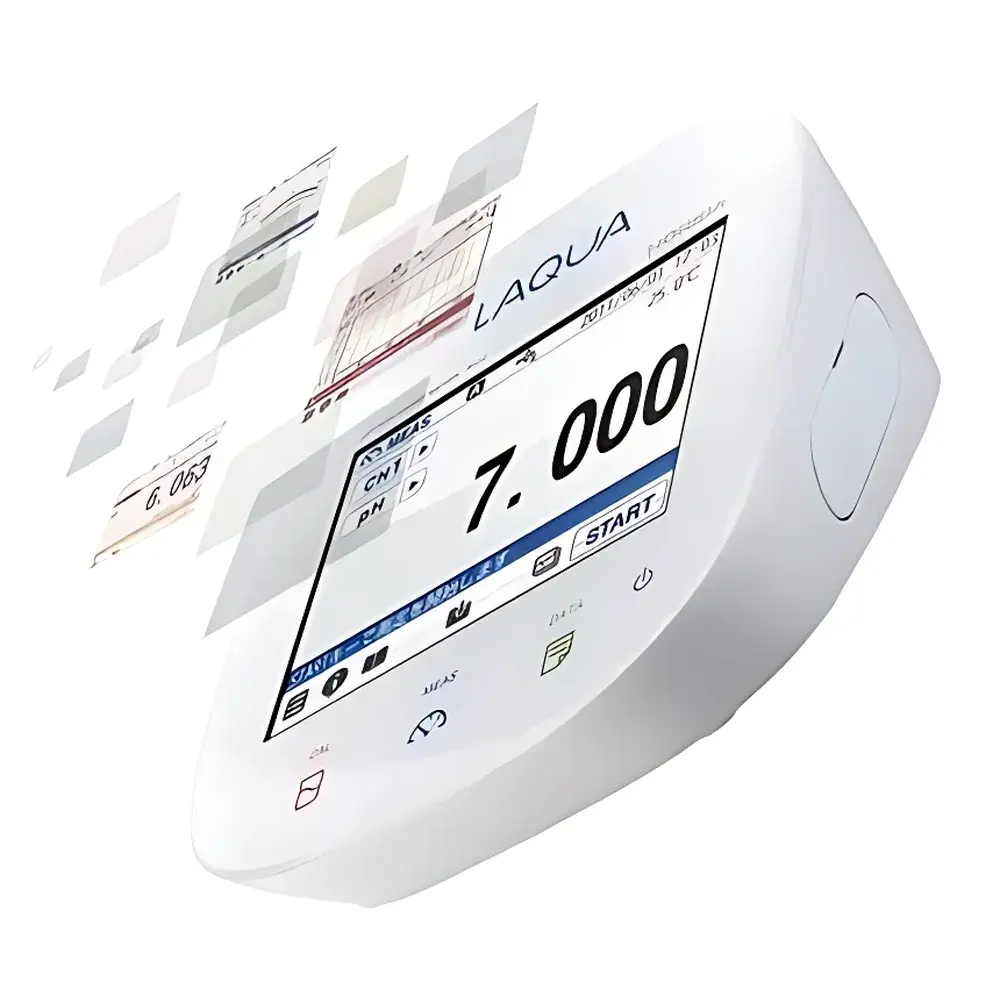
HORIBA LAQUA F-71A-S / F-72A-S / F-73A-S / F-74A-S Benchtop Multi-Parameter Water Quality Analyzer
| Brand | HORIBA |
|---|---|
| Origin | Japan |
| Model Series | F-71A-S, F-72A-S, F-73A-S, F-74A-S |
| Measurement Parameters | pH, mV (ORP), Conductivity, Resistivity, Salinity, TDS, Temperature |
| Instrument Type | Laboratory Benchtop Water Quality Analyzer |
| Compliance | Designed for ISO/IEC 17025-compliant labs and GLP environments |
| Software Interface | USB and RS-232 connectivity for data export and instrument control |
Overview
The HORIBA LAQUA F-70 Series benchtop water quality analyzers represent a precision-engineered platform for standardized, multi-parameter analysis of aqueous samples in regulated laboratory settings. Based on potentiometric (pH, ORP, ion-selective electrodes) and conductometric (four-electrode conductivity cell) measurement principles, these instruments deliver high reproducibility and long-term stability across routine environmental, industrial, and academic testing workflows. The F-71A-S through F-74A-S models constitute the core laboratory variant of the F-70 platform—distinguished from portable or process-oriented counterparts by enhanced calibration traceability, expanded memory capacity, and dual-channel electrode support for simultaneous pH/conductivity or dual-ion measurements. All units are manufactured in Japan under HORIBA’s stringent quality control system, with factory calibration traceable to NIST-certified reference standards.
Key Features
- Four distinct model configurations (F-71A-S to F-74A-S) optimized for incremental functionality: F-71A-S supports pH/mV/Temperature; F-72A-S adds conductivity/resistivity/salinity/TDS; F-73A-S enables dual-channel pH/mV measurement; F-74A-S integrates full multi-parameter capability with programmable auto-ranging conductivity and temperature compensation algorithms (linear, non-linear, and NaCl-based).
- High-accuracy four-electrode conductivity cell (standard on F-72A-S and above) minimizes polarization error and enables stable measurement across wide ranges—from ultrapure water (≥18.2 MΩ·cm resistivity) to concentrated brines (up to 200 mS/cm).
- Integrated temperature sensor with ±0.1 °C accuracy ensures precise automatic temperature compensation (ATC) for all electrochemical parameters, critical for compliance with ASTM D1125 (conductivity) and ISO 7888 (electrical conductivity of water).
- Large backlit LCD display with dual-line parameter readout and real-time graphical trend logging (up to 1,000 data points per channel).
- Rugged ABS housing rated IP54 for dust and splash resistance; designed for continuous operation in controlled laboratory environments under ISO 17025 accreditation requirements.
Sample Compatibility & Compliance
The F-70 Series is validated for use with deionized water, surface water, groundwater, wastewater effluents, boiler feedwater, and pharmaceutical-grade purified water (PW/WFI). Electrode compatibility includes standard combination pH electrodes (e.g., HORIBA 9615S-10D), platinum ORP sensors, and interchangeable conductivity cells (e.g., 3551-10D, 3552-10D). All firmware and calibration protocols adhere to Good Laboratory Practice (GLP) documentation standards—including mandatory operator ID entry, timestamped calibration logs, and audit-trail-enabled memory. Data output conforms to ASTM E2500-18 (verification of analytical systems) and supports FDA 21 CFR Part 11 readiness when paired with HORIBA’s optional LAQUA Connect software (version 3.0+).
Software & Data Management
Data transfer and instrument configuration are supported via USB-B and RS-232 interfaces. HORIBA LAQUA Connect PC software (Windows 10/11 compatible) enables remote calibration, method storage, automated report generation (PDF/CSV), and electronic signature capture. Raw measurement files include embedded metadata: date/time stamp, electrode serial number, calibration history, ambient temperature, and user-defined sample ID. Exported datasets comply with LIMS integration requirements (ASTM E1578-22) and are structured for direct import into statistical process control (SPC) platforms or ELN systems.
Applications
- Environmental monitoring laboratories performing EPA Method 120.1 (pH), 120.2 (conductivity), and ISO 5667-3 (sampling preservation) compliant analyses.
- Pharmaceutical QC labs verifying USP (Water Conductivity) and (pH) specifications for Purified Water and Water for Injection.
- Power generation facilities conducting daily feedwater and condensate purity verification per IAPWS guidelines.
- Academic research groups requiring traceable, multi-parameter baseline characterization of natural and engineered aquatic systems.
- Calibration service providers offering accredited verification services under ISO/IEC 17025 Clause 6.5 (equipment verification).
FAQ
What electrode types are compatible with the F-74A-S model?
Standard HORIBA LAQUA series electrodes—including refillable combination pH electrodes (9615S-10D), double-junction reference electrodes (9625S-10D), and four-electrode conductivity cells (3551-10D)—are fully supported. Third-party electrodes with BNC or DIN connectors may be used but require manual slope/offset adjustment.
Does the instrument support automatic calibration recognition?
Yes—the F-72A-S and higher models recognize HORIBA Smart Electrodes (with embedded EEPROM chips) to auto-load calibration coefficients, electrode type, and expiration dates.
Is GLP-compliant data archiving possible without additional software?
Basic calibration and measurement logs are stored internally with timestamps and user IDs. Full GLP audit trails—including electronic signatures and change history—require LAQUA Connect software and a configured Windows domain environment.
Can the F-70 Series meet ISO 17025 requirements for uncertainty estimation?
When operated with certified reference materials (e.g., NIST SRM 3151a for pH, BAM KCl solutions for conductivity) and documented calibration procedures, the F-70 Series contributes to measurement uncertainty budgets per ISO/IEC 17025:2017 Clause 7.6. HORIBA provides uncertainty guidance documents upon request.
What is the recommended maintenance interval for the conductivity cell?
The four-electrode cell should undergo cleaning with 0.1 M HNO₃ every 500 measurements or weekly in high-fouling matrices; full recalibration is advised after cleaning or every 30 days in continuous use.







