
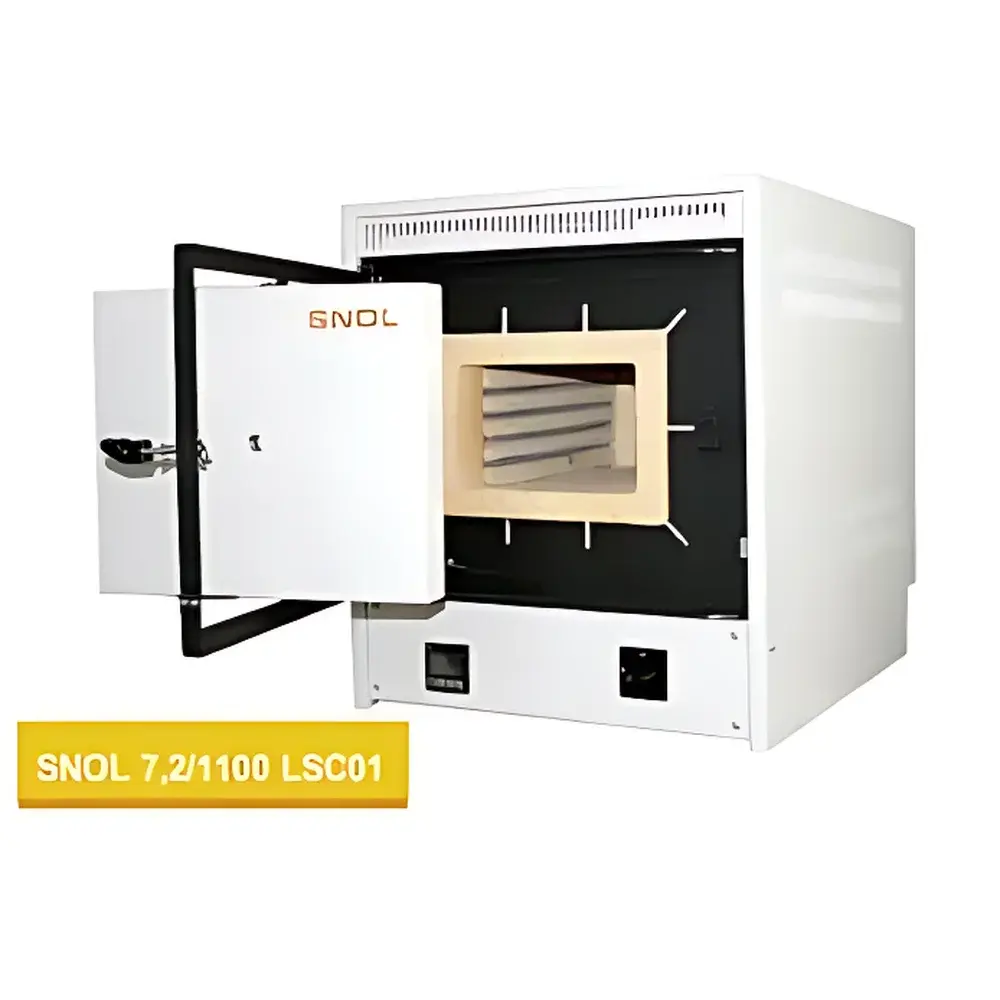
SNOL Ceramic-Bodied Box Furnace (900–1300 °C)
| Origin | Imported |
|---|---|
| Manufacturer Type | Authorized Distributor |
| Model Range | SNOL 4/900, 7.2/900, 12/900, 15/900 |
| Heating Configuration | Exposed heating elements (for 1100 °C and 1300 °C models) |
| Chamber Volume | 4–15 L |
| Max Operating Temperature | 900, 1100, 1200, or 1300 °C |
| External Finish | RAL 7035 textured powder coating |
| Construction | Stainless steel outer casing with solid ceramic chamber lining |
| Thermal Insulation | High-purity refractory ceramic fiber board and firebrick |
| Control System | Microprocessor-based PID temperature controller with digital timer, over-temperature protection, and process monitoring viewport (Ø35 mm, rated to 1100 °C) |
| Connectivity | RS232 / RS485 / USB interface for data logging and remote monitoring |
| Compliance | Designed to support GLP/GMP-aligned thermal processing workflows |
Overview
The SNOL Ceramic-Bodied Box Furnace is a precision-engineered laboratory muffle furnace designed for controlled high-temperature thermal processing in research, quality control, and industrial development environments. Engineered for stability and repeatability across extended dwell cycles, it employs a monolithic solid-ceramic chamber structure—distinct from conventional brick-lined or fiber-wrapped cavities—to ensure exceptional thermal uniformity, low thermal mass, and minimized outgassing during operation. Its operational range spans four discrete maximum temperature classes: 900 °C, 1100 °C, 1200 °C, and 1300 °C—each corresponding to optimized heater configuration (exposed or encapsulated), insulation architecture, and thermocouple placement per IEC 60584-2 and ASTM E230 standards. The furnace operates on resistive heating principles, with temperature regulation achieved via dual-stage PID control and Class 1 (±0.5 °C) Pt100 RTD sensing integrated into the chamber wall. It serves as a primary tool for annealing, sintering, ashing, calcination, stress-relieving, and pre-heat treatments where material integrity, oxidation control, and atmosphere consistency are critical.
Key Features
- Solid ceramic chamber construction providing superior thermal inertia, chemical inertness, and dimensional stability up to 1300 °C
- Modular heating element design: exposed Kanthal A1 wire for rapid response at 1100 °C and 1300 °C models; fully encapsulated elements in Al₂O₃ sheaths for enhanced longevity and reduced contamination risk at 900 °C and 1200 °C models
- Microprocessor-based controller with programmable ramp-hold profiles, real-time deviation alarm, and auto-shutdown on sensor fault or over-temperature event (>5 °C above setpoint)
- Integrated Ø35 mm borosilicate viewport rated for continuous use up to 1100 °C, enabling visual process verification without thermal interruption
- Reinforced ceramic hearth plate and heavy-duty stainless steel support grid accommodating loads up to 15 kg (distributed)
- RS232/RS485/USB communication interface supporting bidirectional command exchange and time-stamped temperature logging compliant with FDA 21 CFR Part 11 audit trail requirements when paired with validated software
- External enclosure finished in RAL 7035 light gray textured powder coating for corrosion resistance and cleanroom-compatible surface properties
Sample Compatibility & Compliance
The SNOL furnace accommodates a broad spectrum of sample geometries and material classes—including metallic alloys, ceramics, polymers, pharmaceutical excipients, geological specimens, and composite precursors—within its 4–15 L chamber volume options. Chamber dimensions (e.g., 210 × 410 × 160 mm for the 15 L model) and dual-opening configurations (side-hinged or top-lifting) facilitate safe loading of crucibles, boats, and custom fixtures. All models meet CE marking requirements under the EU Machinery Directive 2006/42/EC and Electromagnetic Compatibility Directive 2014/30/EU. The furnace’s thermal performance aligns with ISO 8573-1 for particulate cleanliness in heated zones and supports GLP-compliant validation through optional IQ/OQ documentation packages. Optional exhaust port integration enables connection to fume hoods or scrubber systems for volatile byproduct management during organic ashing or binder burnout.
Software & Data Management
Furnace operation and data acquisition are supported via optional PC-based software compatible with Windows 10/11. The interface enables full profile programming (up to 32 segments), real-time graphing of chamber temperature vs. time, export of CSV-formatted logs with UTC timestamps, and password-protected user role assignment (operator, supervisor, administrator). Raw thermocouple voltage and controller output signals are recorded at 1 Hz resolution. When configured with a calibrated reference thermocouple and NIST-traceable DAQ system, the platform satisfies analytical instrument qualification (AIQ) criteria for regulated environments. Audit trails include user ID, timestamp, parameter change, and reason-for-change fields—fully compliant with Annex 11 and ALCOA+ data integrity principles.
Applications
- Materials science: Sintering of oxide and non-oxide ceramics; grain growth studies; phase transformation analysis
- Pharmaceutical QA/QC: Loss-on-drying (LOD) determination per USP <731>; residual solvent removal; tablet coating stability testing
- Metallurgy: Heat treatment of tool steels and superalloys; decarburization assessment; intergranular corrosion testing per ASTM A262
- Environmental testing: Total organic carbon (TOC) combustion; gravimetric ash content analysis per EPA Method 1631
- Academic research: Solid-state synthesis; catalyst activation; precursor decomposition kinetics
FAQ
What temperature uniformity can be expected across the working zone?
Typical radial and axial uniformity is ±5 °C at 1000 °C and ±8 °C at 1300 °C (measured per ASTM E220 at 3-point grid, 25 mm from chamber walls).
Is the furnace suitable for inert or reducing atmospheres?
Yes—when equipped with optional gas inlet/outlet ports and sealed door gasket, it supports N₂, Ar, or forming gas (5% H₂/95% N₂) purging at flow rates up to 2 L/min.
How is temperature calibration performed and documented?
Factory calibration uses dual-reference Pt/Pt–13%Rh thermocouples traceable to NIST SRM 1750; users may perform field verification using a portable dry-block calibrator and documented SOP per ISO/IEC 17025.
Can the furnace be integrated into a central laboratory automation system?
Yes—via Modbus RTU over RS485 or ASCII commands over USB, enabling PLC-level coordination with conveyor feeders, robotic arms, or LIMS-triggered batch initiation.
What maintenance intervals are recommended for long-term reliability?
Heating elements should be inspected annually; ceramic insulation integrity verified every 2 years; controller firmware updated per manufacturer bulletin; all safety interlocks function-tested prior to each new qualification cycle.



