
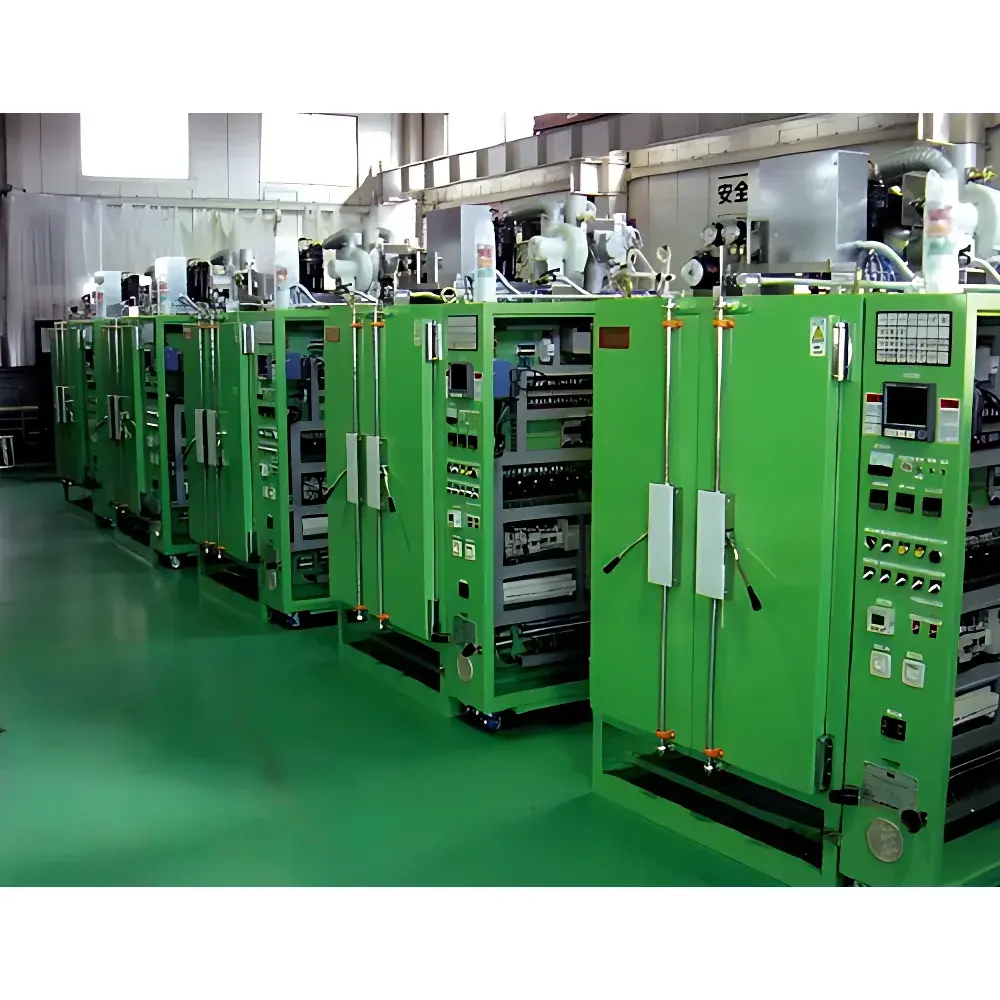
Eastshine Thermal Lens Lamination Oven
| Origin | Japan |
|---|---|
| Manufacturer Type | Authorized Distributor |
| Origin Category | Imported |
| Temperature Range | 10–200 °C (Max. 200 °C) |
| Internal Chamber Dimensions | W800×H1200×D800 mm / W1300×H1200×D1100 mm / W2000×H1500×D1000 mm / W1000×H1000×D1000 mm |
| Control System | Programmable Temperature Controller with Paperless Data Logger (DAQ Station CX-1000) |
| Heater Regulation | SCR Thyristor Regulator |
| Cooling System | Water-Cooled or Air-Cooled Chiller (0.75 kW) |
| Safety Features | Dual Overheat Prevention Regulators, Redundant Thermal Cut-offs |
| Energy Efficiency | Optimized Thermal Insulation & Inverter-Driven Circulation |
Overview
The Eastshine Thermal Lens Lamination Oven is a precision-engineered thermal processing system designed specifically for the controlled lamination of ophthalmic lenses—particularly multi-layered plastic (e.g., polycarbonate, CR-39) and hybrid optical components requiring uniform heat application under tightly regulated ambient conditions. Operating on the principle of convective thermal stabilization within a fully insulated chamber, the oven delivers repeatable, gradient-free temperature profiles across its working volume, critical for eliminating interfacial stress, minimizing optical distortion, and ensuring long-term adhesion integrity between lens substrates and anti-reflective, hard-coat, or photochromic layers. Unlike general-purpose industrial ovens, this system integrates ISO/IEC 17025-aligned thermal uniformity validation protocols into its operational architecture, with chamber stability maintained within ±0.5 °C over extended dwell cycles (up to 12 hours), supporting both batch and semi-continuous production workflows in certified optical manufacturing facilities.
Key Features
- Multi-zone programmable temperature control via integrated PID-based controller, supporting up to 20-step ramp-soak profiles with real-time deviation monitoring
- Paperless data acquisition station (DAQ Station CX-1000) compliant with FDA 21 CFR Part 11 requirements—enabling electronic signature-capable audit trails, encrypted raw data storage, and configurable alarm logging
- SCR thyristor-regulated heating system delivering precise power modulation without thermal overshoot, coupled with redundant overheat protection circuits (dual independent limit switches + mechanical thermal cutoff)
- Chamber-specific cooling configurations: water-cooled chiller integration (for high-throughput environments requiring rapid cooldown cycles) or air-cooled 0.75 kW inverter-driven unit (optimized for energy efficiency and noise reduction)
- Thermally optimized chamber construction using low-conductivity ceramic fiber insulation and stainless-steel interior cladding, validated for thermal uniformity per ASTM E2207-21 Class B specifications
- Modular internal dimensions accommodating diverse lens carriers—from single-frame jigs to multi-tier aluminum trays—ensuring compatibility with ANSI Z80.1-compliant lens geometries up to 2000 mm wide
Sample Compatibility & Compliance
The oven supports all standard ophthalmic lens materials including polycarbonate, Trivex®, acrylic, and high-index plastics (1.60–1.74), as well as coated substrates requiring post-cure stabilization. Its design conforms to ISO 8980-3:2021 (ophthalmic optics – uncut finished lenses – Part 3: Requirements for laminated lenses) and aligns with JIS T 7310:2020 for thermal treatment validation in lens manufacturing. Built-in safety interlocks meet IEC 61000-6-2/6-4 EMC standards and UL 61010-1 electrical safety requirements. Full traceability documentation—including factory calibration certificates for thermocouples (Type K, NIST-traceable), DAQ validation reports, and chamber mapping studies—is supplied with each unit.
Software & Data Management
The DAQ Station CX-1000 provides browser-accessible configuration and real-time visualization via Ethernet/IP. All thermal profiles are stored in .csv and .tdms formats with embedded metadata (operator ID, batch number, chamber sensor IDs). The system supports automated report generation compliant with GLP/GMP Annex 11 expectations, including electronic signatures, user role-based access control (admin/operator/viewer), and tamper-evident log archiving. Optional integration with MES platforms (Siemens Opcenter, Rockwell FactoryTalk) is available through OPC UA interface.
Applications
- Post-lamination stress relief of bonded lens assemblies prior to edging and mounting
- Thermal conditioning of photochromic and electrochromic lens stacks to stabilize dye kinetics
- Curing of UV-hardened edge seals in progressive and bifocal laminated designs
- Accelerated aging simulations for regulatory submission (ISO 10993-12 biocompatibility pre-conditioning)
- Validation of coating adhesion strength per ISO 2409 cross-cut test preconditioning protocols
FAQ
What temperature uniformity can be expected across the chamber volume?
Typical spatial uniformity is ±0.5 °C at setpoint (120 °C), verified per ASTM E2207-21 using 9-point sensor mapping during IQ/OQ qualification.
Is the DAQ Station CX-1000 compliant with FDA 21 CFR Part 11?
Yes—full electronic signature support, audit trail encryption, and role-based permissions are enabled by default; validation templates and URS documentation are provided.
Can the oven be integrated into an existing factory automation network?
Standard Ethernet/IP and optional OPC UA connectivity allow seamless integration with SCADA, MES, and ERP systems for centralized process monitoring.
What maintenance intervals are recommended for the SCR heater regulator and chiller unit?
SCR modules require annual inspection and cleaning; water-cooled chillers demand quarterly coolant analysis and filter replacement—maintenance schedules are embedded in the DAQ Station’s preventive task manager.
Does Eastshine provide IQ/OQ/PQ documentation support?
Yes—comprehensive qualification packages aligned with ISO/IEC 17025 and ISO 9001 are available upon request, including protocol templates, executed reports, and calibration records.
Related Products



