
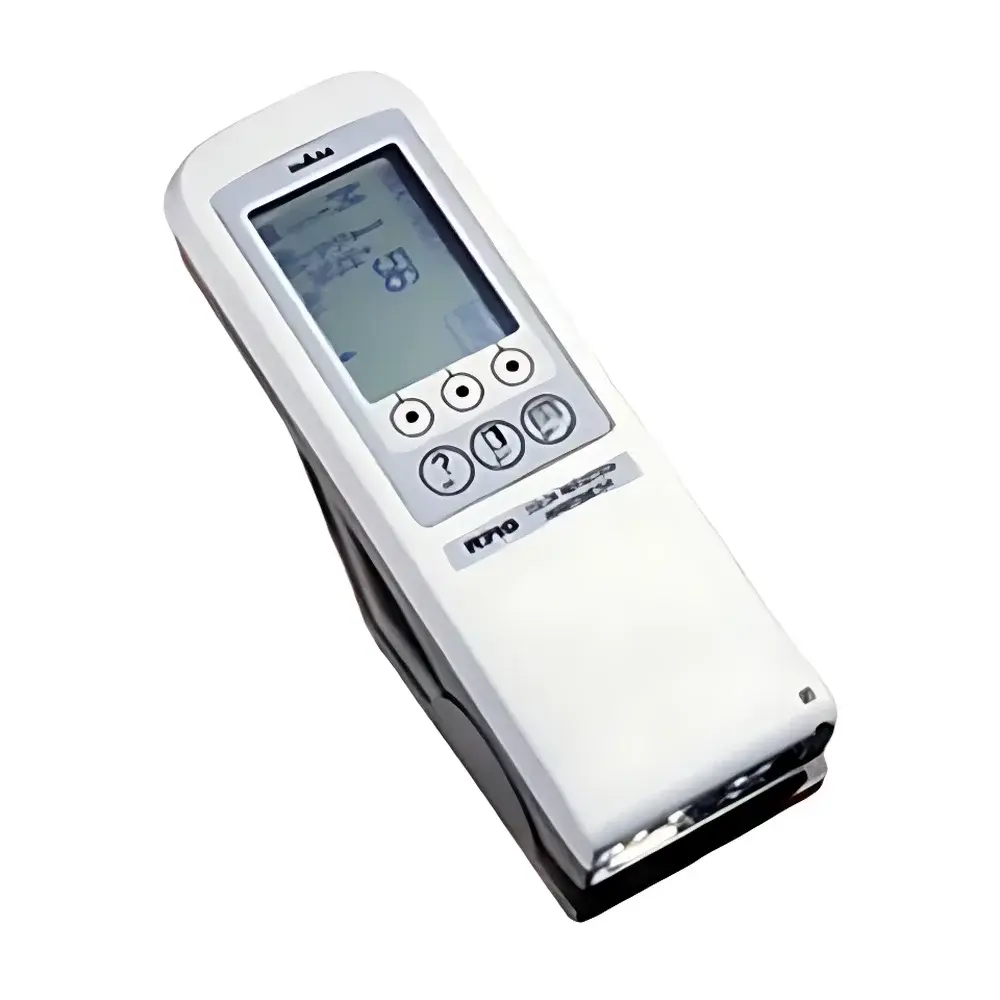
Ihara Electronic R710 Color Reflective Densitometer
| Brand | Ihara Electronic |
|---|---|
| Origin | Japan |
| Model | R710 |
| Type | Handheld Reflective Densitometer |
| Display | Graphical LCD with bilingual (English/Japanese) UI |
| Power | Rechargeable internal battery + AC adapter (9 V, 500 mA) — measurement possible during charging |
| Accessories Included | Calibration plate, instruction manual, soft carrying case |
| Optional | Communication cable |
| Compliance | Designed for ISO 5-3, ISO 2846-1, and ASTM E284-compliant reflective density measurement in print quality control |
Overview
The Ihara Electronic R710 Color Reflective Densitometer is a precision handheld optical instrument engineered for quantitative assessment of reflective optical density in color printing applications. Based on the principle of diffuse reflectance photometry, the R710 measures the logarithmic ratio of incident to reflected light intensity at standardized wavelengths corresponding to cyan (C), magenta (M), yellow (Y), and black (K) process inks—aligned with ISO 5-3:2017 (Graphic technology — Prepress proofs — Part 3: Measurement of reflective density) and ASTM E284 (Standard Terminology of Appearance). Its compact ergonomic design integrates a stable silicon photodiode detector array with spectral response calibrated to CIE 1931 standard observer functions, enabling repeatable, traceable density values in Dmin/Dmax and ΔD formats. The R710 is purpose-built for in-line and lab-based quality assurance in commercial printing, packaging prepress verification, and ink formulation validation—where compliance with ISO 2846-1 (Printing inks — Process color inks for four-color printing) and GRACoL/FOGRA certification workflows is required.
Key Features
- Handheld form factor with integrated rechargeable lithium-ion battery and continuous operation capability—even while connected to the included 9 V / 500 mA AC adapter
- Graphical LCD display supporting intuitive menu-driven navigation and real-time density readouts in both absolute (D) and differential (ΔD) modes
- Bilingual interface with seamless toggle between English and Japanese language displays—optimized for multinational production environments
- Factory-calibrated using NIST-traceable reference standards; includes certified calibration plate for daily verification per ISO 13655:2017 (Graphic technology — Spectral measurement and colorimetric computation for graphic arts images)
- Rugged ABS housing with rubberized grip and IP52-rated ingress protection against dust and incidental moisture
- Optical geometry adhering to 45°/0° illumination/viewing configuration per ISO 13655, minimizing specular interference and ensuring consistency across matte, glossy, and textured substrates
Sample Compatibility & Compliance
The R710 supports measurement on a broad range of reflective media including coated/uncoated paper, cardboard, film laminates, and flexographic printing plates. It accommodates sample areas ≥ 6 mm in diameter and operates reliably across ambient temperatures from 10 °C to 35 °C and relative humidity up to 80 % RH (non-condensing). All density algorithms comply with ISO 5-3 Annex A for status T, E, and I filters—enabling direct comparison with industry-standard densitometers used in pressroom QC. Instrument firmware and calibration documentation support audit readiness under GLP and GMP frameworks, and raw data export (via optional RS-232 or USB communication cable) facilitates integration into LIMS or SPC systems compliant with FDA 21 CFR Part 11 requirements for electronic records and signatures.
Software & Data Management
While the R710 operates as a standalone field instrument, its optional communication interface enables bidirectional data exchange with Windows-based host software (sold separately). This software provides automated report generation—including batch statistics (mean, SD, CPK), trend charts, and pass/fail flagging against user-defined tolerance bands. Audit trail functionality logs operator ID, timestamp, calibration status, and environmental metadata with tamper-resistant timestamps. All exported CSV or XML datasets retain full metrological traceability to the device’s internal calibration certificate, satisfying ISO/IEC 17025 clause 7.7 requirements for measurement uncertainty documentation.
Applications
- Pressroom density profiling during makeready and run-length monitoring
- Prepress proof verification against contract proofs per ISO 12647-2
- Ink lot acceptance testing and batch-to-batch consistency evaluation
- Substrate-dependent density compensation studies (e.g., newsprint vs. art paper)
- Process control charting for statistical process control (SPC) in ISO 9001-certified facilities
- Educational use in graphic communications laboratories for teaching densitometric principles
FAQ
What density standards does the R710 support?
The R710 implements status T, E, and I spectral filter sets per ISO 5-3, enabling compatibility with legacy and modern pressroom densitometers.
Can the R710 measure fluorescent inks?
No—the R710 uses non-UV-enhanced photodiodes and is not designed for fluorescence compensation; it conforms to standard reflective density protocols excluding UV-excited emission.
Is calibration traceable to national standards?
Yes—each unit ships with a calibration certificate referencing NIST-traceable reference materials, and the included calibration plate is certified per ISO 13655 Annex B.
Does the R710 support networked data transfer?
Not natively—the device requires the optional communication cable and host PC software for data export; no built-in Wi-Fi or Bluetooth interface is provided.
How often should the calibration plate be recertified?
Annual recalibration of the reference plate is recommended per ISO/IEC 17025 guidelines, particularly in high-usage or regulated environments.





