
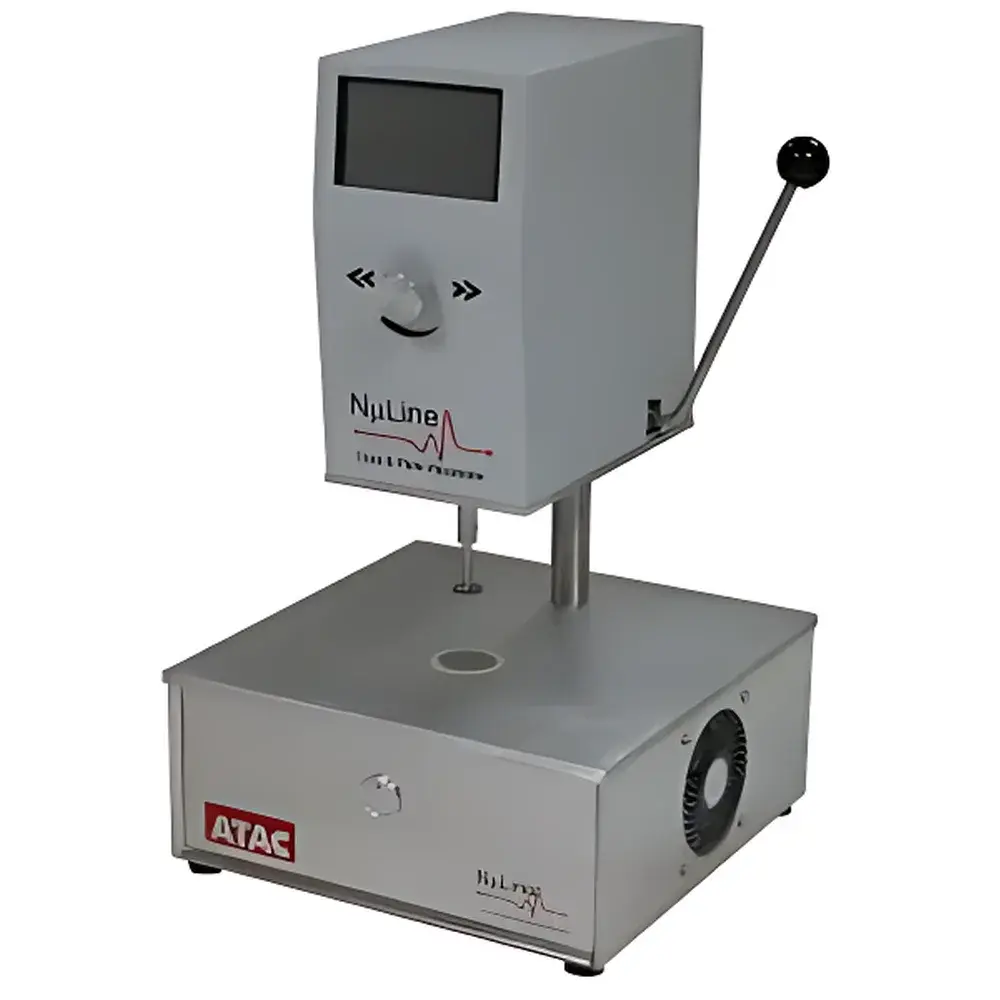
ATAC REL0100/REL0230 Precision Rotational Viscometer
| Origin | UK |
|---|---|
| Manufacturer Type | Authorized Distributor |
| Origin Category | Imported |
| Model | REL0100 / REL0230 |
| Viscosity Range | 0.1 Pa·s to 1 × 10⁶ Pa·s (typical for rotational viscometry with coaxial cylinder geometry) |
| Speed Range | 5–900 rpm |
| Temperature Range (REL0100) | 10–100 °C |
| Temperature Range (REL0230) | 25–230 °C |
| Compliance | BS EN ISO 2884-1:2006 |
| Units | °C/°F, rpm/s⁻¹, Poise/Pa·s |
| Power Supply | 100–240 VAC, 50/60 Hz |
| Warm-up Time | 10 min |
| Dimensions (H×W×D) | 510 × 302 × 302 mm |
| Weight | 13.5 kg (REL0100), 13.0 kg (REL0230) |
Overview
The ATAC REL0100 and REL0230 are precision rotational viscometers engineered for high-reproducibility viscosity measurement under controlled temperature conditions. Based on the Couette flow principle—where torque is measured on a rotating spindle immersed in a sample contained within a thermostatted cup—the instruments deliver traceable, shear-rate-dependent rheological data essential for quality control and formulation development. Unlike capillary or falling-ball systems, these viscometers operate across a broad dynamic range of shear rates (5–900 rpm, convertible to s⁻¹ via geometric calibration), enabling characterization of both Newtonian fluids and shear-thinning/thickening non-Newtonian materials. Designed and assembled in the UK, the platform integrates a self-calibrating torque sensor and active temperature regulation, eliminating reliance on external calibration oils and reducing operator-induced variability. The dual-model architecture addresses divergent thermal requirements: the REL0100 supports low-to-moderate temperature applications (10–100 °C), while the REL0230 extends operational capability to high-temperature processes up to 230 °C—critical for thermoset resins, hot-melt adhesives, and molten polymer melts.
Key Features
- Self-calibrating torque transduction system with real-time zero-point verification, minimizing drift over extended operation.
- Dual-temperature-platform design: REL0100 (10–100 °C) and REL0230 (25–230 °C), each with integrated Peltier or resistive heating/cooling and ±0.1 °C temperature stability.
- Programmable shear rate profiles (rpm or s⁻¹) with step, ramp, and steady-state modes—enabling yield stress estimation and flow curve generation.
- Onboard display showing simultaneous readouts of bath temperature, spindle surface temperature (via optional probe), viscosity (Pa·s or Poise), shear rate, and torque percentage.
- Compliance-ready architecture: supports audit trails, user-level access control, and electronic signature functionality compatible with FDA 21 CFR Part 11 when used with validated software extensions.
- Modular spindle compatibility—including DIN, ISO, and custom geometries—to accommodate high-viscosity pastes, suspensions, and filled systems without wall-slip artifacts.
Sample Compatibility & Compliance
The ATAC viscometers accept samples ranging from low-viscosity solvents (10⁶ Pa·s), provided appropriate spindle geometry and rotational speed are selected per ISO 2555 and ASTM D2196 guidelines. Sample volumes as low as 15 mL (with small-cup configuration) reduce material consumption during R&D screening. Both models comply with BS EN ISO 2884-1:2006 for paint and varnish viscosity determination using rotational methods, and support traceability to NPL (UK National Physical Laboratory) standards via documented calibration certificates. Optional accessories include solvent-resistant cups, inert gas purge ports for oxygen-sensitive resins, and vacuum-sealed chambers for volatile or moisture-sensitive formulations.
Software & Data Management
The native ATAC Control Suite (Windows-based, USB-connected) provides full instrument control, real-time graphing of viscosity vs. time or shear rate, and automated report generation in PDF or CSV format. All raw data—including timestamped temperature, speed, torque, and calculated viscosity—is stored with metadata (operator ID, method name, sample ID) in an encrypted SQLite database. Exported datasets retain full traceability for GLP/GMP audits. Software modules support statistical process control (SPC) charting, multi-curve overlay comparisons, and export to LIMS via ODBC drivers. Firmware updates are delivered through secure authenticated channels, maintaining integrity throughout the instrument lifecycle.
Applications
- Coatings & Surface Treatments: Monitoring dispersion stability, thixotropic recovery, and sag resistance in architectural paints and coil coatings.
- Pharmaceuticals: Quantifying viscosity of topical gels, ointments, and suspension vehicles per USP and EP 2.9.35.
- Inks & Toners: Evaluating jetting performance, pigment settling behavior, and shear-thinning response in digital inkjet formulations.
- Electrical Insulating Materials: Characterizing viscosity-temperature profiles of transformer oils and epoxy encapsulants during cure profiling.
- Powder Coatings: Assessing melt viscosity of thermosetting powders prior to extrusion and fluidized bed application.
- Polymers & Resins: Tracking molecular weight distribution effects via zero-shear viscosity and activation energy calculations using Arrhenius modeling.
FAQ
What spindle geometries are supported?
Standard configurations include DIN CC27, ISO MV, and custom cylindrical spindles; geometry selection is guided by sample viscosity and required shear rate resolution.
Is temperature calibration traceable to national standards?
Yes—each unit ships with a UKAS-accredited temperature calibration certificate referencing NPL standards, valid for 12 months under normal use.
Can the instrument be integrated into an automated production line?
Via RS-232 or Ethernet (optional module), the viscometer supports SCADA communication protocols and PLC-triggered measurement sequences.
How is compliance with 21 CFR Part 11 achieved?
When operated with validated ATAC Control Suite v3.2+, the system enforces role-based access, electronic signatures, and immutable audit logs meeting ALCOA+ data integrity principles.
What maintenance is required beyond routine cleaning?
Annual torque sensor verification and temperature chamber validation are recommended; no consumable parts require scheduled replacement under standard operating conditions.
Related Products



